


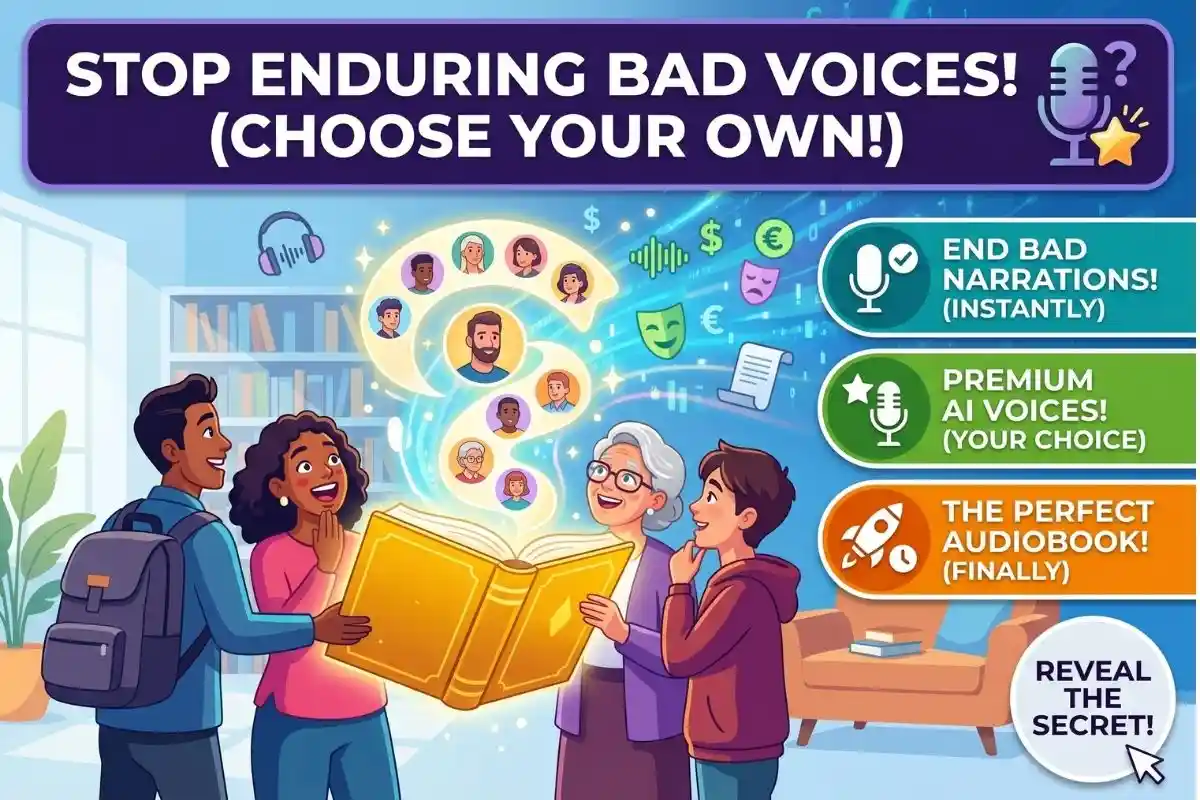
Imagine plugging in your headphones, opening your favorite audiobook app, and realizing within the first five minutes that you absolutely cannot stand the narrator’s voice. Perhaps the pacing is far too slow, the accent feels unauthentic to the setting, or the tone simply lacks the emotional depth required for the story. In the past, you were entirely stuck with this single rendition. You either endured a grating auditory experience, abandoned the audiobook entirely, or begrudgingly returned to the physical paperback. But a sweeping wave of digital innovation is fundamentally changing how we listen to our favorite stories. Welcome to the rapidly evolving era of Dynamic Audiobooks, where the listener is no longer just a passive consumer but an active director in their own storytelling experience. By blending the cutting-edge worlds of interactive publishing and advanced artificial intelligence, major publishers are introducing a highly controversial but fascinating concept: allowing readers to completely customize and choose their preferred narrator. However, there is a distinct catch. This premium feature inevitably comes with an extra financial cost, turning voice customization into a highly lucrative new revenue stream for the industry. Let us dive deep into how this fascinating shift is transforming our literary landscapes.
The Evolution of Interactive Publishing
The journey of storytelling from static ink on paper to immersive digital audio has been nothing short of revolutionary, but the latest leap involves the concept of interactive publishing, a framework that fundamentally alters the reader’s relationship with the text. Historically, when a publisher acquired the rights to a novel, they would cast a single human voice actor to read the manuscript in a recording booth. This solitary artistic interpretation became the definitive, unchangeable audio version of the book, locked in time and distributed globally to millions of listeners. However, as digital platforms have rapidly evolved, so too have baseline consumer expectations. Modern audiences are now deeply accustomed to highly personalized digital experiences, ranging from algorithmically curated music playlists to hyper-tailored movie recommendations. Interactive publishing directly taps into this intense consumer desire for absolute control by offering dynamic audiobooks. In this innovative format, the audiobook is no longer treated as a single, static audio file stored on a server, but rather as a highly flexible software experience. Instead of simply buying a pre-recorded track, consumers are essentially purchasing access to an intelligent platform that generates the audio dynamically.
The Mechanics of AI Voice Selection
At the absolute heart of this massive industry transformation is the rapid advancement of artificial intelligence, specifically in the specialized realm of AI voice selection and text-to-speech technologies. Gone are the frustrating days of robotic, emotionless computer voices that sound remarkably like a dial-up modem struggling to read a dictionary. Today’s sophisticated neural networks can instantaneously analyze the broader context, emotional subtext, and complex punctuation of a sentence to deliver vocal performances that are startlingly human and deeply resonant. Listeners can seamlessly browse a vast digital marketplace of synthetic voices, precisely filtering by age demographics, regional accents, gender presentations, and even specific emotional resonance. Do you desperately want a grizzled, gravelly, world-weary voice to narrate your gritty detective thriller? Or perhaps you would prefer a soft, melodic British accent for a historical romance? AI voice selection makes this granular level of choice entirely possible. This remarkable technology heavily relies on complex deep learning models trained on thousands of hours of real human speech. For a deeper, technical understanding of this underlying technology, you can explore the detailed mechanics of Speech Synthesis on Wikipedia, which comprehensively details exactly how machines are taught to replicate human vocal tracts digitally.
The Premium Customization Business Model
Developing, refining, and actively maintaining this high-fidelity generation technology is certainly not cheap, which brings us to the core, somewhat controversial business model of dynamic audiobooks: intentionally making readers pay extra to choose the audiobook voice. Major publishers are increasingly beginning to offer a standard, baseline default AI voice—or perhaps a single, less-expensive human narrator—for the standard base price of the audiobook. However, if a discerning listener wishes to unlock the premium AI voice selection menu to tailor their experience, they must happily pay a one-time upgrade fee or subscribe to a much higher-tier monthly membership plan. This microtransaction model is undeniably brilliant in its sheer economic simplicity because it directly capitalizes on the highly subjective, deeply personal nature of auditory preferences. What sounds incredibly soothing and pleasant to one person might be highly irritating to another. By strategically gating the ultimate solution behind a digital paywall, publishers are effectively creating a brand-new, high-margin product out of thin air. Market researchers have consistently found that dedicated users who are deeply invested in massive, eighty-hour epic fantasy series are incredibly willing to pay a few extra dollars to practically ensure they genuinely enjoy the narrator’s voice.
Ethical Debates and Copyright Concerns
The aggressive integration of dynamic narrators into mainstream commercial publishing does not come without significant, highly vocal controversy, particularly regarding the severe economic and ethical implications for human voice actors. For many decades, narrating audiobooks has been a highly specialized, respected, and difficult profession, providing a stable livelihood for thousands of talented actors worldwide. The sudden, ubiquitous rise of AI voice selection poses an existential direct threat to this entire cottage industry, as corporate publishers quickly realize they can generate dozens of localized, culturally customized voices for a fraction of the cost of hiring traditional human talent. Furthermore, there are ongoing, highly complex debates regarding intellectual property rights and explicit artistic consent. Many foundational AI models were initially trained on the copyrighted voices of real, working actors, often without their explicit permission or adequate financial compensation. This incredibly messy situation has rapidly sparked intense legal battles and a massive push for stronger federal regulations to protect human artists. The United States government is currently monitoring these rapid developments closely; you can actively review the ongoing legal discussions regarding artificial intelligence at the U.S. Copyright Office’s AI portal.
The Future of Personalized Storytelling
Looking ahead into the next decade, the potential future applications for dynamic audiobooks extend far beyond simply swapping out a narrator’s voice from a drop-down menu. As the broader field of interactive publishing continues to mature and integrate with other smart devices, we could easily see a highly futuristic scenario where the AI dynamically adjusts its vocal performance in real-time based on the listener’s biometric feedback or immediate environmental factors. Imagine a terrifying horror audiobook that actively detects your heart rate is slowing down as you begin to relax, and subsequently lowers its volume, draws out its pauses, and then delivers a sudden jump-scare perfectly timed to your breathing pattern. Alternatively, the next generation of AI voice selection could safely allow readers to securely upload brief voice samples to legally cast their friends, family members, or even themselves as specific characters within the story. While this intense level of hyper-personalization might currently sound like something out of a science fiction novel, the foundational software technology is already being rigorously tested. Ultimately, the long-term commercial success of dynamic narrators will strictly depend on whether everyday consumers feel the added, personalized value genuinely justifies the frustrating extra cost.
Comparing the Audio Experience
Here is a quick breakdown of how traditional audiobooks compare to the emerging dynamic audiobook format:
| Feature | Traditional Audiobooks | Dynamic Audiobooks |
| Voice Selection | Single, fixed human narrator | Multiple AI options (gender, accent, tone) |
| Base Cost | Standard retail price | Standard retail price |
| Customization Fee | N/A (Cannot be changed) | Premium upgrade fee or subscription required |
| Production Speed | Weeks to months of recording | Instantaneous generation via text-to-speech |
| Emotional Adaptability | Fixed interpretation by the actor | Adjustable via AI settings |
| Interactive Elements | None | High (Allows speed and tone adjustments) |
Frequently Asked Questions
What exactly are dynamic audiobooks? Dynamic audiobooks are a new format of digital literature where the audio is generated in real-time using artificial intelligence, rather than being a single pre-recorded audio file. This allows the listener to change the voice, tone, and pacing of the narrator using interactive publishing tools.
Will AI voice selection completely replace human narrators? While AI is becoming incredibly sophisticated, it is unlikely to entirely replace human narrators in the near future. Human actors bring a unique, deeply empathetic interpretation to complex texts that AI still struggles to perfectly mimic. However, AI will likely take over the narration of lower-budget books, textbooks, and highly customizable interactive novels.
How much extra does it cost to change the narrator? Pricing models vary strictly by publisher and platform. Some apps charge a small one-time microtransaction (e.g., a few dollars to unlock a premium voice pack for a specific book), while others require a premium monthly subscription tier to access the full library of dynamic narrators.
A Final Curiosity: The “Voice Cloning” Phenomenon
Did you know that some dynamic audiobook platforms are experimenting with authorized “voice cloning” of historical figures or deceased celebrities? Through complex AI voice selection, literary estates can officially license the voice of legendary actors to read entirely new books. Imagine listening to a brand-new science fiction epic, entirely narrated by the synthesized, officially licensed voice of a golden-age Hollywood star. As we fully embrace Dynamic Audiobooks, the boundaries between past, present, and future storytelling are rapidly blurring, proving that the future of reading is not just about the static words printed on the page, but the highly personalized voice echoing in your ear.

