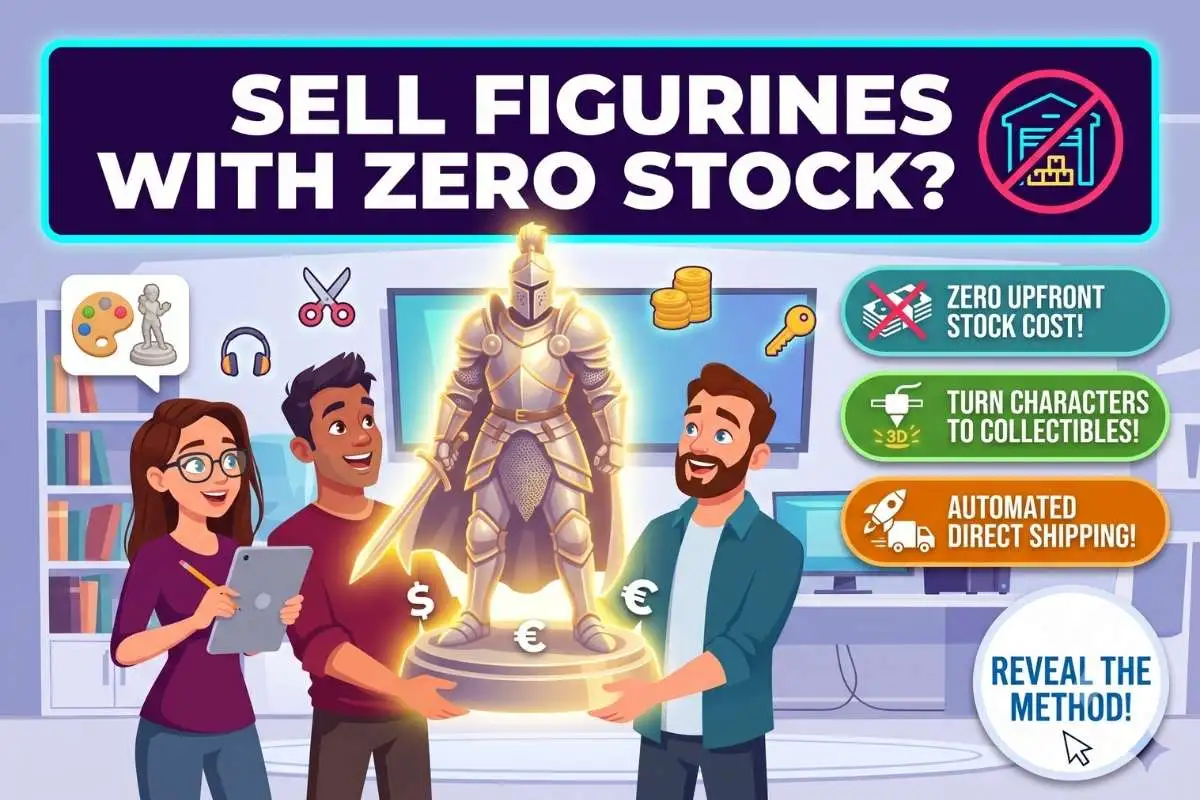
Imagine finishing the final chapter of your fantasy novel, hitting publish, and watching your readership fall in love with your brooding, armored protagonist. Almost instantly, the messages start rolling in from fans asking for character artwork, posters, and tangible keepsakes they can display on their bookshelves. In the past, turning a fictional character into a physical figurine required tens of thousands of dollars in factory tooling, massive minimum order quantities, and a garage overflowing with unsold inventory. Today, a revolutionary shift is quietly changing the independent publishing landscape, allowing writers and world-builders to bypass traditional manufacturing entirely and ship custom character models directly to their readers’ doorsteps without ever holding a single box of stock.
The Death of the Garage Warehouse
For decades, the physical merchandise game was heavily rigged against independent creators, forcing writers to gamble their life savings on injection molding runs that demanded minimum orders of thousands of units at a time. This traditional manufacturing model created an insurmountable barrier to entry for self-published authors who simply wanted to offer a commemorative statue of their main character to their most dedicated readers. However, the rapid democratization of additive manufacturing has completely flipped this script, introducing a flexible alternative known as print on demand that applies directly to three-dimensional objects. Instead of buying merchandise in bulk and praying it sells, creators now integrate specialized printing services directly into their online storefronts. When a fan purchases a figurine of your novel’s hero, an automated system sends the digital file to a third-party print farm where the model is created, inspected, packaged, and shipped to the buyer, completely removing financial risk and eliminating the nightmare of storing endless cardboard boxes in your spare bedroom.
From Digital Clay to Tabletop Reality
Bringing a character from the written page into the physical world relies on a fascinating technological journey that begins with digital sculpting and ends in high-resolution resin. Authors typically collaborate with character artists who use digital clay software to sculpt a three-dimensional model based on the book’s descriptions, ensuring every scar, weapon, and intricate armor detail is faithfully captured. Once the digital file is finalized, it is uploaded to a specialized fulfillment partner that utilizes advanced manufacturing techniques like stereolithography, a process that cures liquid resin layer by layer using precise ultraviolet lasers. Unlike older, clunky filament printers that leave visible, rough lines across a figure’s face, modern industrial resin printing delivers breathtakingly smooth surfaces and microscopic details that rival major commercial toy brands. This technological leap means your superfans receive a museum-quality collectible that truly honors the emotional investment they made while reading your story, elevating your brand from a simple digital ebook to an immersive, multi-sensory universe.
The Economics of Zero-Inventory Collectibles
While the creative appeal of holding your own character in the palm of your hand is undeniable, the underlying business model is what truly makes three-dimensional merchandising a viable, long-term strategy for independent authors. Navigating the modern e-commerce landscape requires keeping overhead costs remarkably low, a foundational principle often highlighted by small business resources like the U.S. Small Business Administration when advising entrepreneurs on sustainable growth models. Because you do not need to invest capital upfront to produce physical stock, your only initial expenditure is the one-time creative fee paid to your digital sculptor to design the character file. Once that asset is created, every subsequent sale generates a predictable profit margin without requiring any ongoing manufacturing capital from your bank account. This sustainable framework allows authors to experiment with niche merchandise—like a beloved sidekick, an iconic magical weapon, or a terrifying story villain—without the terrifying financial fear that a product flop could bankrupt their writing career.
Comparing Merchandising Models
To understand why independent creators are abandoning traditional manufacturing, it helps to see how zero-inventory 3D printing stacks up against legacy methods and standard two-dimensional apparel printing.
| Feature | Traditional Injection Molding | Standard 2D Print-on-Demand | 3D Print-on-Demand Models |
| Upfront Cost | Extremely High ($5,000–$20,000+) | Extremely Low (Time & 2D Art) | Moderate ($150–$500 for 3D Sculpting) |
| Inventory Risk | High (Must store thousands of units) | Zero (Printed as ordered) | Zero (Printed as ordered) |
| Per-Unit Profit | High (Once tooling costs are cleared) | Low to Moderate | Moderate to High (Premium pricing) |
| Product Type | Mass-market plastic toys | T-shirts, mugs, flat posters | Premium resin statues & miniatures |
| Ideal Audience | Global retail distribution | Casual readers & general supporters | Dedicated superfans & collectors |
Frequently Asked Questions
How much does it cost to hire an artist to sculpt my character?
Commissioning a professional 3D artist to design a printable character model typically costs between $150 and $500, depending on the complexity of the design, the level of surface detail required, and the commercial rights included. While this is an upfront investment, remember that you only pay for the digital sculpt once, and you can subsequently sell an infinite number of physical prints from that single file without incurring any additional design expenses.
How do I protect my digital character files from being stolen or pirated?
One of the greatest advantages of utilizing a fulfillment service is that your raw digital files are never distributed directly to the public or sent to your customers. When a fan buys a figurine from your shop, the secure order system transmits the encrypted file directly to the manufacturing partner for printing. The customer receives the physical, tangible statue in the mail, while your intellectual property remains securely locked away on protected servers.
What should I charge my readers for a custom 3D printed character model?
Pricing largely depends on the size of the figurine and the materials used by your fulfillment partner, but premium custom collectibles command much higher price points than standard merchandise. For a standard tabletop-sized miniature (around 32mm to 75mm), authors typically charge between $30 and $60, leaving a comfortable profit margin of $15 to $30 per unit after subtracting the manufacturing and shipping costs deducted by the print service.
Do these figurines arrive painted, or do readers have to paint them themselves?
Currently, the vast majority of on-demand resin models are shipped as unpainted, solid-color kits (usually in neutral gray, white, or black resin), which strongly appeals to tabletop gamers, hobbyists, and craft-loving readers who enjoy painting figures themselves. However, full-color sandstone and multi-material printing technologies are rapidly advancing, meaning automated, fully painted, tabletop-ready character models are quickly becoming a cost-effective reality for indie creators.
A Glimpse Into the Future of Fandom
We are standing on the edge of a massive transformation in how fiction creators interact with their audiences and monetize their intellectual property. Imagine a reader finishing a heart-wrenching battle scene in your novel, turning the final page, and scanning a simple QR code that allows them to instantly order the shattered sword or triumphant hero they just spent hours reading about. By removing the financial barriers of traditional manufacturing, 3D print-on-demand transforms storytelling from a passive reading experience into an interactive culture of collecting. You no longer need to wait for a major studio deal or a massive toy conglomerate to legitimize your universe; you have the tools to build a vibrant, tactile world for your superfans today, one print at a time.