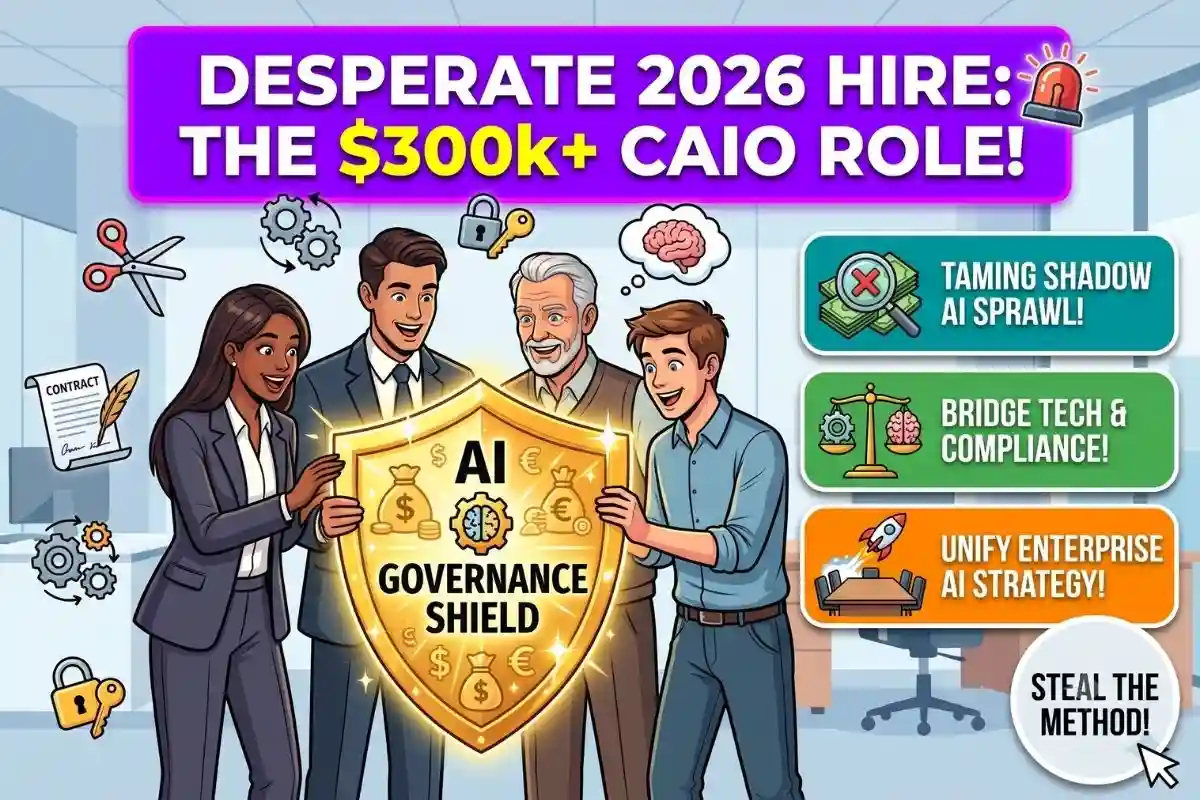
Imagine this: your company has successfully integrated artificial intelligence into customer service, marketing, and software development. Productivity is up, and everyone seems thrilled with the results. But quietly, behind the scenes, there are twelve different pilot projects running simultaneously without any oversight. Three separate departments are secretly paying for premium AI seats using corporate credit cards, and nobody is actively checking if the data being fed into these models is secure, legally compliant, or unbiased. Enter the Chief AI Governance Officer (CAIO). Two years ago, this executive title was virtually nonexistent. Today, as we navigate through 2026, it is the most highly sought-after position in the corporate world, routinely commanding base salaries well over $300,000. Companies are finally waking up to the realization that deploying autonomous AI agents without a dedicated captain steering the ship is a massive financial and legal liability.
The AI Gold Rush Meets the Corporate Reality Check
For the past few years, the business world has been gripped by an absolute frenzy surrounding artificial intelligence. Ever since the mainstream explosion of generative tools, companies of all sizes have rushed to adopt the latest models, terrified of being left behind by their competitors. But the wild west days of purely experimental artificial intelligence are officially over. We have now entered a critical era where AI is deeply embedded in autonomous, agent-based systems that make real-time decisions affecting millions of dollars in revenue and fundamental customer trust. With this incredible technological leap comes a very sobering reality check: governments and regulatory bodies worldwide are cracking down hard. Companies must now navigate a complex web of global frameworks, such as the National Institute of Standards and Technology (NIST) AI Risk Management Framework, which demands strict accountability, continuous monitoring, and human oversight. Failing to comply isn’t just a minor public relations nightmare anymore; it can lead to devastating financial penalties and the loss of operating licenses. The CAIO has emerged as the executive shield designed to protect the company from these existential threats while simultaneously ensuring that innovation is allowed to thrive in a safe, controlled environment.
Bridging the Chasm Between Technology and Risk
You might be wondering why a company can’t just hand these overwhelming responsibilities over to their Chief Technology Officer (CTO) or Chief Information Officer (CIO). The simple truth is that CTOs are essentially builders—their primary job is to create robust technological infrastructure, push the boundaries of software development, and ship products as fast as possible. Chief Risk Officers, on the other hand, are deeply focused on compliance and might instinctively want to halt operations at the very first sign of a data vulnerability. The Chief AI Governance Officer exists precisely to bridge this vast, often contentious chasm. They are a rare breed of leader who speaks the deeply technical language of machine learning engineers while simultaneously understanding the intricate legal and ethical requirements of policies like the Artificial Intelligence Act recently implemented by the European Union. A successful CAIO evaluates which AI projects are actually worth funding, shutting down redundant software subscriptions and ensuring that any generative model used by the company is producing accurate, unbiased, and legally safe outputs. They transform scattered, chaotic AI enthusiasm into a disciplined, measurable business strategy that aligns with the company’s core values.
The Economics of Desperation: Why the Price Tag is Skyrocketing
If you want to truly understand why a Chief AI Governance Officer easily commands a base salary of $300,000—and often clears well over half a million dollars when equity, performance metrics, and signing bonuses are factored in—you just have to look at the basic economic principles of supply and demand. The modern mandate for this role requires a candidate to possess a unicorn-like blend of highly specialized skills. They need at least seven years of technical data science experience, the sharp business acumen required to defend return on investment to a skeptical Chief Financial Officer, and the sophisticated regulatory expertise needed to converse with federal lawmakers. Finding someone with just two of these traits is exceptionally difficult; finding someone with all three is nearly impossible in today’s labor market. As a result, Fortune 500 companies, massive financial institutions, and global healthcare providers are actively engaging in fierce, cutthroat bidding wars to secure top-tier talent. When a company’s entire multi-year strategic roadmap relies heavily on successfully automating enterprise workflows without running afoul of strict new privacy laws, paying a massive premium for a qualified CAIO is no longer viewed as an extravagant executive expense. It is quite literally seen as essential corporate insurance.
Taming the Sprawl and Unifying the Digital Workforce
One of the most immediate and dangerous crises a newly hired CAIO has to solve is what industry insiders refer to as “shadow AI.” In the complete absence of a unified corporate strategy, well-meaning employees often take matters into their own hands, quietly uploading highly sensitive corporate data, trade secrets, and client information into public language models just to draft emails faster or analyze complex spreadsheets. This rampant, unchecked sprawl creates terrifying security blind spots that keep CEOs awake at night. A competent CAIO steps in to ruthlessly audit the entire organization, identifying exactly where and how artificial intelligence is being utilized across every single department. They are responsible for establishing strict internal review boards, creating crystal-clear data handling policies, and making the difficult decisions about when it makes sense to build custom internal models versus buying off-the-shelf solutions from major tech vendors. By centralizing all of these critical decisions, the CAIO stops the financial bleeding of wasted budget on duplicate tools. More importantly, they ensure that the enterprise’s new digital workforce is operating safely, securely, and harmoniously under one closely monitored roof.
The Future of the Role: Fractional Leadership and Boardroom Power
As we look ahead to the remainder of 2026 and beyond, the profound influence of the Chief AI Governance Officer is only set to expand further. While massive global corporations are eagerly hiring full-time CAIOs at premium, eye-watering rates, mid-market businesses and agile startups are getting creative by hiring “fractional” CAIOs. These seasoned experts offer their strategic guidance and risk assessment on a part-time retainer basis. This clever arrangement gives smaller companies the elite, boardroom-level executive oversight they desperately need without the crushing financial burden of a full-time, half-million-dollar salary. Regardless of whether they are full-time or fractional, the CAIO is rapidly securing a permanent, highly respected seat at the boardroom table. Venture capitalists and institutional investors are now increasingly demanding to thoroughly review a company’s AI governance strategy before writing a check, knowing full well that unmanaged AI deployment can destroy a brand’s reputation overnight. The CAIO is no longer just a fleeting tech trend; they are the essential architectural visionary who will define which companies successfully survive the artificial intelligence revolution.
Chief AI Officer Salary Breakdown by Company Size
| Company Profile | Average Base Salary | Equity & Bonus Structure | Primary Mandate |
| Growth-Stage Startups | $250,000 – $320,000 | 0.5% – 2% equity | Building infrastructure and proving ROI |
| Mid-Market ($100M – $1B) | $280,000 – $380,000 | 15% – 30% bonus, RSUs | Taming AI sprawl, unifying enterprise strategy |
| Enterprise / Fortune 500 | $400,000 – $650,000 | 30% – 50% bonus, major equity | Managing model risk, executive board reporting |
| Frontier AI Labs | $550,000 – $900,000+ | Seven-figure stock grants | Setting industry standards, hyper-growth |
Frequently Asked Questions
What is the core difference between a CAIO and a CTO?
A Chief Technology Officer (CTO) focuses on the overall technological architecture, software development, and infrastructure of a company. A CAIO focuses specifically on artificial intelligence—aligning AI projects with business goals, ensuring strict regulatory compliance, and actively managing the unique, fast-evolving risks associated with machine learning models.
Can a company realistically just use a fractional CAIO?
Yes, and many successfully do! For companies with under $50 million in annual revenue, a fractional CAIO provides high-level strategy and governance on a part-time basis (often 8 to 15 hours a week) for a fraction of the total cost, usually landing around $5,000 to $15,000 a month on retainer.
Why did this specific role become so incredibly popular in 2026?
While AI adoption exploded in 2023 and 2024, the subsequent years brought a massive wave of strict global regulations and privacy concerns. Companies quickly realized that experimental AI was far too risky to leave unmanaged, creating an urgent, widespread demand for dedicated, executive-level AI governance leadership.
Do Chief AI Governance Officers absolutely need to know how to code?
While they don’t necessarily need to be writing code on a daily basis, successful CAIOs usually possess a very strong technical background. They must deeply understand machine learning infrastructure, model deployment, and data pipelines so they can effectively evaluate technical proposals and immediately spot fatal flaws.
A Final Curiosity: The Incredible Speed of Corporate Evolution
It is truly fascinating to consider the sheer, unprecedented speed at which the Chief AI Governance Officer has evolved from an obscure, academic idea into a mandatory corporate necessity. If you closely examined executive job postings a mere two or three years ago, the CAIO was widely considered a novelty—a highly specialized role reserved almost entirely for experimental tech incubators or massive AI hyperscalers. Today, recent studies show that over three-quarters of large global organizations either currently have a CAIO in place or are actively, aggressively trying to hire one. This dramatic shift represents one of the fastest adoptions of a brand-new C-suite title in the history of modern business, easily outpacing the rise of the Chief Digital Officer a decade ago. It serves as a powerful, undeniable reminder that in the fast-paced age of artificial intelligence, technology moves at lightning speed, but the absolute need for human wisdom, ethical oversight, and strict governance moves even faster. The $300k price tag isn’t just compensating someone who understands complex algorithms and machine learning; it is quite simply the fundamental cost of securing lasting peace of mind in a volatile and unpredictable digital frontier.