Picture a Friday evening where you crave spicy Korean fried chicken, your partner wants an authentic Neapolitan margherita pizza, and your kids demand artisan vegan burgers. Just a few years ago, placing this order meant paying three separate delivery fees and waiting anxiously while drivers navigated across town. Today in 2026, all three meals arrive at your doorstep in a single, steaming-hot bag within twenty-five minutes of clicking checkout. This everyday dining magic is not happening in a sprawling food court with dozens of cashiers and waiters. Instead, it originates inside a discreet, windowless building tucked behind a neighborhood grocery store: an artificial intelligence-powered ghost kitchen. By pairing data-driven automation with high-efficiency commercial cooking spaces, these invisible culinary engines are completely redefining how local communities experience restaurant dining.
The Invisible Revolution Happening Behind Closed Doors
To understand the sheer magnitude of this transformation, it helps to look at the architectural shift taking place across urban and suburban centers worldwide. According to the authoritative definition outlined on Wikipedia, a ghost kitchen—often called a dark kitchen or cloud kitchen—is a professional food preparation facility established specifically for delivery-only meals without any traditional dine-in seating or public storefronts. While early iterations of this concept surfaced over a decade ago simply to reduce expensive commercial real estate costs, the 2026 landscape has evolved into something far more sophisticated. Today’s commercial cooking spaces operate like high-speed data centers rather than chaotic traditional kitchens. By stripping away front-of-house operations like dining room maintenance, hostess stands, and physical cash registers, local restaurant operators can channel 100% of their energy and capital into ingredient quality, algorithmic recipe execution, and rapid dispatch logistics.
Smart Order Orchestration and Algorithmic Chefs
The secret behind how a single kitchen brigade can flawlessly prepare authentic Mexican tacos, gourmet Thai noodles, and smash burgers simultaneously lies in artificial intelligence order orchestration. When an order lands on a delivery platform, neural network algorithms immediately calculate prep times for every individual component down to the second. If a brisket burger takes eight minutes to grill on an automated double-sided griddle while waffle fries require exactly two minutes and thirty seconds in a self-lowering smart fryer, the artificial intelligence staggers the firing times so both items finish piping hot at the exact same moment. Furthermore, computer vision cameras mounted above stainless-steel prep tables inspect plates and takeout cartons in real time. These optical sensors verify portion weights, ensure sauce accuracy, and confirm allergy guidelines before a digital label ever seals the delivery bag.
Use this interactive dashboard to explore how shifting fixed overhead, staffing levels, and technology investments alter operating margins between traditional dining rooms and automated delivery hubs:
Key insight: Removing front-of-house real estate and service staff shifts cost structures dramatically, allowing operators to reinvest up to 15% of revenue directly into premium ingredients and automated kitchen display hardware.
Overcoming Labor Shortages and Eliminating Food Waste
For decades, the restaurant industry has grappled with grueling hours, razor-thin profit margins, and chronic staff turnover. Recent occupational outlook reports from the U.S. Bureau of Labor Statistics highlight the ongoing challenges food service employers face in attracting and retaining qualified culinary professionals. AI-powered ghost kitchens address these labor pressures not by replacing human creativity, but by automating the most repetitive, hazardous, and physically exhausting kitchen tasks. Automated robotic arms handle continuous basket frying, precision chopping, and heavy dough kneading, allowing human chefs to focus entirely on recipe development, flavor balance, and final quality control. Simultaneously, predictive machine learning models forecast inventory needs with astonishing precision by analyzing historical sales data, local weather forecasts, and upcoming community events. By ordering only the exact kilograms of produce required for a given shift, these facilities have reduced commercial food waste by nearly forty percent compared to traditional dining establishments.
The Economics of the Cloud Kitchen Playbook
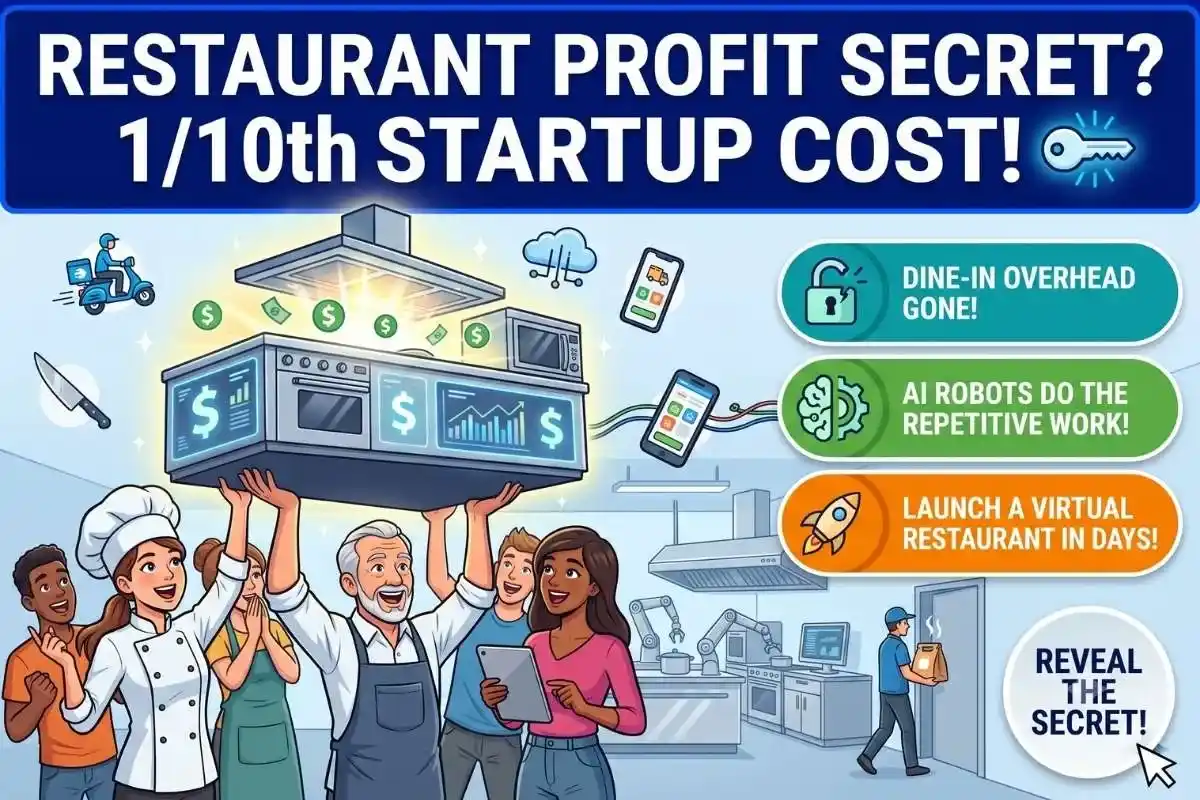
From an entrepreneurial perspective, artificial intelligence ghost kitchens have democratized the restaurant startup ecosystem by dramatically lowering the financial barrier to entry. Opening a traditional brick-and-mortar restaurant in a bustling metropolitan area easily requires half a million dollars in upfront capital, lengthy construction permits, and a permanent commitment to a static menu concept. In vivid contrast, an aspiring local chef in 2026 can lease a fully outfitted, AI-integrated cloud kitchen station and launch a brand-new virtual restaurant concept within two weeks for a fraction of the capital. If a regional neighborhood suddenly shows a surging search demand for gluten-free Mediterranean bakery items, an innovative operator can design a virtual brand, upload digital photos to delivery aggregators, and begin fulfilling local orders the very next morning from an existing prep line.
Operational Comparison: Traditional vs. AI Ghost Kitchens
| Operational Metric | Traditional Brick-and-Mortar | AI-Powered Ghost Kitchen |
| Primary Focus | Dine-in ambiance and hospitality | High-volume delivery and takeout speed |
| Average Space Required | 2,500 to 4,000 square feet | 400 to 800 square feet |
| Typical Startup Capital | $400,000 to $1,000,000+ | $30,000 to $80,000 |
| Order Preparation Speed | 15 to 30 minutes average | 6 to 12 minutes average |
| Food Waste Percentage | 8% to 14% of purchased inventory | 2% to 5% via predictive AI forecasting |
| Menu Adaptability | Months of planning and print updates | Real-time digital deployment in hours |
Enhancing the Customer Experience at Lightning Speed
While the physical equipment sits out of sight, the everyday consumer feels the benefits of this technological overhaul in every bite. Because algorithms optimize delivery driver dispatch times alongside kitchen cooking schedules, delivery couriers walk through the facility doors exactly thirty seconds before orders are sealed. Meals are immediately placed into smart, climate-controlled dispatch lockers that maintain precise holding temperatures—keeping sushi chilled at 38°F and crisp French fries heated at 165°F until the courier scans a secure QR code. Furthermore, generative AI customer service interfaces built directly into delivery apps track dietary preferences over time, automatically suggesting customized flavor pairings or modifying sodium levels to match individual health goals without causing kitchen bottlenecks.
Frequently Asked Questions (FAQ)
What exactly is an AI-powered ghost kitchen?
An AI-powered ghost kitchen is a commercial food preparation facility designed exclusively to fulfill online delivery and takeout orders without a traditional dining room. It uses artificial intelligence to coordinate order timing, monitor food quality through computer vision, manage inventory purchases, and automate repetitive cooking processes across multiple virtual restaurant brands operating under one roof.
Does automated kitchen tech mean human chefs are losing their jobs?
No. Rather than replacing skilled culinary professionals, kitchen automation takes over mundane, physically taxing tasks such as continuously standing over hot oil fryers, flipping burger patties, and tracking expiration labels. This technological assistance frees up human chefs to concentrate on culinary artistry, recipe creation, taste testing, and menu management, ultimately creating safer and more sustainable culinary careers.
How do ghost kitchens manage multiple distinct restaurant brands from one space?
Through shared, modular equipment lines controlled by intelligent kitchen display systems. Because the restaurant concepts exist solely online as virtual storefronts, a single culinary team using smart combi ovens and AI order routing can prepare components for a pizza brand, a salad brand, and a wing brand simultaneously using the same inventory and workstation infrastructure.
Are meals prepared in ghost kitchens held to the same safety standards as normal restaurants?
Yes, absolutely. Ghost kitchens must pass the exact same municipal health inspections, sanitation protocols, and food safety standards as traditional brick-and-mortar dining rooms. In fact, many AI-powered kitchens achieve higher safety ratings because IoT sensors automatically record refrigerator temperatures 24/7 and smart cameras verify proper food handling compliance continuously.
Curiosity Corner: The Future of Your Neighborhood Menu
The next time you unpack a perfectly crispy, steaming-hot dinner box on your living room coffee table, take a moment to marvel at the invisible digital orchestra that brought it to life. We have entered an era where predictive algorithms know your neighborhood is likely to crave savory comfort food before rain clouds even gather on the local radar. As autonomous delivery rovers and neighborhood drone dispatch stations continue to link up with these cloud kitchens throughout 2026, the boundary between fine restaurant dining and instant home convenience is dissolving completely. The neighborhood restaurant hasn’t disappeared—it has simply shed its dining room walls, embraced algorithmic efficiency, and moved right into your pocket.