


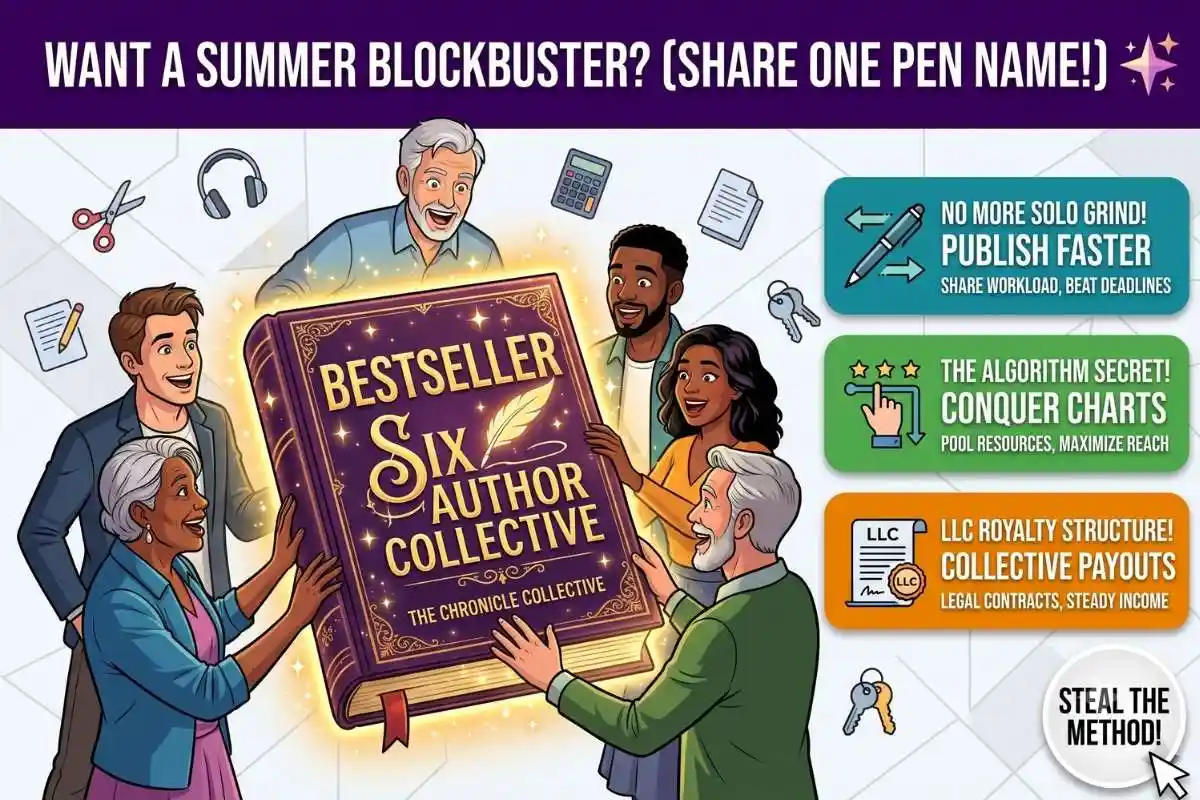
Imagine walking into a bookstore, seeing a massive display for the summer’s most anticipated thriller, and knowing that the name printed in bold letters across the cover isn’t one person—it is actually six. Welcome to the thrilling, rapidly expanding world of crowdsourced book pen names. In an era where content demands are higher than ever, a quiet revolution is taking place in the publishing industry. Writers are teaming up, pooling their talents, and releasing blockbuster novels under a single, unifying pseudonym. This collaborative approach allows a group of authors to write faster, market harder, and share the staggering workload of producing a bestseller. But how exactly does a team of distinct creative minds merge into one seamless voice? Let’s dive into the fascinating mechanics of shared authorship and discover how you could be part of the next big literary sensation.
The Hidden History of Shared Pseudonyms
While the concept of crowdsourcing might feel like a distinctly modern invention born from the internet age, the tradition of multiple authors hiding behind a single collective pseudonym is actually quite old. If you grew up reading the adventures of Nancy Drew or the Hardy Boys, you have already experienced the magic of a shared pen name. Carolyn Keene and Franklin W. Dixon never actually existed; they were fictional identities created by the Stratemeyer Syndicate. Under these names, a revolving door of ghostwriters and outline creators churned out hundreds of novels. The syndicate provided detailed character bibles, plot outlines, and strict style guides, ensuring that no matter who sat down at the typewriter, the resulting story sounded exactly like the one that came before it. Today’s crowdsourced authors are simply taking this time-tested model and updating it for the digital age, replacing corporate syndicates with democratic, independent author collectives. By looking at the past, modern writers are discovering an incredibly powerful tool for scaling their production and reaching readers faster than a solo author ever could.
The Modern Mechanics of Collaborative Writing
So, how exactly do five or six different people write a single, cohesive novel without it turning into a chaotic mess? The secret lies in meticulous planning, robust communication, and a willingness to check one’s ego at the door. Modern author collectives usually begin with an extensive world-building and outlining phase, utilizing shared digital workspaces and cloud-based documents. Every character arc, setting detail, and plot twist is agreed upon before a single word of the actual manuscript is drafted. Once the blueprint is set, the work is divided. Some groups assign specific chapters to specific authors, while others might divide the work by character perspective. To maintain a consistent voice, the collective often appoints one member as the “showrunner” or lead editor. This person reviews the combined drafts, smoothing out stylistic differences and ensuring the prose flows naturally. It is a highly synchronized dance of creativity that requires intense trust and coordination, producing a rich story that benefits from diverse strengths.
Marketing Magic and the Power of the Algorithm
Beyond the creative benefits, the primary driver behind the surge in crowdsourced pen names is pure business strategy, particularly when it comes to conquering digital storefronts. In today’s publishing landscape, digital algorithms heavily favor authors who publish frequently and consistently. A solo author might take a year to write a polished, full-length novel, but a well-coordinated team of five can comfortably release a new book every two months under their shared pseudonym. This rapid release schedule keeps the algorithm happy, ensuring their books stay visible in recommendations and new release charts. Furthermore, when five authors team up, they combine their individual mailing lists, social media followings, and marketing budgets. An advertising campaign that might be prohibitively expensive for a single writer suddenly becomes highly affordable when split multiple ways. It is a brilliant way to pool resources, dramatically amplifying the pen name’s reach and turning what would have been a modest release into a massive summer blockbuster event.
Navigating the Legal and Financial Labyrinth
Of course, combining the creative and financial efforts of multiple individuals is not without its complications, and navigating the legal landscape is absolutely crucial for a crowdsourced pen name’s survival. When money and intellectual property are involved, handshakes and verbal agreements simply will not suffice. Author collectives must draw up comprehensive collaboration agreements that clearly define how royalties are split, who owns the copyright to the underlying world and characters, and what happens if a member decides to leave the group. The U.S. Copyright Office has specific guidelines on joint works, but authors often form a Limited Liability Company (LLC) to manage the shared pseudonym as a unified business entity. This LLC holds the copyrights, collects the royalties from retailers, and then distributes the earnings to the individual authors according to their contract. Dealing with these logistical hurdles requires a business mindset, but setting up a solid legal framework early on prevents devastating disputes down the road, allowing the team to focus entirely on crafting their next bestseller.
The Future of Fiction in a Connected World
As we look toward the future of publishing, it is clear that the solitary genius working alone in a garret is no longer the only path to literary success. The rise of crowdsourced book pen names represents a fundamental shift in how we view authorship—moving from an isolated endeavor to a dynamic, team-based enterprise. With the continuous advancement of collaborative software and instant global communication, finding compatible co-authors has never been easier. Writers from different continents can seamlessly weave their ideas together in real-time, bringing diverse cultural perspectives and unique life experiences to a single narrative. This trend democratizes the publishing process, allowing writers to share the immense pressure of the industry while reaping collective rewards. Ultimately, readers are the true winners, gifted with faster releases, richer worlds, and blockbuster stories born from the synergy of multiple creative minds working in perfect, thrilling harmony to entertain the masses.
Famous Collective Pen Names
To give you an idea of how successful this strategy can be, here is a quick look at some of the most recognizable shared pseudonyms in publishing history:
| Famous Collective Pen Name | Best Known Series | Number of Actual Authors | Primary Genre |
| Carolyn Keene | Nancy Drew Mystery Stories | Dozens (over decades) | Young Adult Mystery |
| Franklin W. Dixon | The Hardy Boys | Dozens (over decades) | Young Adult Mystery |
| Erin Hunter | Warriors (Cats) | 6 Core Authors | Middle Grade Fantasy |
| Grant Naylor | Red Dwarf | 2 Authors | Sci-Fi Comedy |
Frequently Asked Questions
- How do authors under a shared pen name get paid?Payment distributions are outlined in a legally binding collaboration agreement signed before the project begins. Most modern author collectives form a business entity, such as an LLC, which acts as the official publisher. Retailers pay the LLC, and the manager distributes royalties to each participating author based on an agreed-upon percentage. This might be divided equally, or weighted based on words contributed or administrative overhead.
- Can a reader tell if a book is written by multiple people?If the collective does their job well, the answer is no. The goal of a crowdsourced pen name is to create a seamless reading experience. This is achieved by having a lead editor who polishes the final manuscript to ensure the tone and vocabulary remain consistent. While eagle-eyed readers might spot slight shifts, a rigorous editing process usually masks the seams perfectly.
- What happens if authors disagree on the plot?Creative disagreements are inevitable when writers collaborate. To prevent stalling, successful author teams establish clear dispute-resolution protocols early on. Often, the original creator of the concept or the appointed lead writer holds veto power. Alternatively, some groups rely on a simple majority vote to decide the story’s direction. Clear communication is the best defense against gridlock.
Curiosity: The Pen Name That Fooled the World
As a final thought, consider the fascinating case of “Nicolas Bourbaki.” While not a summer blockbuster novelist, Bourbaki is perhaps the most intellectually intimidating shared pen name in history. Created in the 1930s by a secret society of prominent French mathematicians, Bourbaki published a massive series of foundational books on advanced mathematics. For years, the global academic community believed Nicolas Bourbaki was a single, reclusive genius. They even submitted applications for him to join prestigious mathematical societies and created a fictional biography complete with a Russian heritage. The Bourbaki group demonstrated that a collective identity can become so distinct, so incredibly unified in its voice and output, that it takes on a living, breathing life of its own. It is a powerful reminder that when brilliant minds unite under one name, whether to solve complex theorems or to write a thrilling summer blockbuster, the resulting creation is truly greater than the sum of its parts.

