


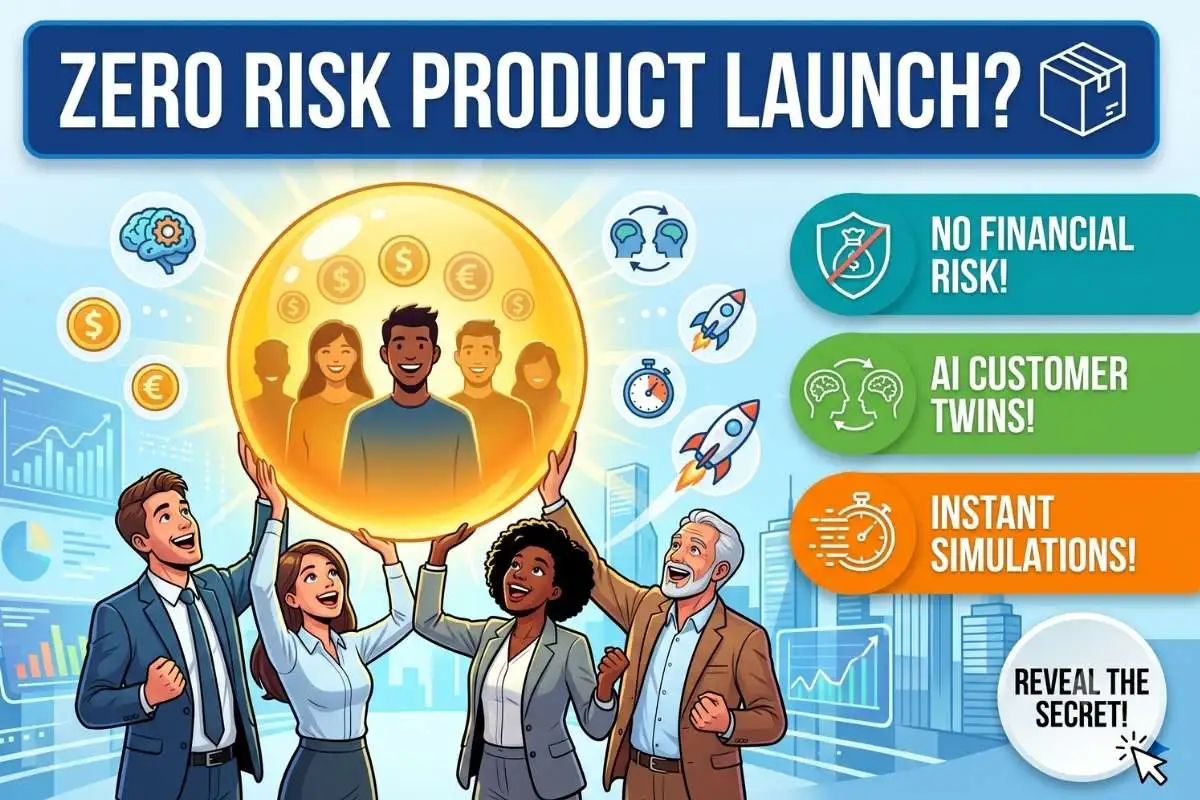
Imagine spending eighteen grueling months and millions of dollars designing, manufacturing, and marketing a brand-new consumer product, only to launch it into the marketplace and watch it crash into utter irrelevance. For decades, global businesses have relied on traditional focus groups, retrospective online surveys, and expensive live testing to guess what shoppers truly desire before pulling the financial trigger. Yet, even the most meticulous market research often fails to capture how complex human beings make decisions under pressure. Today, an extraordinary technological revolution is replacing guesswork with scientific precision: artificial intelligence customer digital twins, enabling risk-free simulation before spending a dime.
From Static Buyer Personas to Living Computational Models
To truly understand this breakthrough, we must first distinguish a dynamic customer digital twin from the outdated, static buyer personas that marketing teams have relied on for generations. A traditional persona is essentially a flat cardboard cutout—a fictional profile on a slide detailing imaginary demographics like “Suburban Sarah, a 34-year-old mother who likes yoga.” In stark contrast, a modern customer digital twin is a living computational model. By adapting the concept of an industrial Digital twin—a virtual replica devised by engineers to monitor jet engines—modern enterprises simulate complex human cognition and behavioral responses across thousands of unique target audiences.
These sophisticated synthetic models do not rely on generic guesswork or scraped, aggregate population statistics; instead, they are constructed directly from verified, privacy-compliant first-party data sources such as customer relationship management records, e-commerce purchase histories, loyalty program interactions, and historical customer service transcripts. When advanced machine learning algorithms ingest these layered behavioral datasets, they construct a dynamic replica that updates autonomously whenever real-world consumer patterns shift. Consequently, if economic inflation suddenly causes everyday shoppers to tighten household budgets, their corresponding digital twins immediately adjust simulated price sensitivity, ensuring researchers experiment with virtual consumers reflecting current financial realities.
Simulating Human Psychology at the Speed of Thought
The engine driving these hyper-realistic simulations is the rapid evolution of Generative artificial intelligence coupled with deep behavioral modeling architectures. Unlike simple statistical calculators that merely predict whether a customer might click a button based on historical averages, modern digital twins simulate the internal psychological reasoning behind human choices. When researchers present a synthetic customer with a novel product concept or a change in pricing structure, the AI evaluates the scenario against personal affinities, cognitive biases, and emotional triggers. It does not simply generate a binary answer; it outputs a detailed rationale explaining precisely why a promotional discount feels compelling.
Comparing Market Research Methods
When evaluating the strategic impact of AI customer digital twins, it is helpful to examine how they stack up against legacy research methodologies. For generations, businesses were forced to navigate an uncomfortable trade-off between speed, cost, and analytical depth. Live testing provides real-world accuracy but requires immense financial investment and exposes brand reputations to public failure if a campaign falls flat. Conversely, traditional focus groups provide qualitative emotional depth but are notoriously slow, expensive, and heavily skewed by groupthink. As illustrated below, synthetic customer simulation fundamentally disrupts this dynamic by delivering instant, massively scalable insights at drastically lower costs.
| Research Methodology | Typical Speed to Insight | Relative Financial Cost | Scalability & Sample Size | Primary Strengths & Limitations |
| Traditional Focus Groups | 3 to 6 weeks | High ($15k–$50k+) | Low (10–50 participants) | Deep qualitative feedback, but slow, expensive, and prone to social desirability bias. |
| Retrospective Surveys | 1 to 3 weeks | Moderate ($5k–$20k) | Medium (100–1,000 respondents) | Good quantitative reach, but suffers from recall errors and fraudulent panel respondents. |
| Live A/B Market Testing | 2 to 4 weeks | Very High ($50k–$100k+) | High (Thousands of users) | High behavioral accuracy, but carries significant financial risk and public exposure if unsuccessful. |
| AI Customer Digital Twins | Minutes to Hours | Low (Software subscription) | Unlimited (Millions of simulations) | Instant predictive simulation and zero financial risk, but requires empirical human calibration. |
Risk-Free Innovation and Maximizing Return on Investment
The financial implications of simulated product testing are nothing short of transformative for modern research and development teams looking to maximize their return on investment. In traditional product launches, companies frequently commit millions of dollars toward manufacturing tooling, global supply chain contracts, and expansive media buying before discovering that their core value proposition fails to resonate with shoppers. By understanding intricate nuances in Consumer behaviour within a virtual sandbox long before launching a campaign, creative teams systematically eliminate features that fall flat. This predictive foresight shifts corporate innovation from a reactive gamble into an empirical, predictable engineering discipline where failure costs nothing.
Guarding Against Bias and Maintaining Scientific Accuracy
Despite the extraordinary power of simulated human testing, responsible business leaders must recognize that digital twins are analytical tools designed to augment human intelligence rather than replace real-world validation entirely. Data scientists and market researchers must actively guard against well-documented algorithmic vulnerabilities, such as AI sycophancy, where language models inadvertently try to please the researcher by providing overly optimistic or agreeable responses. To maintain long-term scientific rigor, industry leaders routinely benchmark the predictions made by their AI digital twins against live human responses. This hybrid framework establishes a healthy equilibrium where virtual twins handle rapid exploratory testing before human validation occurs.
Frequently Asked Questions (FAQ)
Are AI customer digital twins the same thing as synthetic survey respondents?
No, there is a fundamental structural difference between generic synthetic survey respondents and calibrated customer digital twins. Synthetic respondents are typically aggregate artificial personas generated on the fly from broad public datasets, census statistics, and general language model assumptions, lacking a direct connection to a specific business’s actual customer base. In contrast, a true customer digital twin is built directly from verified first-party organizational data, such as real transaction histories, customer relationship management records, and behavioral signals. This precise grounding in proprietary human data ensures that the digital twin acts as a realistic replica of a company’s specific audience segments.
How do companies protect consumer privacy when building AI digital twins?
Protecting consumer privacy is a foundational prerequisite for any enterprise deploying digital twin technology. Organizations achieve strict privacy compliance by utilizing advanced data anonymization, encryption, and synthetic aggregation protocols before any behavioral data is ingested by machine learning models. Personally identifiable information, such as real names, physical home addresses, and phone numbers, is strictly scrubbed from the datasets. Instead, the AI models structural behavioral patterns, preferences, and purchase triggers across cohort segments without ever exposing individual human identities. This rigorous approach ensures full alignment with modern data privacy regulations while allowing organizations to extract powerful predictive insights from historical customer data safely.
Can small businesses use digital twins, or are they only for global corporations?
While early iterations of customer digital twin technology were largely confined to global enterprises with massive research budgets and dedicated data science teams, modern software-as-a-service platforms have democratized access significantly. Today, small and mid-sized businesses can leverage plug-and-play digital twin platforms that integrate seamlessly with standard e-commerce tools, email marketing software, and customer relationship management systems. By activating existing customer data through intuitive software dashboards, smaller brands simulate product pricing strategies, test marketing messaging, and explore consumer preferences with enterprise-grade sophistication, leveling the playing field against larger competitors without requiring massive upfront capital investments.
Curiosity Summary: The Future of Synthetic Consumerism
As we look toward the horizon of modern commerce, the integration of AI customer digital twins marks a profound philosophical shift in how human needs are discovered and satisfied. We are entering an era where products are no longer created through trial and error, but are co-designed in continuous conversation with virtual populations that mirror our collective desires, anxieties, and aspirations. Imagine a near-future where software autonomously simulates millions of user interactions overnight to design a physical product that feels instinctively perfect. By testing our next great ideas on simulated humans before spending a dime, businesses unlock unprecedented levels of precision and innovation.

