Welcome to the future of reading. It is 2026, and the days of simply staring at black text on a white page until your eyes grow heavy are largely behind us. Today, reading is an immersive, multi-sensory lifestyle choice, and the publishing industry has evolved to match our relentless, on-the-go habits. If you have purchased a digital book recently, chances are you have encountered Amazon’s Whispersync technology—a seamless bridge that allows you to switch between reading on your screen and listening through your headphones without ever losing your place. But what feels like a technological miracle designed entirely for your convenience is actually the foundation of the most brilliant marketing strategy of the decade.
Authors and publishers have cracked the code of modern consumption. They have figured out exactly how to tap into our desire for uninterrupted entertainment, transforming single-format buyers into “dual-consumers.” By leveraging human psychology, algorithmic pricing, and cutting-edge production tricks, creators are quietly convincing millions of readers to open their wallets and purchase the exact same story twice. Let us pull back the curtain and explore the fascinating narrative strategies and platform hacks that are making this possible.
The Psychology of the “Hybrid Reader”
Imagine settling into your favorite armchair on a rainy Sunday afternoon. You open your e-reader and lose yourself in a sprawling fantasy epic. The world-building is dense, the characters are rich, and the plot has its hooks deep in your imagination. But then, reality intrudes. You have to commute to work, hit the gym, or tackle a mountain of laundry. A few years ago, you would have simply bookmarked the page and waited until evening to return to the story. In 2026, however, authors know that momentum is their greatest asset, and they write specifically to cultivate the “hybrid reader.” This is a consumer who refuses to hit pause on a gripping narrative just because their hands are busy.
By strategically ending chapters on massive cliffhangers or introducing incredibly complex character dialects that demand to be heard aloud, authors build a psychological dependency on the audiobook companion. It becomes an addictive, frictionless loop. You buy the e-book for the quiet, contemplative moments before bed, but the pacing of the narrative makes the audiobook an absolute necessity for your morning commute. You are no longer just buying a book; you are purchasing a ticket to an uninterrupted narrative experience. This phenomenon of dual-consumption has revolutionized the literary market, turning audiobooks from a niche accessibility format into a primary driver of digital revenue.
The “Audio-Exclusive” Easter Egg Strategy
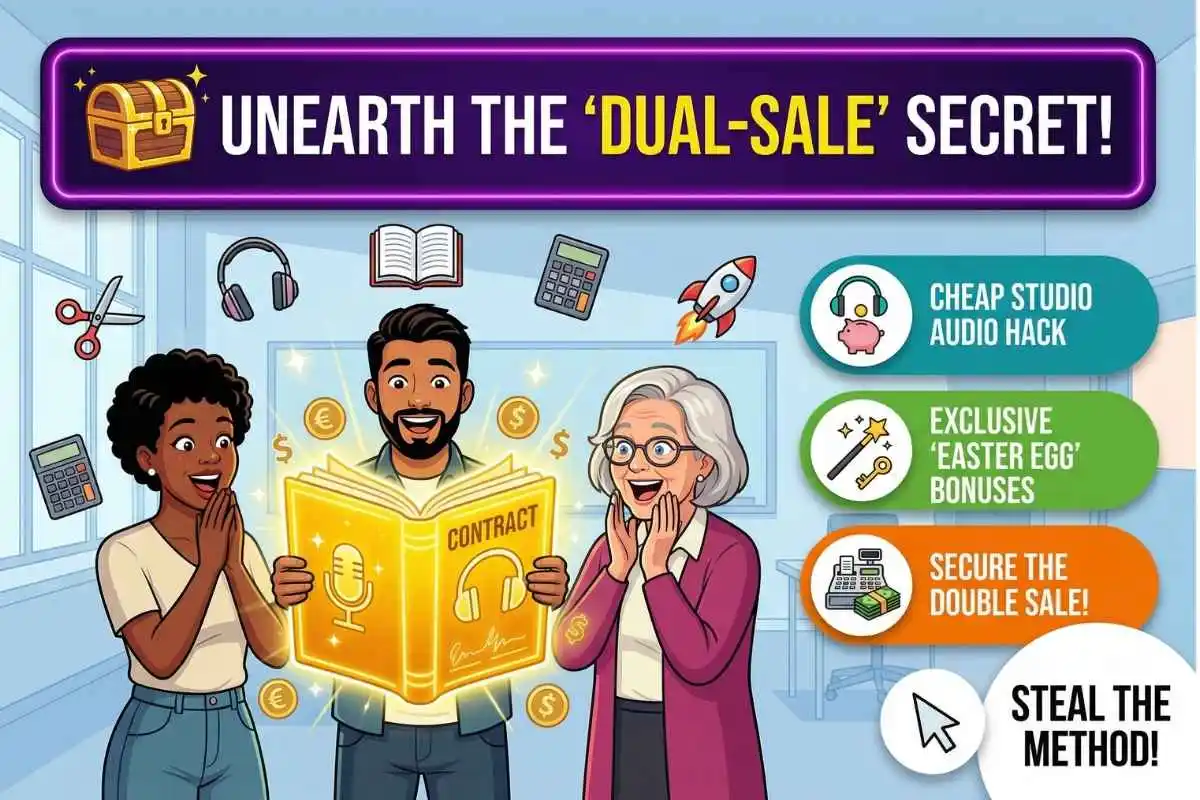
The cleverest trick in the modern author’s playbook involves hiding narrative treasures where only the ear can find them. Industry insiders call this the “Easter Egg” audio strategy. Instead of merely hiring a narrator to read the text verbatim, ambitious authors and production companies are treating the audiobook as a “Director’s Cut.” They are weaving in ambient soundscapes, outtake conversations between characters, and even secret epilogues that simply do not exist in the printed or digital text. Imagine finishing a thrilling mystery novel on your screen, only to discover on a fan forum that the audio version contains a hidden five-minute interrogation tape at the very end.
The Fear of Missing Out (FOMO) kicks in immediately. You already own the text, you already know who committed the crime, but the promise of hidden narrative depth compels you to upgrade. Authors frequently tease these exclusive audio additions on social media platforms, turning the audiobook into a premium, must-have collectible. Furthermore, because these audioscapes often involve unique musical scores and distinct performances, authors can register these unique audio arrangements as distinct works through the U.S. Copyright Office, protecting their expanded intellectual property while successfully getting paid a second time for the same fundamental story architecture.
Algorithmic Nudges and the Whispersync Discount
Of course, the financial psychology of the retail platforms plays a massive, undeniable role in this trend. The underlying algorithms of digital storefronts are designed to make the upgrade process so frictionless that it feels like a mistake not to buy the second format. When you purchase the text version of a novel, the system immediately dangles the perfectly synced audio companion in front of you at a steeply discounted rate. To the everyday consumer, it feels like an unbeatable bargain. “Why not add the professional narration for just three dollars more?” you might ask yourself, rationalizing that a standalone audiobook usually costs five times that amount.
However, savvy authors are intentionally pricing their initial e-books to maximize the attractiveness of this exact digital bundle. They are willing to take a slight hit on the front-end price of the text because their internal data shows that the conversion rate for the audio add-on is astronomically high when presented as an immediate, discounted upgrade. It is a masterful exercise in perceived value, governed by the very machine-learning algorithms designed to maximize the lifetime value of users within the broader e-commerce ecosystem. The reader feels victorious for snagging a deal, while the author secures a highly profitable double-sale.
AI Voice Models and Hyper-Personalized Immersion
The publishing landscape shifted dramatically with the integration of highly advanced, emotionally intelligent AI voice models into the standard production pipeline. Before the boom of the mid-2020s, hiring top-tier human narrators was a prohibitively expensive gamble for many independent authors, severely limiting their ability to utilize dual-format strategies effectively. Today, however, authors can license bespoke voice models that flawlessly mimic specific regional dialects, subtle emotional cadences, and dramatic pauses with terrifying accuracy. This hyper-personalization makes the audio version completely irresistible to a reader who is already invested in the text.
If you are reading a gritty science fiction novel set on a Martian colony, the digitally generated audiobook does not just read the words; it performs them with the exact mechanical rasp and atmospheric echo the author envisioned. Readers are increasingly finding that the e-book serves as the foundational script, but the audiobook provides the true cinematic release. This vast improvement in automated production quality has completely democratized the dual-purchase strategy. It allows even debut authors writing from their kitchen tables to offer a premium, multi-format experience that routinely convinces fans to buy the book twice just to experience the sheer quality of the performance.
The Social Proof and “Follow-Along” Trend
Finally, we cannot ignore the cultural shift driven by online book communities. In 2026, reading is highly performative. On platforms dedicated to book lovers, there is a massive trend of “following along”—where readers physically track the words on their e-readers while listening to the audiobook at 1.5x or 2.0x speed. This method is touted by influencers as the ultimate way to absorb complex information, retain plot details, and consume massive novels in record time. It has become a bizarre status symbol within the community to showcase that you own both formats.
Authors lean into this heavily. They encourage “read-alongs” and host virtual book clubs where the dual-consumption method is not just suggested, but essentially required to keep up with the pacing of the group. By framing the dual-purchase as an investment in comprehension and community participation rather than just a redundant expense, authors completely neutralize the reader’s financial guilt. You aren’t buying the same book twice; you are buying the ultimate, community-approved immersion toolkit.
The Data Behind the Dual-Purchase Boom
The numbers clearly illustrate how rapidly consumer behavior has shifted. The table below demonstrates the steady decline of single-format purchasing in favor of the Whispersync bundle over the last few years.
| Year | E-Book Only Sales (%) | Audiobook Only Sales (%) | Dual-Format / Bundled Purchases (%) |
| 2022 | 68% | 20% | 12% |
| 2024 | 55% | 22% | 23% |
| 2025 | 45% | 20% | 35% |
| 2026 (Est.) | 38% | 18% | 44% |
Frequently Asked Questions
What exactly is Whispersync? Whispersync is a proprietary technology developed by Amazon that synchronizes your reading progress across different devices and formats. If you read up to chapter four on your Kindle, you can open the Audible app on your phone, and the audiobook will begin playing exactly at the start of chapter four.
Do authors actually make more money when I buy the discounted audio add-on? Yes, significantly. While the audio add-on is heavily discounted for the consumer, the royalty structure for these bundles is often highly favorable to the author. Because they are not relying on a subscription credit for the sale, the actual cash payout they receive from a dual-purchase bundle frequently exceeds the royalty of selling the e-book and audiobook separately to two different people.
Is it really necessary to buy both formats? Absolutely not. The core story is always present in the text version. Purchasing both formats is a luxury and a convenience. However, if you are someone who struggles with reading focus, or if you simply love immersive audio dramas and hate putting a good story down when you have to drive, the dual-format experience provides undeniable entertainment value.
Are AI narrators replacing human voice actors? This is a complex issue. While AI has made audio production accessible for low-budget authors, traditional publishing houses and top-tier authors still heavily utilize and champion human voice actors for their nuanced performances. The market has simply expanded to include lower-cost, high-quality AI options, rather than entirely replacing the human element.
The Curiosity of the Modern Page
The way we consume stories has always been in a state of flux. From the oral traditions of ancient history to the invention of the printing press, and now to the synchronized digital ecosystems of 2026, the goal has always remained the same: to get lost in a narrative. The modern author’s ability to sell us the same book twice isn’t a scam; it is a testament to how deeply we crave these fictional worlds.
By bridging the gap between the visual and the auditory, technology has allowed writers to command our attention whether we are sitting in a quiet library or navigating rush hour traffic. The next time you find yourself clicking “Add Audible Narration” for just a few extra dollars, take a moment to appreciate the brilliant, psychological marketing at play. You aren’t just buying a file; you are buying the right to never, ever have to pause your imagination.