


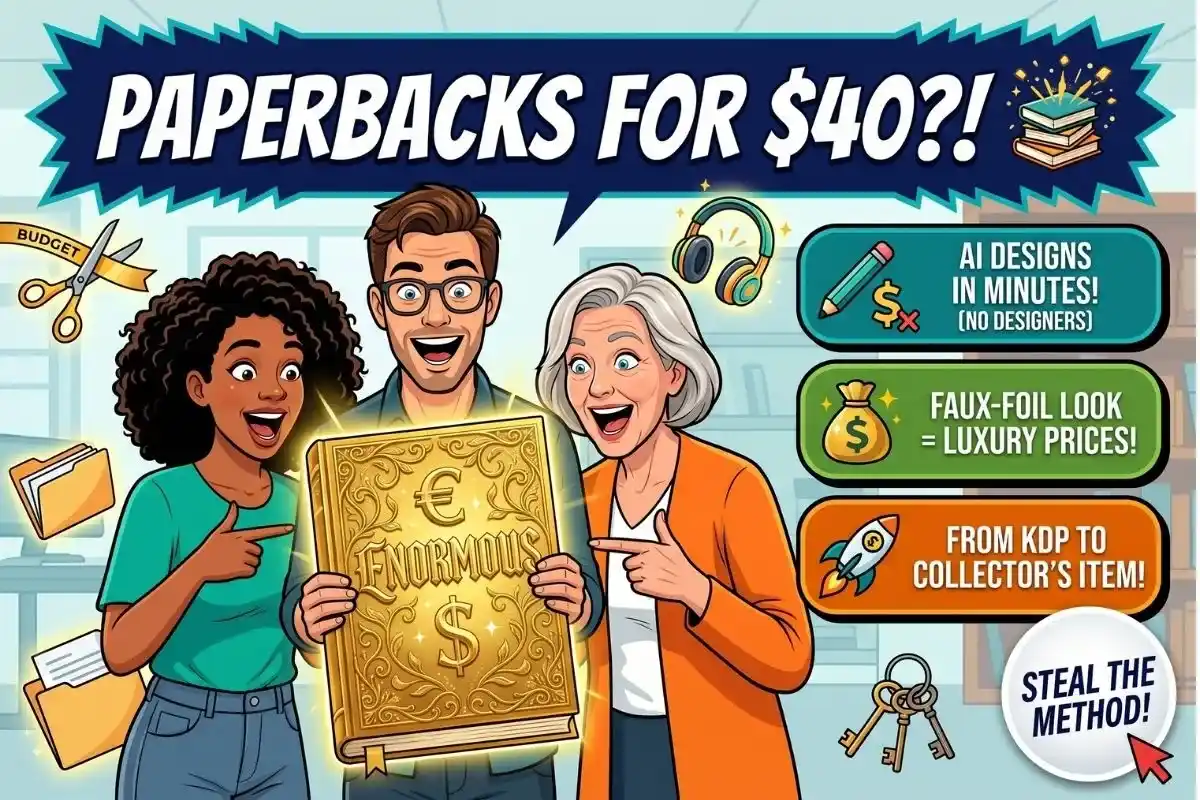
Have you walked through a local bookstore recently or scrolled through the digital aisles of your favorite online retailer, only to stop dead in your tracks? You probably saw a mesmerizing book cover. It had gleaming, intricate golden vines winding around bold, Gothic lettering. It looked heavy, expensive, and ancient—like a rare relic you might find in a hidden, dusty library. You clicked ‘buy’ and happily parted with $40. But when the book finally arrived at your doorstep, it wasn’t a centuries-old tome. It was a standard, flat paperback. And the author? An independent writer operating out of their living room, using Amazon’s Kindle Direct Publishing platform. Welcome to the brilliant, slightly deceptive, and massively profitable world of the “Gold Foil” trick. In an era where self-publishing has evolved from an amateur pursuit into a lucrative corporate enterprise, independent authors are leveraging cutting-edge Artificial Intelligence to transform cheap paperbacks into luxury items. This shift is turning the traditional publishing industry completely upside down.
The Illusion of Luxury
At the very heart of this modern publishing phenomenon is a masterclass in visual illusion known among independent authors as the “Gold Foil” trick. In traditional publishing, achieving an actual metallic, reflective finish on a book cover requires an expensive physical process called hot foil stamping. This involves pressing a thin layer of actual metallic foil onto the paper stock using heated metal dies. For a typical print-on-demand author using standard platforms, true foil stamping simply isn’t an option because the mass-production digital printers used by these services only print in standard flat ink. However, this is exactly where the magic of AI-assisted design comes into play. Authors are now using advanced image generators to create stunning, high-resolution textures that perfectly simulate the way light hits embossed gold, silver, or copper. When these digital images are printed on a high-quality matte or glossy paperback cover, the human eye is instantly tricked into perceiving three-dimensional depth and metallic reflection. It is a stunning visual trompe l’oeil that elevates a standard, digitally printed paperback from a cheap reading copy into a highly desirable collector’s item. By mastering this digital trickery, independent creators bypass massive production costs while still offering a product that looks like a rare treasure.
The Economics of Premium Print
To understand why readers are willingly handing over $40 for a book printed on standard paper, we have to deeply explore the fascinating economics of modern print on demand services. Historically, self-published books carried a heavy stigma of poor quality. Covers often looked homemade, the interior formatting was sloppy, and authors struggled to justify charging even ten dollars for their work. Today, the landscape is radically different. Platforms have drastically improved their printing technology, offering premium color interiors, heavyweight paper, and incredibly vibrant cover printing. But the real genius lies in the psychology of pricing. When an AI-designed cover successfully utilizes the Gold Foil trick to mimic luxury publishing, the perceived value of the physical book skyrockets. The reader isn’t just buying a story; they are buying a premium aesthetic experience. An author might spend exactly $5.50 to manufacture and print the physical paperback through a standard fulfillment service. If they price it at $15, they make a modest royalty. But by positioning the book as a “Premium Deluxe Edition”—complete with an ornate, faux-foil cover and intricate interior graphics—they can confidently price it at $39.99. It is a perfect marriage of low-cost manufacturing and high-end branding.
The AI Generation Wave
None of this premium repositioning would be possible without the explosive rise of generative artificial intelligence. Just a few short years ago, commissioning a bespoke, highly detailed, fantasy-style book cover with intricate filigree and simulated studio lighting would cost an author hundreds, if not thousands, of dollars. Today, utilizing sophisticated text prompts in AI art generators, an author can produce a gallery of breathtaking, hyper-realistic cover assets in a matter of minutes. The unprecedented speed and quality of these tools have completely democratized luxury design for the masses. However, this sudden gold rush has also brought a wave of new challenges, particularly concerning the ownership of these digital assets. Because AI-generated art cannot typically be copyrighted in the traditional sense, authors must be incredibly strategic about how they protect their growing publishing empires. Savvy writers are moving beyond simply relying on the artwork itself. Instead, they are aggressively trademarking their unique series titles, brand names, and proprietary book frameworks through official government channels like the United States Patent and Trademark Office. By building a legally protected brand around their AI-designed luxury books, these creators ensure that copycats cannot easily steal their hard-earned market share.
Reader Psychology and Shelf Appeal
The final, and perhaps most crucial, piece of the puzzle is understanding the psychology of the modern reader. We are currently living in a highly visual culture heavily driven by social media platforms, where aesthetic presentation is just as important as the content itself. For millions of readers, a book is no longer merely a vessel for an entertaining story; it is a vital piece of interior decor. They want books that look absolutely stunning on a shelf, books that can be artfully arranged next to a steaming cup of coffee for the perfect photograph. The Gold Foil trick perfectly caters to this deep desire for visually striking, highly shareable objects. Even when a reader holds the book in their hands and realizes the metallic sheen is just an incredibly clever print illusion, the disappointment is rarely enough to trigger a return. Why? Because the book still looks absolutely phenomenal on camera and on the shelf. The intricate AI design does its job of signaling status and refined taste. The independent publishing world has simply cracked the code on what modern consumers truly value, realizing that a physical book must offer something extraordinary to justify its existence today.
The Economics of the “Gold Foil” Trick
| Publishing Metric | Standard Paperback | Premium AI-Designed Paperback |
| Cover Design Cost | $50 – $200 (Freelancer) | $20 (AI Tool Subscription) |
| Perceived Value | Average / Mass Market | High-End / Collector’s Edition |
| Typical Retail Price | $12.99 | $39.99 |
| Printing Cost | ~$4.50 | ~$5.50 |
| Author Profit Margin | ~$3.29 per copy | ~$18.49 per copy |
| Primary Reader Appeal | Purely reading material | Aesthetic shelf decor & status |
Frequently Asked Questions
What exactly is Amazon KDP? Amazon KDP, or Kindle Direct Publishing, is a print-on-demand platform that allows independent authors to self-publish eBooks, paperbacks, and hardcover books. When a customer orders a book, Amazon prints and ships it directly to them, eliminating the need for authors to hold large amounts of physical inventory. It revolutionized the industry by removing the traditional gatekeepers, meaning anyone with a manuscript and a cover can become a published author overnight.
Does KDP actually print real gold foil? No, standard KDP facilities do not offer hot foil stamping or real metallic finishes. The “Gold Foil” trick relies entirely on high-resolution, AI-generated imagery that simulates the 3D look, shadows, and reflections of real gold foil on a flat, matte cover. Boutique printers or high-volume offset printing presses are typically required for true metallic foil, embossing, or debossing.
Why are readers willing to pay $40 for a paperback? Consumers are paying for the perceived value and aesthetic experience. With the rise of visually driven social media trends, readers want books that serve as beautiful display pieces. An intricately designed cover that looks like a luxury edition justifies a higher price tag in the minds of many buyers, even if the printing method is standard. The psychological anchor is tied to the visual weight of the design; if it looks like a masterpiece, it commands a masterpiece price.
Is it legal to use AI for book covers? Yes, it is currently legal to use AI-generated images for commercial book covers. However, AI-generated artwork generally cannot be copyrighted. Authors protect their intellectual property by trademarking their brand names, series titles, and logos instead of relying on the copyright of the cover image itself.
A Curiosity to Conclude: The Future of the Bookshelf
As technology continues to rapidly evolve, the line between traditional luxury publishing and independent print-on-demand will only blur further. The “Gold Foil” trick is just the beginning of this exciting revolution. Soon, we may see AI-generated textures that simulate aged leather, distressed canvas, or even holographic shifting colors. We might even see the integration of augmented reality, where a flat printed cover comes alive with moving parts and sound when viewed through a smartphone camera. What remains fascinating is how deeply human the underlying motivation is. We love beautiful things. We love to collect, display, and admire art. As long as readers crave a touch of magic on their bookshelves, clever authors will find a way to print it—even if it’s just an illusion.

