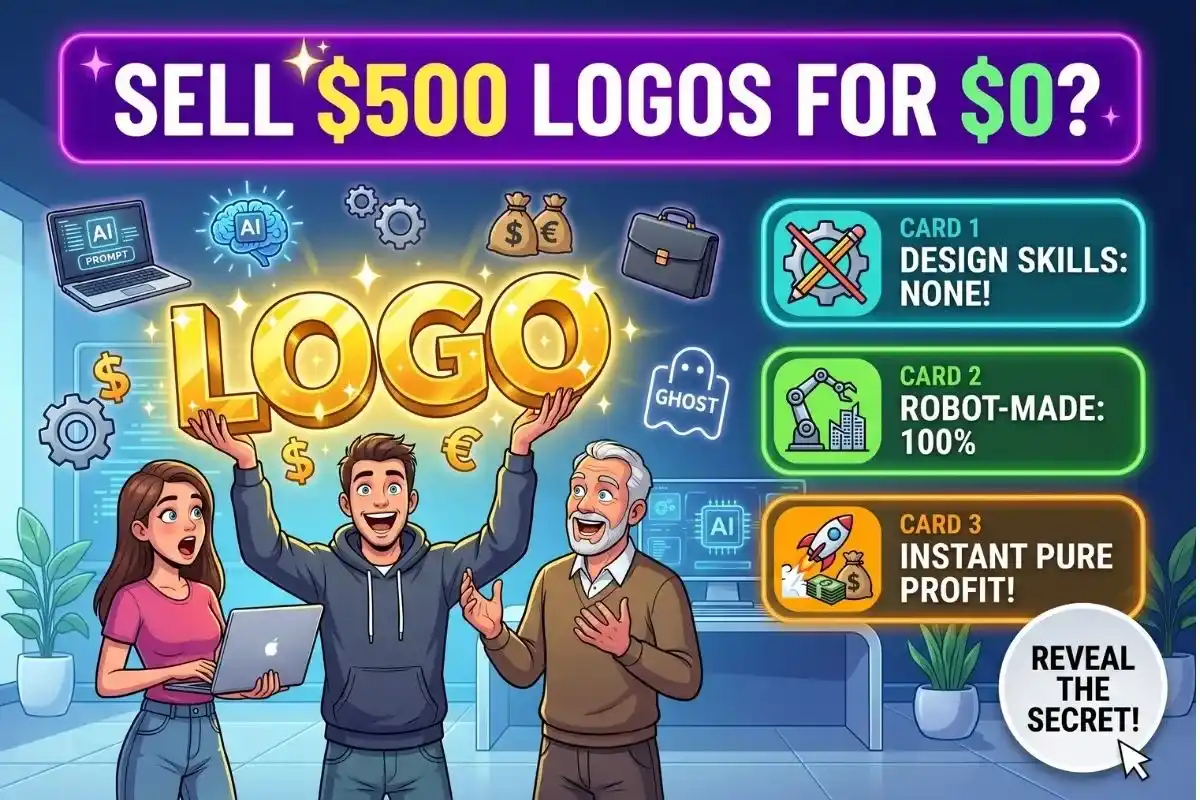
In the fast-paced digital economy of 2026, a new breed of entrepreneur is quietly taking over the creative industry. They do not necessarily know how to use complex graphic design software, they do not spend hours sketching intricate concepts, and they certainly do not hire expensive teams of freelance artists to do the heavy lifting. Instead, they operate what is now widely known as a “Ghost Agency.” These digital pioneers have mastered an innovative, highly profitable AI business model called AI Drop-Servicing. By leveraging the astonishing capabilities of modern artificial intelligence, they are selling premium digital assets—like custom corporate logos—for $500 or more, while the actual creative work is executed by machines in a matter of seconds. It sounds almost too good to be true, but this micro-agency startup trend is fundamentally reshaping how freelance services are bought and sold online. If you have ever wondered how everyday people are capitalizing on the AI revolution directly from their laptops, welcome to the fascinating, highly lucrative world of the modern ghost agency.
The Rise of AI Drop-Servicing and the Middleman Economy
To truly understand the mechanics of this rapidly growing phenomenon, we must first demystify the concept of AI Drop-Servicing. Historically, drop-servicing was a traditional business model where an entrepreneur would secure a high-paying client for a digital service—such as web design, video editing, or copywriting—and then secretly outsource that exact work to a cheaper human freelancer in another country. The entrepreneur managed the client relationship and pocketed the difference as pure profit. Today, however, the digital landscape has radically evolved. Instead of outsourcing to human freelancers who require days to complete a task and might deliver inconsistent quality, the modern micro-agency startup routes these tasks directly through advanced artificial intelligence platforms. The entrepreneur acts merely as a highly efficient middleman, pairing clients who have specific creative needs with AI tools capable of fulfilling those needs almost instantly. Because the client is paying for the final result and the convenience of a professionally managed project, they are often perfectly happy with the outcome, completely unaware that a sophisticated algorithmic tool generated their shiny new branding package. For more foundational knowledge on how modern businesses define and regulate these digital operations, you can explore the Small Business Administration (SBA), which provides excellent resources on navigating modern digital service companies and ensuring your digital hustle remains compliant.
The Economics of a $500 AI-Generated Logo
Let us break down the exact, step-by-step economics of how a ghost agency sells a $500 logo that requires absolutely zero human illustration. In the traditional graphic design world, a professional human designer might charge anywhere from $500 to $5,000 for a corporate logo because the process involves extensive market research, multiple concept sketches, several client revision rounds, and the final rendering of vector files. The new AI business model short-circuits this entire exhaustive timeline. When a small business client approaches a ghost agency needing a logo, the agency owner simply inputs the client’s industry, color preferences, and core brand values into a state-of-the-art AI logo generator. Within sixty seconds, the software spits out dozens of stunning, professional-grade concepts. The agency owner curates the best three or four options, presents them beautifully in a professional digital mockup, and delivers them to the eager client. The actual cost of goods sold for the agency? Perhaps a few cents in API generation credits or a flat $20 monthly subscription to the AI software platform. Because the overhead is virtually non-existent, the profit margins are astronomically high, often exceeding 95% on every single transaction. This incredible financial leverage is exactly why so many ambitious individuals are aggressively pivoting toward this specific micro-agency startup model in 2026.
Designing the Illusion of a Massive Creative Firm
The secret to successfully pulling off the ghost agency model does not lie in the technology itself, but rather entirely in presentation, marketing, and perceived value. You cannot simply tell a high-ticket corporate client that you are casually typing a few text prompts into a machine; you must carefully construct and present the facade of a premium, highly established design firm. Successful AI Drop-Servicing entrepreneurs invest heavily in their own initial branding, creating slick, highly polished websites that look like they belong to a massive Madison Avenue advertising agency. They use sophisticated corporate jargon, establish clear and professional client onboarding processes, and offer premium communication channels. When a client hands over $500, they are not just paying for the arrangement of pixels in the logo; they are paying for the premium customer experience, the expert curation of the best designs, and the psychological comfort of working with what appears to be a top-tier creative team. By focusing heavily on the customer journey, the ghost agency successfully justifies its premium pricing tier. To understand the complex underlying technology that reliably powers these seemingly massive creative operations, you can read about the evolution of Artificial Intelligence on Wikipedia, which comprehensively details the rapid advancements in generative machine learning models over the last few years.
Overcoming the Ethical Dilemmas of the AI Business Model
As is common with any massively disruptive technology, the rapid, unchecked rise of AI Drop-Servicing has sparked intense ethical debates within the global creative community. Traditional, formally trained graphic designers argue that selling AI-generated art as a premium, high-ticket service is fundamentally deceptive, especially if the ghost agency implies that the visual work was painstakingly hand-crafted by human artisans. However, the operators of these ghost agencies counter this criticism by emphasizing that business has always been fundamentally about solving specific problems and delivering tangible value to the end consumer. If a client receives a logo that perfectly matches their unique vision, successfully helps them launch their new brand, and looks completely professional across all media formats, does it truly matter if a neural network arranged the vectors instead of a human hand? To proactively mitigate potential backlash, the most successful micro-agency startup owners in 2026 are adopting a strict policy of transparent curation. They may not explicitly advertise that the work is 100% AI-generated on their landing page, but they focus their marketing strictly on the speed, efficiency, and stunning final results rather than making false, exaggerated claims about having a large back-office team of human illustrators. This honest shift in positioning helps maintain vital client trust while still allowing the agency to leverage the massive speed advantages of their automated creative workflows.
Scaling the Micro-Agency Startup to New Heights
Once the foundational AI Drop-Servicing pipeline is firmly established for standard logo design, the true, unrestricted potential of the ghost agency model reveals itself through rapid and aggressive scalability. Because the total time required to fulfill a single client order is drastically reduced from several days to mere minutes, a solo digital entrepreneur can theoretically handle dozens, if not hundreds, of clients simultaneously without breaking a sweat. This unprecedented level of scale was previously impossible for a traditional service-based business without hiring a massive support team and taking on significant, stressful payroll liabilities. Furthermore, modern ghost agencies quickly expand their lucrative service offerings far beyond just simple logos. Using the exact same highly leveraged AI business model, they rapidly begin offering comprehensive brand identity kits, AI-generated website copywriting, fully automated social media management calendars, and even synthetic voiceovers for digital marketing video campaigns. By strategically upselling these supplementary, high-margin services to their existing satisfied logo clients, the micro-agency startup can dramatically increase its average order value with zero extra friction. The ultimate end goal for these entrepreneurs is to build an entirely autonomous, self-sustaining revenue machine where client acquisition, service generation, and final product delivery are all seamlessly integrated and heavily automated.
The Ghost Agency vs. Traditional Agency Comparison
To give you a clearer picture of why this AI business model is dominating the landscape, here is a breakdown of how the 2026 Ghost Agency compares to a traditional creative firm:
| Business Metric | Traditional Design Agency | AI “Ghost Agency” |
| Fulfillment Time | 1 to 3 Weeks | 10 to 60 Minutes |
| Labor Costs | High (Salaries, Freelancers) | Extremely Low (Software Subscriptions) |
| Profit Margins | 20% – 40% | 90% – 98% |
| Primary Tools | Adobe Creative Suite, Sketch | AI Logo Generators, Automated Prompts |
| Scaling Bottleneck | Human fatigue and limited hours | Client acquisition and server limits |
| Client Interaction | Extensive revisions and meetings | Streamlined, automated intake forms |
Frequently Asked Questions (FAQ)
What exactly is AI Drop-Servicing?
AI Drop-Servicing is a modern online business model where an entrepreneur sells digital services (like graphic design, copywriting, or video editing) to clients at a retail price, but fulfills those services using artificial intelligence tools rather than human labor. The entrepreneur acts as the curator and project manager, keeping the massive profit margin.
Do I need design skills to start a micro-agency startup?
No, you do not need traditional graphic design skills. The core competency of a ghost agency owner is marketing, client communication, and knowing how to write effective prompts for AI tools. You are functioning as an art director who curates machine-generated options rather than an illustrator drawing from scratch.
Is it legal to sell AI-generated logos?
Yes, it is currently legal to sell AI-generated logos. However, copyright laws regarding AI art are constantly evolving. Most AI platforms grant commercial usage rights to their paid users, allowing you to sell the outputs. It is highly recommended to stay updated on intellectual property laws and transparently outline trademark limitations in your agency’s client contracts.
Why would a client pay $500 if they could use AI themselves?
Clients pay for convenience, curation, and the final result. Most business owners do not have the time, desire, or technical know-how to research the best AI tools, learn prompt engineering, and format vector files correctly. They are happily paying the ghost agency to handle the headache and deliver a polished, ready-to-use professional product.
The Autonomous Future: A Final Curiosity
As we look beyond 2026, the trajectory of the AI Drop-Servicing model points toward a fascinating, almost entirely autonomous future. We are already seeing the early stages of “zero-click agencies”—systems where an AI not only generates the logo but also runs the marketing ads to acquire the client, automatically emails the final deliverables, and independently handles customer service inquiries via sophisticated chatbots. The micro-agency startup of tomorrow may not require a human middleman at all; the AI itself could act as the CEO, the creative director, and the sales team simultaneously.
While that concept may sound like science fiction, the rapid evolution of agentic workflows suggests it is right around the corner. For now, human entrepreneurs hold the keys to this highly lucrative AI business model, capitalizing on the sweet spot between human curation and machine generation. The “Ghost Agency” is not just a fleeting internet trend; it is the blueprint for the future of digital service commerce.