


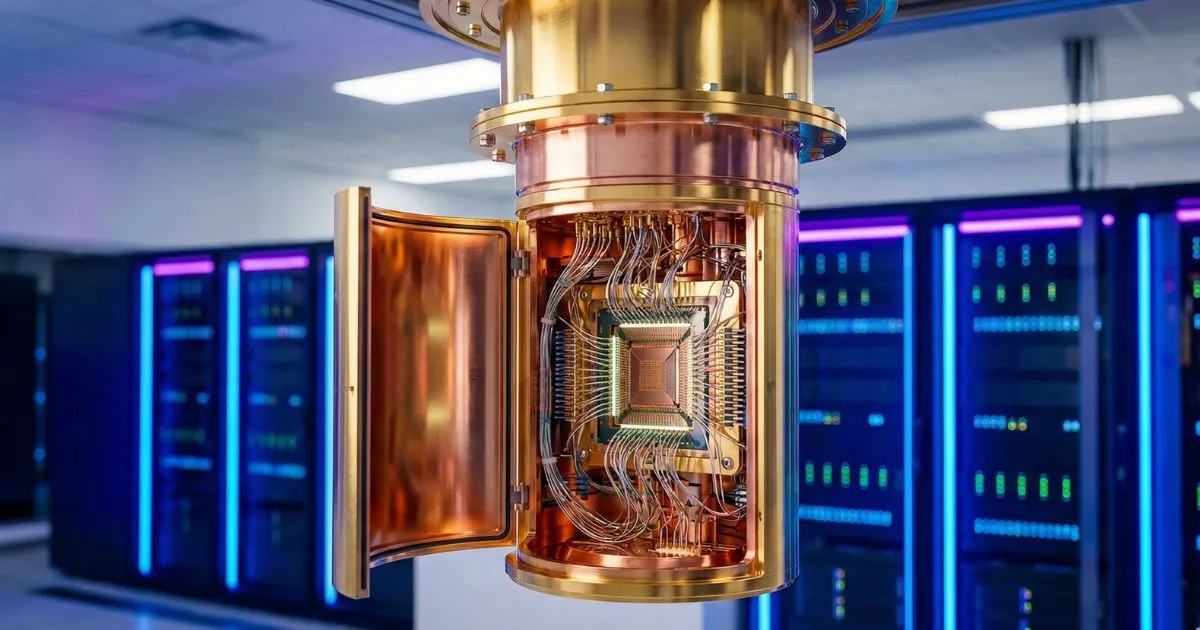
I was sitting in a cramped coffee shop in Palo Alto last Tuesday, watching a guy at the next table try to explain to his bored date why his venture fund was pivoting toward sub-atomic cooling systems. He kept using the word “inevitable,” a term that usually makes my skin crawl in a finance context. But as I looked at the morning’s headlines about the latest shift in superconducting circuits, I realized he wasn’t entirely wrong. We are standing at a weird, shivering edge of a cliff in the computing world. The old silicon roads are hitting a wall of physics that they simply cannot climb over.
Micro-quantum computing has moved from the realm of “maybe in our lifetime” to “here is the purchase order for the liquid nitrogen.” It is no longer a science project funded by government grants alone. In the first few months of 2026, the narrative has shifted toward modular, scalable hardware that actually fits into the existing infrastructure of modern data centers. If you have been following the markets, you know the volatility in January was brutal for the pure-plays, yet the underlying technology didn’t blink. The chips are getting colder, the error rates are dropping, and the smart money is moving toward the physical backbone of this entire operation.
Quantum hardware and the race for stable qubits
The real story isn’t about the software or the hypothetical algorithms that might crack encryption in a decade. It is about the plumbing. Specifically, the breakthrough in barium-based qubits and neutral-atom arrays has changed the math for everyone involved. For years, we were told that scaling was impossible because the moment you added more qubits, the whole system collapsed into a noisy mess of decoherence. But the latest demonstrations of 256-qubit systems have shown that we can finally network these chips together using standard visible light technology.
This is where the investment landscape gets interesting for those of us who prefer physical assets over vaporware. We are seeing a move toward vertical integration. Companies are no longer just building a chip and hoping someone writes a program for it. They are buying up foundries and securing their own supply chains for rare earth metals and specialized cooling components. It reminds me of the early days of the semiconductor boom, where the winners weren’t necessarily the ones with the flashiest prototypes, but the ones who could actually manufacture a thousand units without a 90% failure rate.
I find myself looking at the small-scale hardware providers, the ones building the “micro” versions of these machines that don’t require an entire warehouse to operate. These modular units are being designed to slide into existing server racks, bridging the gap between classical supercomputers and the quantum future. The hardware breakthrough of 2026 isn’t a single “Eureka” moment, it is the quiet commoditization of the extreme cold. We are learning how to package the most complex physics in the universe into a form factor that a regional bank or a pharmaceutical lab can actually use.
Tech stocks 2026 and the shift toward hybrid infrastructure
When you look at tech stocks 2026, the traditional split between “safe” blue chips and “risky” startups has blurred. The giants like Nvidia and Microsoft aren’t trying to build the entire quantum computer themselves anymore. Instead, they are positioning themselves as the indispensable middleman. They are creating the links, the NVQLinks of the world, that allow a classical GPU to talk to a quantum processor without losing its mind. This hybrid approach is the only reason the market hasn’t completely cooled off after the January sell-off.
Investors who are waiting for a “pure” quantum winner might be waiting for a ghost. The real returns are being buried in the companies that provide the high-fidelity gates and the error-correction layers. I’ve noticed a trend where the most resilient portfolios are those that treated quantum hardware as an infrastructure play rather than a software moonshot. You look at the balance sheets of these mid-cap hardware firms and you see a lot of cash burn, sure, but you also see a growing list of commercial contracts from automotive and aerospace companies that need to solve optimization problems yesterday.
There is a certain grit required to stay in this sector right now. It is noisy, it is expensive, and the analysts are constantly arguing over which modality will win. Is it trapped ions? Superconducting loops? Photonic chips? Honestly, I’m not sure it matters which one “wins” in the end. The infrastructure being built to support all of them is where the value is accruing. We are seeing the birth of a new utility layer for the global economy. It is a slow, cold, and incredibly precise revolution that doesn’t care about quarterly earnings as much as it cares about the stability of a single atom.
The future computing landscape is being carved out by those who understand that we are transitioning from a world of “if” to a world of “how much.” The hardware is here, the integration is happening, and the only question left for the finance crowd is how long they can afford to look the other way. I suspect that by the end of this year, the conversation won’t be about whether the hardware works, but about who owns the patents for the specific lasers that keep it all running. It’s a game of inches played at absolute zero, and for once, the physicists are leading the accountants by the hand.
I often wonder if we’ll look back at 2026 as the year the noise finally settled. Not the quantum noise, but the market noise. We’ve stopped chasing the hype of “supremacy” and started looking at “utility.” It’s a more sober, more grounded way to look at the most exotic technology we’ve ever created. And in a world where everything else feels increasingly fragile, there is something oddly comforting about a machine that only works when everything is perfectly, frozenly still.

