


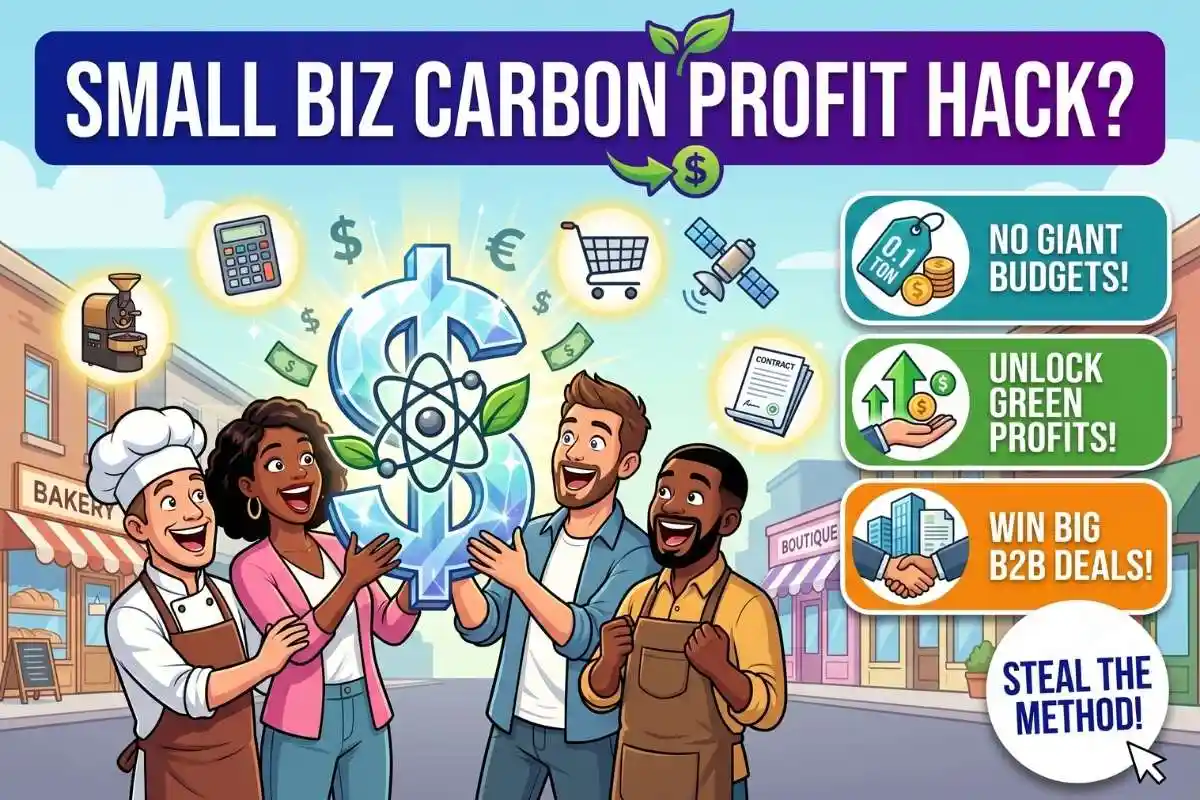
For years, corporate sustainability felt like a VIP club with an impossibly high cover charge. Giant multinational corporations could afford to pledge millions toward sprawling reforestation projects, reaping the public relations rewards and tax benefits that followed. Meanwhile, small businesses—local coffee roasters, independent boutiques, and small agencies—were left outside, struggling to reconcile ethical operations with tight profit margins. The traditional carbon market simply wasn’t built for the little guy.
But as we navigate 2026, the landscape has radically shifted. The emergence of fractional carbon credit offsets has completely democratized the green economy. By dividing massive environmental investments into affordable, bite-sized units, new trading platforms are allowing small businesses not just to participate in global climate action, but to actually turn sustainability into a measurable competitive advantage. Today, going green is a viable, profit-driving strategy for the businesses lining Main Street.
Breaking Down the Barriers of the Traditional Market
Historically, the carbon offset market was an arena reserved strictly for the heavyweights of the business world. Carbon credits, which represent the verified removal or avoidance of one metric ton of carbon dioxide, were typically sold in massive bulk blocks. A single transaction on the open market often required purchasing thousands of tons at a time, creating an insurmountable financial barrier for a small enterprise whose entire annual footprint might only amount to fifty tons.
However, financial technology innovations maturing in the mid-2020s brought about the transformative concept of fractionalization. Much like retail investors can now buy a fraction of a high-priced tech stock, small business owners in 2026 can effortlessly purchase fractional carbon credits through specialized digital brokers. This means a local bakery can invest the precise amount needed to offset the emissions from its delivery van for a single month, without locking up crucial operating cash flow. This unprecedented accessibility transforms sustainability into a highly manageable, scalable line item.
Turning Environmental Responsibility into Tangible Profit
The most fascinating aspect of this 2026 trend is that small businesses no longer view these fractional offsets merely as a sunk cost or a charitable donation; they actively leverage them as powerful engines for profitability. Modern consumers, particularly younger demographics who fiercely prioritize climate action, are increasingly making purchasing decisions based on a brand’s environmental footprint.
Savvy small business owners are responding by embedding fractional carbon offsets directly into their point-of-sale systems. A customer buying a handmade sweater online might be offered the option to make their shipping “climate positive” for an additional forty cents at checkout. These micro-contributions often cover the business’s entire carbon offset costs while simultaneously boosting customer loyalty and increasing cart conversion rates. Furthermore, small businesses achieving verified carbon-neutral status are finding it significantly easier to win lucrative B2B contracts, directly translating sustainability into increased sales revenue from larger corporate partners.
The Technological Engine Driving Transparency and Trust
The explosive growth of fractional carbon credits wouldn’t be possible without profound advancements in the technology used to verify and track them. In the early days of the Voluntary Carbon Market, the industry was frequently plagued by scandals involving “phantom credits” and double-counting, making many cautious small businesses hesitant to participate.
Today, the integration of robust blockchain technology and artificial intelligence has revolutionized market transparency and restored buyer confidence. When a small business purchases a fractional credit in 2026, they receive a unique digital certificate backed by continuous satellite imagery and AI-driven data analysis that proves exactly where their money is being used. Whether it is protecting an acre of the Amazon rainforest or funding a fraction of a biochar facility, the impact is undeniable. This immutable proof allows business owners to share their climate impact with customers confidently, completely eliminating the risk of “greenwashing” accusations.
Navigating Regulations and Future-Proofing the Business
Beyond immediate marketing benefits and customer acquisition, the shift toward fractional carbon credits is heavily influenced by a rapidly changing regulatory environment. Governments worldwide are tightening emissions standards at an unprecedented pace. While the strictest rules initially targeted massive industrial polluters, the regulatory net is steadily expanding to encompass much smaller entities.
By proactively integrating fractional offsets into their daily operations today, small businesses are effectively future-proofing themselves against impending carbon taxes and stricter compliance mandates. Government bodies such as the Environmental Protection Agency (EPA) and international frameworks like the Science Based Targets initiative (SBTi) provide clear guidance on how enterprises can legitimately account for residual emissions. Getting ahead of these regulations means avoiding future financial penalties, securing more favorable loan terms from eco-conscious lenders, and establishing a rock-solid reputation as a responsible community leader long before compliance becomes a legal necessity.
Creating New Revenue Streams Through Local Generation
Perhaps the most exciting and disruptive evolution in 2026 is the flip side of the carbon coin: small businesses generating and selling their own fractional credits. We are witnessing a massive surge in localized, community-driven sustainability projects where the businesses themselves are the frontline innovators.
A cooperative of small urban farms, for instance, might implement advanced soil carbon sequestration techniques, generating verified micro-credits in the process. By utilizing regional carbon registries designed specifically for smaller projects, they can sell these fractional credits to other local businesses wanting to support their immediate community’s climate resilience. This dynamic creates a powerful, hyper-local circular green economy. Instead of capital flowing out to anonymous international mega-projects, money circulates within the community, creating a highly profitable revenue stream for the small businesses implementing sustainable practices.
The Economics of Fractional Carbon Credits in 2026
To understand how small businesses are budgeting for these initiatives, it is helpful to look at the current market rates. The table below outlines the average cost per metric ton of various carbon offset projects, and how a small business utilizes a fractional approach by purchasing just 0.1 tons at a time.
| Project Type | Average Cost per Ton (USD) | Fractional Cost (0.1 Ton) | Typical Small Business Use Case |
| Avoided Deforestation (REDD+) | $15.00 – $25.00 | $1.50 – $2.50 | Offsetting monthly office electricity usage. |
| Renewable Energy (Solar/Wind) | $10.00 – $18.00 | $1.00 – $1.80 | Neutralizing emissions from employee commuting. |
| Biochar / Soil Sequestration | $150.00 – $200.00 | $15.00 – $20.00 | Premium offsets bundled with high-end physical products. |
| Direct Air Capture (DAC) | $350.00 – $500.00 | $35.00 – $50.00 | Corporate B2B service neutralization for premium clients. |
| Methane Capture (Landfills) | $12.00 – $20.00 | $1.20 – $2.00 | Covering the footprint of local delivery fleets. |
Frequently Asked Questions (FAQ)
What exactly is a fractional carbon credit?
A fractional carbon credit is simply a portion of a standard carbon credit. Since one standard credit represents one metric ton of carbon dioxide removed or avoided, a fractional credit allows a buyer to purchase offset amounts in smaller increments, such as 100 kilograms. This makes it financially accessible for small businesses to offset specific, smaller-scale emissions without having to buy in bulk.
How do small businesses profit from buying offsets?
Businesses profit by leveraging their verified green status to attract eco-conscious consumers, increase brand loyalty, and justify premium pricing. Additionally, many pass the micro-cost of a fractional offset to the consumer at checkout as an optional add-on, generating goodwill without impacting the bottom line. It also opens doors to lucrative B2B contracts with larger companies requiring green supply chains.
Are fractional carbon credits legitimate and verifiable?
Yes, provided they are purchased through reputable platforms. In 2026, the industry standard relies heavily on blockchain technology and independent third-party verification to track every fraction of a credit. This ensures the emissions reduction is real, permanent, and not double-counted.
Can a small business generate its own fractional credits?
Absolutely. Many small businesses engaged in agriculture, forestry, or renewable energy are utilizing new micro-registries to certify their own carbon-reducing practices. By verifying their emissions reductions, they can mint their own fractional credits and sell them, creating a completely new revenue stream.
The Curiosity Corner: When Carbon Becomes Currency
As we look beyond 2026, the concept of fractional carbon offsets is pushing us toward an entirely new economic paradigm: the idea of carbon as a literal currency. We are already seeing the early stages of this in specific micro-economies where consumers can earn fractional carbon credits as “cashback” rewards for making sustainable purchasing decisions. Imagine a local coffee shop where buying a reusable mug deposits a fractional carbon credit into your digital wallet—a credit you can later trade, sell, or use to offset your upcoming weekend road trip.
This gamification and financialization of sustainability represent a profound psychological shift. Carbon emissions are no longer just invisible pollution; they are quantifiable liabilities, and carbon reductions are quantifiable assets. Small businesses are at the absolute forefront of this revolution because they have the agility to experiment with these novel concepts much faster than massive corporations. By turning sustainability into a tangible, tradable commodity, they are proving that saving the planet may just be the most profitable business model of all.

