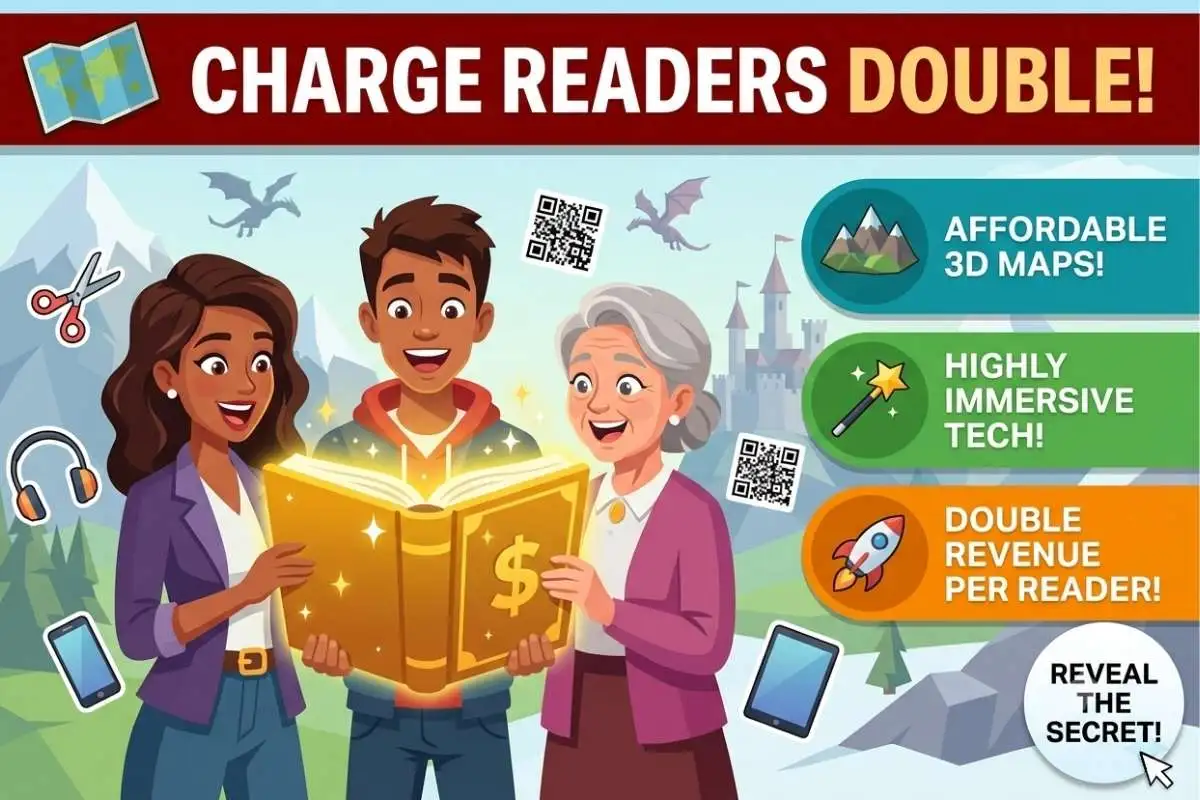
Imagine opening a brand-new fantasy novel, the comforting scent of fresh paper rising as you study the beautifully illustrated map on the front pages. For decades, this cherished ritual has launched millions of readers into thrilling new literary adventures. But what if, instead of merely tracing mountain ranges with your finger, you could strap on a headset and literally fly over them? Welcome to the rapidly expanding, highly profitable frontier of interactive book VR maps. This technological leap is completely revolutionizing how modern stories are consumed and rewriting the economic playbook for authors. By seamlessly adding a digital world to your fantasy novel, you are no longer just selling a story—you are selling a destination, allowing you to easily double your book’s retail price.
The Evolution of Fantasy Cartography
The evolution of fantasy cartography is a fascinating journey that closely mirrors our own technological advancements over the past century. Since the days when legendary authors first sketched out the sprawling landscapes of their high-fantasy realms, readers have possessed an insatiable hunger to visualize the territories they are reading about. A well-crafted map grounds the reader, providing vital geographical context that makes the fictional stakes feel incredibly real and urgent. However, traditional paper maps have inherent, unavoidable limitations; they are completely static, bounded by the physical dimensions of the page, and entirely silent. While the transition to digital mediums initially gave us zoomable high-resolution images, the leap into Virtual Reality fundamentally shatters the old paradigm. When a reader steps into an interactive VR map, they instantly transition from a passive observer to an active explorer. This profound level of immersion transforms a simple reading session into a multi-sensory entertainment experience, capturing the human imagination in ways that standard text alone simply cannot achieve.
The Technology Behind the Magic
Creating these immersive, three-dimensional environments is no longer a pipe dream reserved strictly for major video game studios equipped with massive development budgets. The technology behind the magic has become incredibly accessible to independent creators, self-published authors, and forward-thinking publishing houses alike. By utilizing powerful, user-friendly game engines, authors can easily collaborate with freelance 3D artists to translate their flat, 2D parchment sketches into fully realized, navigable spaces. Furthermore, the rise of modern web technologies means that virtual experiences can run directly within a standard mobile or desktop web browser. For a deeper understanding of how these immersive environments function on a technical hardware level, you can explore the fundamental principles of Virtual reality on Wikipedia, which details the vast ecosystems driving this revolution. Authors can simply include a QR code on their physical paper map or a hyperlink at the beginning of their eBook. When the reader scans the code, they are instantly transported into the digital realm without any confusing software friction.
The Economics of Immersive Reading
Let us critically examine the economics of immersive reading and precisely why this specific strategy allows creators to effectively double their revenue per reader. In the highly competitive global publishing industry, readers are notoriously price-sensitive when evaluating standard paperbacks or digital eBooks. However, human consumer psychology dictates that audiences are more than willing to pay a premium for exclusive “experiences” and enhanced “collector’s editions.” When an author bundles a novel with an interactive VR map, they successfully shift the product category from a simple book to a premium hybrid entertainment package. Readers perceive massive added value in these interactive digital components; they feel they are buying a ticket to a private theme park built entirely around the story they love. This highly profitable business model is deeply rooted in the principles of digital immersion. You can read more about how value is generated through spatial computing by visiting the Augmented reality Wikipedia page. By smartly tapping into this desire for deeper engagement, authors can drastically increase their profit margins.
Crafting the Experience Without Breaking the Bank
Crafting this premium digital experience without breaking the bank is naturally the most common concern for authors looking to adopt this cutting-edge marketing strategy. The absolute key to profitability lies in smart project scope management and a deliberate, highly focused artistic direction. A virtual reality map does not need to be a photorealistic, incredibly dense open-world video game to be effective and enchanting. In fact, highly stylized, low-polygon artistic aesthetics often work much better because they purposely leave room for the reader’s own imagination to fill in the blanks. An author can hire a skilled independent 3D environment artist to build a beautiful, atmospheric diorama of their fantasy world for a relatively modest upfront investment. To easily offset these initial software and design development costs, many authors turn to popular crowdfunding platforms. By pitching the interactive VR map as an exclusive campaign stretch goal, authors can secure all necessary funding before they even begin the digital development phase, entirely eliminating their personal financial risk.
Building a Community Inside Your World
Beyond the immediate, undeniable financial benefits, developing interactive book VR maps allows authors to build a fiercely loyal, highly engaged community right inside their own fictional universe. These virtual maps can effectively serve as dedicated social hubs where avid readers from all over the globe gather to discuss the latest plot twists, share complex fan theories, and interact directly with the creator. Imagine effortlessly hosting a virtual book club or a live author Q&A session inside the very digital tavern where your main characters first met. By regularly updating the VR map as new sequels are released—perhaps revealing previously clouded, mysterious areas of the map or adding bustling new digital cities—the author creates a continuous, recurring revenue stream. Readers will eagerly pay for these digital “expansion packs” to explore the newly unveiled territories alongside their favorite characters, solidifying a long-term, highly profitable literary career for the ambitious author.
The Value Shift: Traditional vs. Immersive Publishing
To truly understand the massive shift in value proposition, it is helpful to compare standard publishing methods with the new immersive approach. The table below outlines the stark differences between traditional fantasy maps and interactive VR maps across several key publishing metrics.
| Publishing Metric | Traditional Fantasy Map | Interactive VR Map Bundle |
| Reader Engagement | Passive, brief visual reference | Active, multi-sensory exploration |
| Average Retail Price (eBook) | $4.99 – $9.99 | $14.99 – $24.99 |
| Community Aspect | Isolated, solitary reading | Social hubs, multiplayer potential |
| Production Cost | Low (2D Illustration) | Moderate (3D Modeling & Hosting) |
| Monetization Potential | Single point of sale | High (Paid digital expansions) |
Frequently Asked Questions (FAQ)
As this technology is still relatively new to the publishing world, both authors and readers often have questions. Below are some of the most frequently asked questions regarding the integration of VR maps into fantasy literature.
- Do readers need to purchase expensive virtual reality headsets to enjoy the map?Not necessarily. While high-end VR headsets provide the absolute most immersive and breathtaking experience, modern WebVR technology ensures that these digital worlds are highly accessible. Readers can easily explore the interactive 3D maps using their standard smartphones, tablets, or desktop computer browsers, simply dragging their fingers or using a mouse to pan across the landscape.
- How much does it typically cost an independent author to create a VR map?The cost can vary wildly depending on the exact scope of the project. A basic, low-polygon 3D diorama created by a freelance artist might cost anywhere from $500 to $2,000. However, because authors can easily charge double for the immersive edition of their book, the return on investment is usually incredibly swift, especially if funded through pre-orders.
- Does exploring a virtual environment distract the reader from the actual text of the novel?When designed correctly, it does exactly the opposite. The VR map is intended to act as a supplementary companion piece, not a replacement for the text. Readers are explicitly encouraged to visit the virtual world between chapters or parts of the book, allowing them to visualize the exact path the characters just took before happily diving back into the written narrative.
The Curiosity Cabinet: Breathing Life into “Here Be Dragons”
For centuries, ancient mapmakers inscribed the chilling phrase “Here Be Dragons” on the uncharted, dangerous edges of the known world, leaving the rest entirely up to the terrified viewer’s imagination. Today, the virtual reality revolution allows authors to literally animate those dragons, letting them roar and soar across the digital sky directly above the reader’s head.
The incredible journey from static, ink-stained parchment to fully explorable, interactive digital realities is arguably the most exciting evolution in the history of storytelling. By transforming your fantasy novel into a multidimensional digital world, you are not merely exploiting a new monetization gimmick to charge readers double; you are genuinely elevating the ancient art of world-building to its absolute highest, most immersive potential. As the lines between traditional literature and interactive media continue to beautifully blur, the only true limit remaining is the boundless scope of your own imagination.