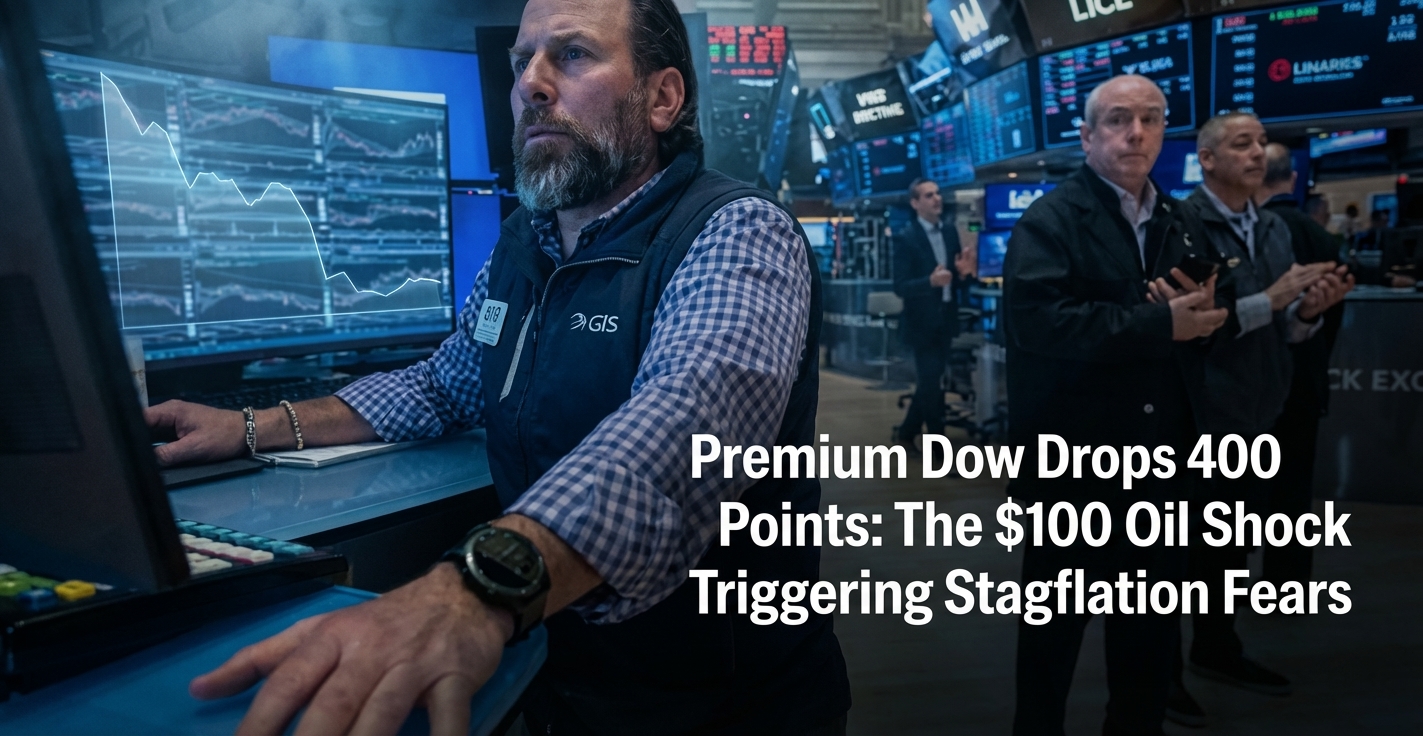
The tectonic plates of the global economy are shifting under the crushing weight of energy costs. Last week’s unnerving slide in equities saw the Dow Jones Industrial Average shed a staggering 400 points, bringing an end to a brief period of relative optimism. This severe dip wasn’t driven by a singular corporate earnings disaster but by a far more primal fear: the return of sustained, high oil prices threatening to drag the world into a toxic mix of high inflation and meager growth, the dreaded stagflation.
The initial trigger for this market panic was the breach of a psychological and economic barrier: West Texas Intermediate crude soaring past $100 per barrel in overnight trading. What made this spike particularly toxic was the speed, pushing prices momentarily toward $119, a level not seen since earlier geopolitical flare-ups rattled commodity markets. This level serves as a critical stress point for the U.S. economy, an invisible line that if crossed and sustained, forces the Federal Reserve into an impossible bind. The market reaction was immediate and visceral, with the Cboe Volatility Index, Wall Street’s fear gauge, piercing 30, signaling a level of anxiety reminiscent of significant past market dislocations, specifically tariff-driven sell-offs.
While stocks managed to rally slightly off their intraday lows—the Dow recovered from a near 900-point drop—the damage was done. The resilience shown by semiconductor stocks like Broadcom and Nvidia hints at a few isolated pockets of strength, primarily in the technology sector, but this was not enough to stem the bleeding across the broader index. The initial bearish fervor was clearly fueled by the realization that the delicate dance between inflation control and economic growth has been severely disrupted by this energy shockwave. This is the textbook definition of a supply-side crisis hitting consumer and corporate wallets simultaneously.
The Ghosts of the 1970s: Why Stagflation Scares Investors Now
Whenever oil prices spike violently and remain elevated, seasoned investors immediately look back decades to the malaise of the 1970s. That era fundamentally reshaped capital markets, proving that monetary policy alone could not easily tame inflation driven by external shocks. The primary danger lies in the Federal Reserve’s mandate. If the Fed aggressively raises rates to combat inflation exacerbated by $100 oil, they risk choking off economic activity, ushering in recession and rising unemployment. Conversely, if they remain dovish to support growth, they risk embedding runaway inflation expectations deeper into the consumer psyche, leading to a damaging, sustained loss of purchasing power.
The market is currently grappling with the implications of this dual threat. Ed Yardeni of Yardeni Research articulated the core concern perfectly, noting the potential for a “Stagflating 1970s Redux scenario.” This scenario is historically devastating for equity valuations, especially for growth stocks whose future earnings are discounted more heavily when inflation is high and future growth prospects are murky. We saw this play out as bonds sold off alongside equities, signaling that investors were not seeking safe harbor in fixed income but were instead bracing for a fight against inflation that might necessitate a painful economic contraction.
The narrative driving the initial oil surge centered on output cuts by Middle Eastern producers and reports suggesting a serious operational issue along the critical Strait of Hormuz passageway. When global supply faces intentional constriction simultaneous with demand remaining relatively firm, prices must obey basic economic laws. Even minor disruptions in key chokepoints, like those recently reported from Iraq and Kuwait, have an outsized impact on confidence, leading traders to bid prices up rapidly, anticipating potential future scarcity.
The brief market reprieve came via G7 chatter concerning tapping strategic oil reserves. While this action is traditionally deflationary or at least supply-supportive, the fact that coordinated release was “not ready yet” underscored the bureaucratic speed bumps involved. Markets hate uncertainty, and the slow-motion response to a fast-moving oil shock amplified investor anxiety, leading to the sharp rebound and subsequent re-selling seen throughout the trading day. This volatility is a clear sign of structural fragility.
The Gravity of Oil: Analyzing the Market’s Extreme Sensitivity
To understand the depth of this correction, one must appreciate the sheer gravity of oil prices relative to economic health. When oil hovered below $60 at the start of the year, the economy was viewed through a lens of steady, if unspectacular, recovery. The move to over $100 is not just a 60% increase in energy cost; it represents a massive, unbudgeted tax on consumers and businesses. Every dollar increase translates into billions siphoned away from discretionary spending and into fuel tanks and heating bills, slowing consumer outlays which form the bedrock of GDP.
This pressure directly impacts corporate margins. Companies reliant on transportation, manufacturing, or petrochemical inputs see their costs soar immediately. For the dominant tech sector, while often insulated by strong pricing power, the secondary effect of broader economic slowdown—reduced corporate IT spending and cooling consumer demand for gadgets—presents a tangible headwind. This is why the technology-heavy NASDAQ futures were hit hard initially, even if semis staged a late-day defense.
Furthermore, the geopolitical backdrop underpinning this oil price surge adds a layer of unaccountable risk. Reports regarding developments in the Middle East and the political statements made regarding strategic interests act as wild cards. The market dislikes geopolitical uncertainty precisely because it undermines the predictability required for long-term investment and capital allocation. When headlines can move energy markets by 5% in an afternoon, long-term models break down, forcing risk managers to deleverage and sell assets across the board as a precaution.
The semiconductor rally, while noteworthy, should be viewed with a degree of skepticism in this environment. While companies like Advanced Micro Devices and Micron are integral to the digital future, they are not immune to a deep recession sparked by energy costs. Their gains suggest that some investors still believe in the secular growth story, viewing the oil shock as a potentially temporary barrier rather than a fatal economic flaw. However, this optimism clashes sharply with the Fear Gauge’s high reading, creating a divided market sentiment.
What Happens Next: Three Scenarios for Wall Street
The coming weeks will be defined by oil price stabilization, or the lack thereof. We can delineate three primary paths forward for the markets, each carrying distinct implications for the NASDAQ futures and the broader indices.
#
Scenario One: The Diplomatic De-escalation
In the most optimistic trajectory, diplomatic maneuvers relating to the Strait of Hormuz or perhaps unexpected inventory increases from non-OPEC producers cool the market heat quickly. Oil prices fall back toward the $80 mark within two weeks. This rollback validates Ed Yardeni’s base case: the shock was transient, supply chains remain fundamentally sound, and the world can proceed toward that technology-led boom. In this scenario, the Fed regains flexibility, and the Dow could see a sharp V-shaped recovery, aided by bargain hunting in sectors that were oversold purely on energy fear.
#
Scenario Two: The Stuck-in-Stagflation Quagmire
This is the scenario the market is currently pricing in, based on the initial 400-point drop. Oil prices stabilize unevenly, perhaps hovering between $95 and $105 for a prolonged period. In this environment, inflation remains stubbornly high, forcing the Fed’s hand toward continuous, moderate rate hikes. Economic growth slows visibly, leading to a correction rather than a crash. Corporate earnings estimates will be systematically downgraded across the board, and we will witness a prolonged period of market choppiness, where rallies are sold into, and volatility remains elevated above 25\. This scenario spells a tough year for passive investors.
#
Scenario Three: The Oil Shock Escalates to Crisis
This is the nightmare scenario. Geopolitical instability widens, perhaps leading to further severe supply disruptions or physical blockades, pushing WTI firmly over $125 without any immediate countervailing policy response. In this crisis mode, the Fed would pivot from fighting inflation to desperate damage control, perhaps pausing hikes altogether as unemployment begins to tick upward rapidly. This forces a true bear market, where the focus shifts entirely from earnings growth to capital preservation. Investors would flee risk assets almost entirely, potentially seeing the Dow challenge significant technical support levels not revisited since the depths of the last major downturn. This trajectory validates the peak fear seen in the volatility index.
The market’s current state is one of hyper-vigilance, watching every headline related to energy supply and every utterance from central bankers. The $100 oil ceiling is more than a price point; it is a threshold of economic pain that forces difficult policy choices. Until that immediate energy uncertainty dissipates, expect equities to remain hostage to commodity traders and geopolitical developments, making conviction trades exceptionally difficult for even the most seasoned capital allocators.
FAQ
What triggered the recent 400-point drop in the Dow Jones Industrial Average?
The primary trigger for the market slide was the breach of the $100 per barrel mark for West Texas Intermediate (WTI) crude oil. This spike reignited fears of sustained, high energy costs leading to stagflation, overriding earlier positive market sentiment.
What is stagflation, and why are investors particularly fearful of it now?
Stagflation is the unwelcome combination of high inflation and stagnant economic growth, often exacerbated by an external supply shock like high oil prices. Investors fear this now because it forces the Federal Reserve into an extremely difficult policy bind between controlling prices and supporting growth.
What specific level did WTI crude briefly reach, causing significant anxiety?
WTI crude briefly soared toward $119 per barrel during overnight trading after crossing the psychological and economic barrier of $100. This rapid ascent signaled severe market stress, reminiscent of previous major geopolitical disruptions.
How did the Cboe Volatility Index (VIX) react to the oil shock?
The VIX, known as Wall Street’s fear gauge, pierced 30 following the oil-driven market dip. A reading above 30 signals anxiety levels comparable to major past market dislocations, such as those driven by tariff conflicts.
Which specific stocks showed resilience despite the broader market decline?
Semiconductor stocks, specifically naming companies like Broadcom and Nvidia, hinted at isolated pockets of strength. Their relative resilience suggests some belief in the secular growth story within the technology sector.
Why do seasoned investors compare the current situation to the 1970s?
The comparison stems from the volatile oil price spikes of the 1970s, which proved that external energy shocks could undermine monetary policy efforts alone. That era resulted in reshaping capital markets due to persistent inflation driven by external supply constraints.
What is the Fed’s dilemma when high oil prices fuel inflation?
If the Fed aggressively raises rates to fight oil-driven inflation, they risk choking off economic activity and triggering a recession. Conversely, remaining dovish encourages deeply embedded inflation expectations, eroding purchasing power.
What did Ed Yardeni suggest the market might be facing regarding future valuations?
Ed Yardeni articulated the potential for a ‘Stagflating 1970s Redux scenario.’ This historical parallel is troubling for equity valuations, especially for growth stocks whose expected future earnings are heavily discounted in uncertain, high-inflation environments.
What caused the initial spike in oil prices preceding the market panic?
The initial price surge was attributed to supply constraints resulting from output cuts by Middle Eastern producers and reports of operational issues along the vital Strait of Hormuz passageway.
Why did investor confidence briefly improve following the initial drop?
A temporary reprieve occurred due to discussions surrounding the G7 nations potentially tapping strategic oil reserves to boost supply. However, the market reacted negatively when it learned coordinated release actions were ‘not ready yet,’ highlighting bureaucratic slowness.
How much of a taxing effect does the move to $100 oil have on the economy compared to $60 oil?
The change from $60 to over $100 oil represents substantially more than a 60% increase in unavoidable energy costs for consumers and businesses. This higher cost acts as a massive, unbudgeted tax, siphoning billions away from discretionary spending and slowing GDP.
How does the oil shock negatively impact the technology sector’s NASDAQ futures?
While tech firms have pricing power, they face secondary headwinds from the broader slowdown, leading to reduced corporate IT spending and cooling consumer demand for electronics. This collective risk caused NASDAQ futures to fall sharply initially.
What is the specific risk that geopolitical uncertainty introduces to capital markets?
Geopolitical uncertainty undermines the predictability necessary for long-term investment and capital allocation strategies. When headlines can move energy markets drastically in short periods, risk managers are forced to deleverage by selling assets defensively.
How should one interpret the late-day rally in semiconductor stocks amidst high volatility?
The rally suggests some investors still prioritize the secular growth narrative of technology, viewing the energy shock as merely a temporary disruption. This optimism starkly contrasts with the high reading on the VIX, indicating a deeply divided market sentiment.
What defines Scenario One for the markets, and what oil price level supports it?
Scenario One involves a diplomatic de-escalation causing oil prices to rapidly fall back toward the $80 mark. This transient shock allows inflation fears to subside, enabling the Fed flexibility and potentially leading to a sharp V-shaped recovery for the Dow.
What is the key characteristic of Scenario Two, the ‘Stuck-in-Stagflation Quagmire’?
In this scenario, oil prices fluctuate unevenly between $95 and $105 for an extended period, keeping inflation high and forcing the Fed into continuous, moderate rate hikes. This leads to systematically downgraded corporate earnings and a prolonged period of choppy, sideways trading.
What would initiate Scenario Three, the ‘Oil Shock Escalates to Crisis’?
Scenario Three is triggered if geopolitical instability widens, causing severe supply disruptions that push WTI crude decisively over $125 without an immediate policy countermeasure. This state forces the Fed to pivot toward damage control rather than inflation fighting.
How would the Federal Reserve react in the worst-case Scenario Three?
In a crisis scenario, the Fed would likely pause its interest rate hikes altogether as unemployment begins to rise rapidly due to economic contraction. The market focus would then drastically shift from earnings growth to pure capital preservation.
What action by the G7 was considered potentially deflationary for oil prices?
The potential coordinated release of oil from strategic reserves was seen as deflationary because it would temporarily increase global supply. However, the slow implementation disappointed markets needing immediate certainty.
Why are conviction trades difficult for allocation managers in the current environment?
Conviction trades are exceptionally hard because the market is being held hostage by energy supply headlines and central bank communications. Until the immediate energy uncertainty resolves, daily volatility makes long-term capital allocation perilous.
What specific technical support level might the Dow challenge in the deepest downturn scenario?
In the nightmare Scenario Three, if risk assets are fled entirely, the Dow could challenge significant technical support levels typically only revisited during the depths of a major prior downturn. This transition reflects a shift to capital preservation mode.