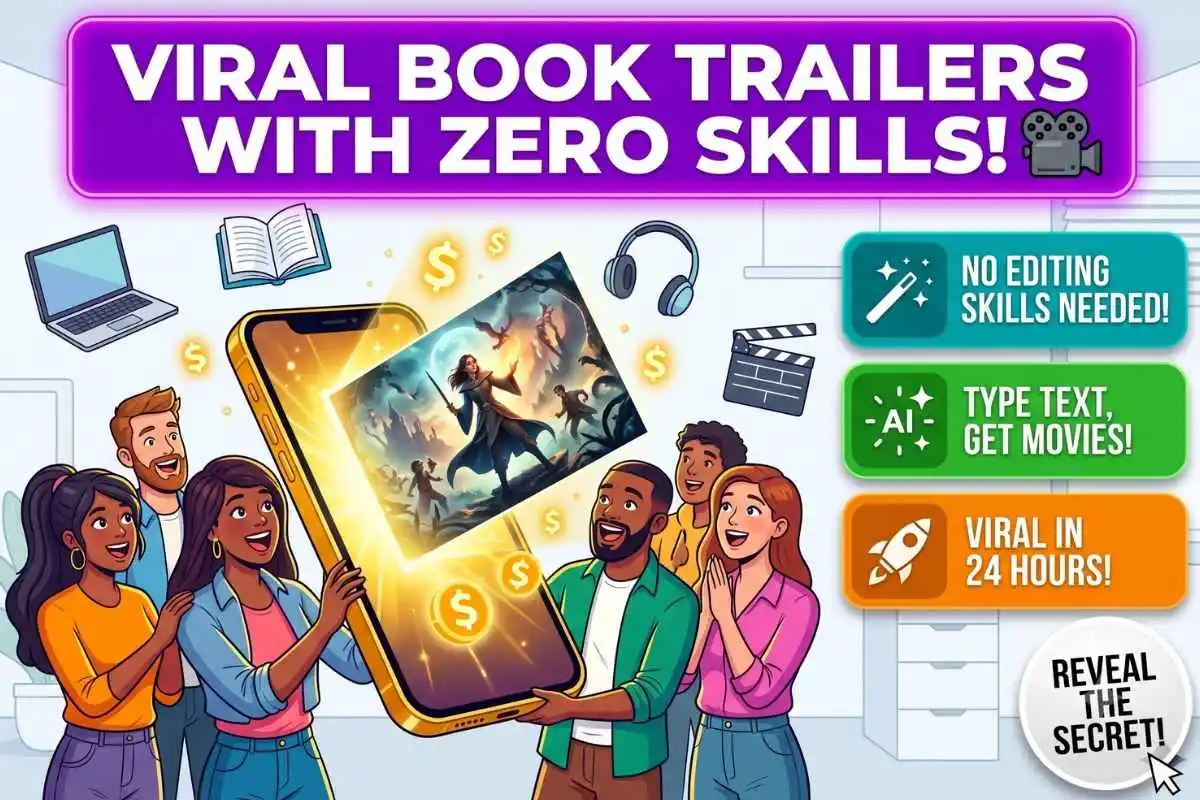
Imagine staring at a screen after spending months pouring your heart into a novel. You hit publish, only to realize the real battle is just beginning: getting people to read it. In today’s visual digital landscape, traditional text excerpts rarely cut through the algorithmic noise. TikTok’s reading community has become a powerful driving force for fiction sales globally. But there is a massive catch for indie authors: how do you produce a cinematic video trailer with zero editing skills, no budget for actors, and only a laptop? This is where artificial intelligence steps in to level the playing field, turning written prose into captivating mobile video.
The Evolution of Visual Book Marketing
For decades, the publishing industry treated visual marketing as an afterthought, relying almost exclusively on cover design and print advertisements. However, the rise of short-form vertical video has fundamentally altered how audiences discover narratives. A compelling visual teaser triggers an immediate emotional response, instantly conveying genre, mood, and tension much faster than a printed back-cover blurb. Readers scrolling on their phones are looking for cinematic immersion; they want to see the dark alleys of a thriller or the sweeping landscapes of a fantasy epic before committing their time. By translating plot points into video clips, authors tap directly into the psychological triggers that drive impulse book purchases.
The traditional approach to creating a book trailer once involved hiring video editors, licensing expensive stock footage, and struggling with complex editing software. For most independent writers, this process was frustratingly expensive and creatively restrictive, often resulting in clunky slideshows that did more harm than good. Today, modern AI story trailer generators remove these technical barriers entirely, allowing independent creators to act as executive directors of their own digital movie sets. By inputting character descriptions, setting details, and narrative prompts, authors can generate custom, studio-quality animations and cinematic sequences in minutes, rivaling the marketing output of traditional publishing powerhouses.
How AI Transforms Words Into Moving Pictures
At the core of these revolutionary tools is a sophisticated blend of generative technologies that analyze human language to synthesize new visual media. When you paste a scene description into an AI generator, neural networks parse the text for keywords related to emotion, lighting, and camera angles. Instead of pulling pre-existing clips from a database, the system constructs unique frames from scratch, applying deep learning principles found in artificial intelligence art models. This allows for hyper-specific storytelling: if your protagonist has distinctive silver hair standing in a neon-lit rainstorm, the AI builds that exact aesthetic rather than forcing you to settle for generic stock footage.
Crafting an engaging story trailer requires thinking more like a film editor and less like a novelist summarizing an entire book. The most successful BookTok promotions follow a strict micro-structure designed to capture attention within two seconds: a compelling hook, rapid-fire complications, and a dramatic cliffhanger. You begin by feeding the AI generator a punchy, one-sentence hook that establishes the central conflict or a fascinating scenario. For example, instead of explaining lore, you might generate text over an image of a burning castle that reads: “What if the only person who could save the kingdom was the villain they locked away?” This immediate friction forces scrolling viewers to pause.
Once you capture initial attention, your next step is generating three to four distinct visual sequences that showcase your novel’s aesthetic and core character dynamics. Best practice dictates keeping each individual clip short—between two and four seconds—to maintain a rapid visual pacing that aligns with TikTok’s high-energy algorithm. Use the AI tool to experiment with different camera perspectives, such as a sweeping drone shot over a wasteland or an intense close-up of a character’s face. Overlay these visuals with rhythmic text captions that tease plot twists without revealing the ending, ensuring users watching on mute can follow the narrative and feel the growing tension.
Navigating the Software Landscape
Navigating the expanding software landscape can feel overwhelming, as different AI video generators specialize in distinct visual styles and pricing structures. Some platforms are engineered specifically for photorealistic realism, making them ideal for high-stakes thrillers, historical fiction, and gritty sci-fi epics. Others excel at rendering vibrant 2D anime or stylized 3D animation, which cater brilliantly to young adult fantasy and cozy romance demographics. When choosing a platform, pay close attention to features like character consistency models, which allow you to generate multiple clips featuring the exact same protagonist across different scenes without frustrating facial variations or wardrobe shifts that break visual immersion.
To demystify the ecosystem and assist you in finding the right software for your creative process, it is helpful to compare the primary types of AI video suites currently available. While some tools operate as standalone generators requiring manual editing in external apps, others offer end-to-end workspaces where you can script, generate, edit, and export your final TikTok promo in a single streamlined interface. The table below breaks down the key categories of AI trailer generators, evaluating their core strengths, ideal genre applications, and overall ease of use for complete beginners who have no formal background in video production.
| Tool Category | Best For | Core Strengths | Learning Curve |
| End-to-End Suite | Beginners & Indie Authors | All-in-one scripting, video generation, voiceovers, and auto-captions. | Very Low |
| Dedicated Video Generator | High-Fantasy & Sci-Fi | Unmatched cinematic visuals, advanced lighting, and deep prompt control. | Moderate |
| Avatar-Led Storyteller | Non-Fiction & Thrillers | Realistic AI narrators speaking directly to the camera with expressive emoting. | Low |
| Stylized Animation Engine | YA & Romance Novels | Rich artistic aesthetics, anime styles, and consistent character design. | Moderate |
Algorithm Secrets for BookTok Reach
Having a visually stunning AI-generated trailer is only half the battle; ensuring it reaches voracious readers requires strategic alignment with social media algorithms. When uploading your promo to TikTok, always integrate trending audio tracks softly beneath your AI voiceover, as the platform actively favors videos utilizing currently popular sound libraries. Additionally, craft a concise, question-based caption that invites audience interaction, such as asking viewers if they would survive the dilemma presented in your video. High engagement metrics in the first hour of posting—particularly comments, shares, and watch-throughs—will immediately signal to the platform’s distribution algorithm that your creative content deserves widespread promotion across user feeds.
Frequently Asked Questions (FAQ)
Are AI story trailer generators complicated to use if I have zero technical experience?
Not at all; in fact, the newest generation of AI video suites is explicitly designed for writers and creative beginners who have never opened a professional editing program in their lives. The primary interface operates entirely on natural language processing, meaning your ability to write descriptive, evocative text is the only true skill required. You simply type out what you want to see—like a brooding vampire standing on a gothic balcony—select an artistic style from a convenient drop-down menu, and let the software handle all the complex rendering, seamless frame transitions, and audio synchronization automatically in the background.
Will my AI-generated book trailer look like a generic slideshow, or can it produce real motion?
Early versions of generative video tools were certainly prone to creating static, slideshow-style images with minor panning effects, but today’s advanced text-to-video models generate fluid, cinematic motion. Modern platforms seamlessly simulate complex camera movements, including sweeping aerial drone shots, dynamic tracking shots that follow a running character, and slow-motion cinematic zooms that dramatically heighten tension. Furthermore, AI physics engines now accurately render complex environmental dynamics like blowing wind, flickering campfire shadows, and flowing water, giving your promotional trailers the polished, high-budget aesthetic of a theatrical movie preview rather than a basic digital presentation.
The Future of Fiction Marketing: A New Creative Horizon
As generative artificial intelligence continues to evolve at a breathtaking pace, the traditional boundaries separating solo novelists from multimedia production studios are rapidly dissolving. We are entering an exciting storytelling era where an author’s imagination is no longer constrained by marketing budgets, technical software barriers, or expensive production logistics. By embracing these powerful AI trailer generators, writers can finally give their spoken dialogue and vivid world-building the cinematic visual representation they truly deserve. The next viral BookTok sensation, captivating millions of readers and climbing top-seller charts worldwide, will not be driven by a massive publishing house; it will be launched by a creative storyteller armed with a great book and a brilliant visual prompt.