


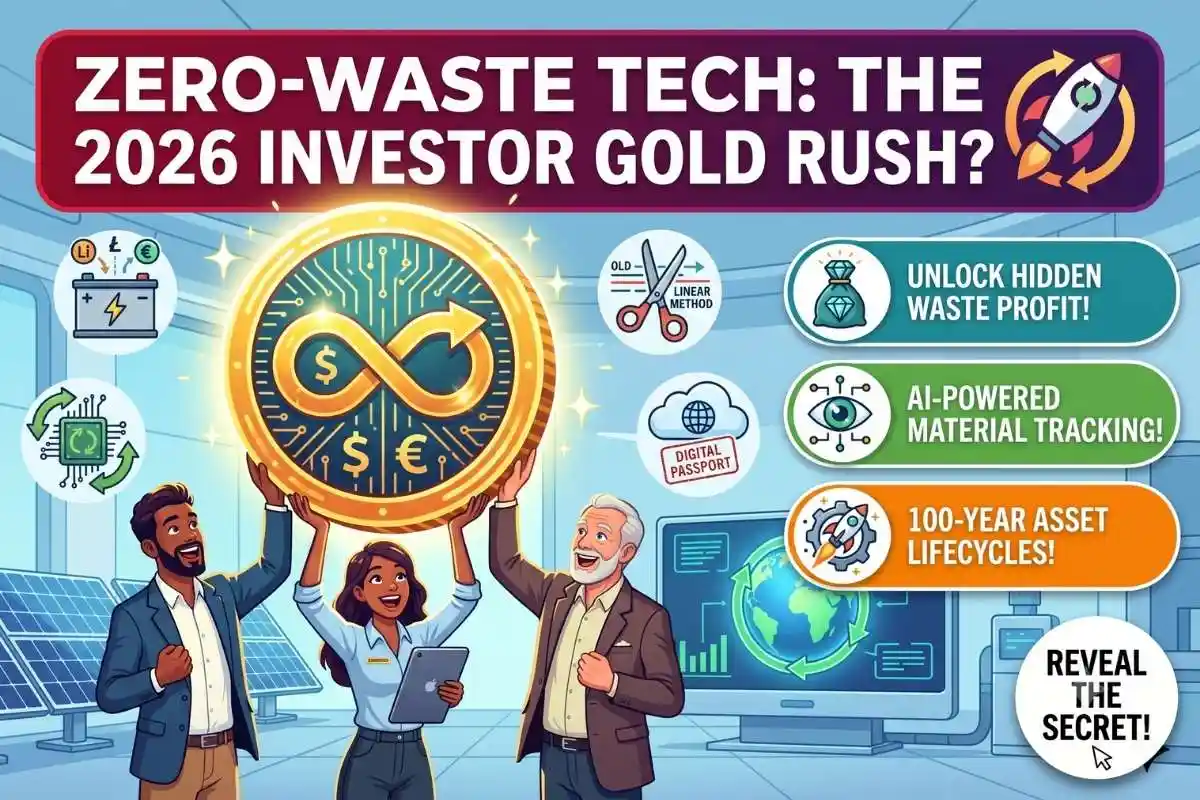
For decades, the global economy operated on a simple, destructive premise: take raw materials, make a product, and throw it away when we are done. This linear model is no longer economically or environmentally viable. Today, a quiet revolution is happening behind the scenes of global commerce. Enter the circular economy—a system intentionally designed to eliminate waste by keeping materials, components, and resources in continuous circulation.
While recycling has long been the public face of sustainability, the real magic in 2026 is happening much earlier in the cycle. We are witnessing the rise of zero-waste supply chain tech: software, hardware, and deep-tech innovations that prevent waste before it is ever created. Venture capitalists and institutional investors are pouring billions into startups that redesign how products are tracked, recovered, and remanufactured.
Why The Investment Landscape Has Changed in 2026
The surge in venture capital funding for circular economy tech is not just about corporate altruism; it is driven by hard economic realities and geopolitical shifts. In 2026, raw material costs are more volatile than ever, and supply chains face unprecedented pressure from resource scarcity. Investors realize that companies controlling their own secondary material loops are far more resilient to global supply shocks. Furthermore, stringent environmental mandates are forcing major corporations to modernize their operations immediately.
According to guidelines and data from the U.S. Environmental Protection Agency, traditional industrial waste handling has severe economic and climate costs that modern tech can systematically dismantle. When organizations shift from merely mitigating waste to mining their own supply chains for valuable inputs, they unlock hidden revenue streams. Venture capitalists are rushing to fund the startups providing the underlying infrastructure for this massive transition.
The Digital Brain of the Loop: AI and Material Intelligence
You cannot save what you cannot see, and until recently, most supply chains were largely blind to what happened to products after they left the factory. Today’s funded startups are deploying artificial intelligence and Internet of Things (IoT) sensors to create continuous “material intelligence”. These platforms track a product from its initial assembly, through its active lifecycle, right down to its molecular degradation.
By utilizing computer vision and machine learning, AI-powered systems can instantly identify, sort, and route complex waste streams at speeds human workers could never match. This transformation has turned reverse logistics—the process of bringing goods back from the consumer to the manufacturer—from a costly operational headache into a profitable material recovery mechanism. Startups building these smart software platforms are securing massive Series A and Series B rounds because they serve as the essential digital backbone for zero-waste manufacturing.
Protecting Critical Minerals Through Battery and E-Waste Tech
Nowhere is the race for circularity more urgent than in the technology and renewable energy sectors. As the adoption of electric vehicles and smart appliances skyrockets, the demand for finite resources like lithium, cobalt, and rare earth elements has outpaced traditional mining capacities. Investors are heavily targeting deep-tech startups that specialize in urban mining—recovering critical minerals from spent batteries and discarded electronics.
Modern circular tech allows companies to extract these high-value, low-volume materials with near-virgin purity, drastically reducing the reliance on ecologically disruptive mining operations. Educational resources from Wikipedia’s Circular Economy overview outline how biological and technical nutrient cycles must be separated to preserve value—a concept startups are now executing at an industrial scale. Capitalizing on these advanced extraction methods is no longer just a green initiative; it is a vital national security and economic preservation strategy.
The Rise of Digital Product Passports
A major catalyst for the 2026 funding boom is the widespread implementation of Digital Product Passports (DPPs). Pioneered by European regulatory frameworks and quickly adopted globally, DPPs require manufacturers to attach a digital identity to their products. This digital record details the item’s exact material composition, origin, repair history, and end-of-life recycling instructions.
Startups that provide the software infrastructure for these passports are seeing explosive growth. By turning every physical product into a data-rich asset, these tech companies enable recyclers and repair technicians to process goods safely and efficiently. Investors love DPP platforms because they create sticky, long-term software-as-a-service (SaaS) relationships with major global brands that must comply with new transparency laws to stay in business.
Where the Capital is Flowing in 2026
To understand the scale of this transition, it helps to look at how venture capital is being distributed across the circular supply chain landscape. Investors are focusing on technologies that offer immediate ROI through resource recovery and operational efficiency.
| Technology Sector | Core Innovation | Primary Investor Motivation | Target Industry Impact |
| AI & Material Intelligence | Computer vision and IoT tracking for waste identification and routing. | High software margins and scalable SaaS business models. | Manufacturing, Logistics, Retail |
| Critical Mineral Recovery | Chemical and enzymatic extraction of metals from spent electronics. | Protection against volatile mining costs and supply chain bottlenecks. | EV Automotive, Consumer Tech |
| Digital Product Passports | Blockchain and cloud platforms tracking product lifecycle and materials. | Mandatory global regulatory compliance and brand retention. | Fashion, Electronics, Batteries |
| Bio-Based Packaging Tech | Converting agricultural waste into compostable, industrial-grade replacements. | Elimination of single-use plastic taxes and landfill dependency. | Food & Beverage, E-commerce |
Frequently Asked Questions (FAQ)
What is the difference between recycling and the circular economy?
Recycling is an end-of-pipe solution that processes waste after it has already been created, often resulting in degraded material quality. The circular economy is a comprehensive system design that aims to prevent waste from happening in the first place. It focuses on product longevity, repairability, reuse, and keeping materials at their highest utility for as long as possible.
Why are venture capitalists suddenly so interested in supply chain waste?
In 2026, waste is viewed as lost revenue. With raw material prices escalating and global supply chains facing geopolitical risks, recovering high-value inputs from existing products is often cheaper than virgin extraction. Startups that provide the technology to automate and scale this recovery are presenting massive financial returns.
What is a “zero-waste supply chain”?
A zero-waste supply chain is a logistics and manufacturing network where every by-product or end-of-life item is repurposed as feedstock for a new production cycle. Nothing is sent to a landfill or incinerated; instead, materials flow continuously between manufacturers, consumers, and recovery facilities.
How do artificial intelligence and IoT help in circularity?
AI and IoT sensors provide real-time visibility into where products are, how they are performing, and what materials they contain. AI algorithms can predict when a product needs maintenance to extend its lifespan, or instruct automated robotic sorters on how to dismantle complex goods for recycling without human contamination.
A Final Curiosity: The 100-Year Washing Machine
Imagine buying an appliance today and knowing your grandchildren will use it. In a linear economy, manufacturers thrive on planned obsolescence—designing products to break down so you have to buy new ones. But circular economy tech is flipping this script completely.
One of the most fascinating concepts being funded in 2026 is “Product-as-a-Service” (PaaS), enabled by modular, highly durable engineering. Take the concept of a washing machine: instead of buying the machine, you subscribe to “clean clothes as a service”. Because the manufacturer retains ownership of the hardware, their financial incentive completely reverses. They suddenly want that machine to last for 100 years.
To achieve this, startups are designing commercial appliances like Lego sets. When a motor wears out or a computer chip needs an upgrade, smart sensors alert the company, and a single modular part is swapped out in minutes. The old part is taken back, remanufactured, and put into another machine. By funding the zero-waste tech that makes these continuous loops possible, investors aren’t just cleaning up our industrial mess—they are completely redesigning the relationship between humans and the things we build.

