


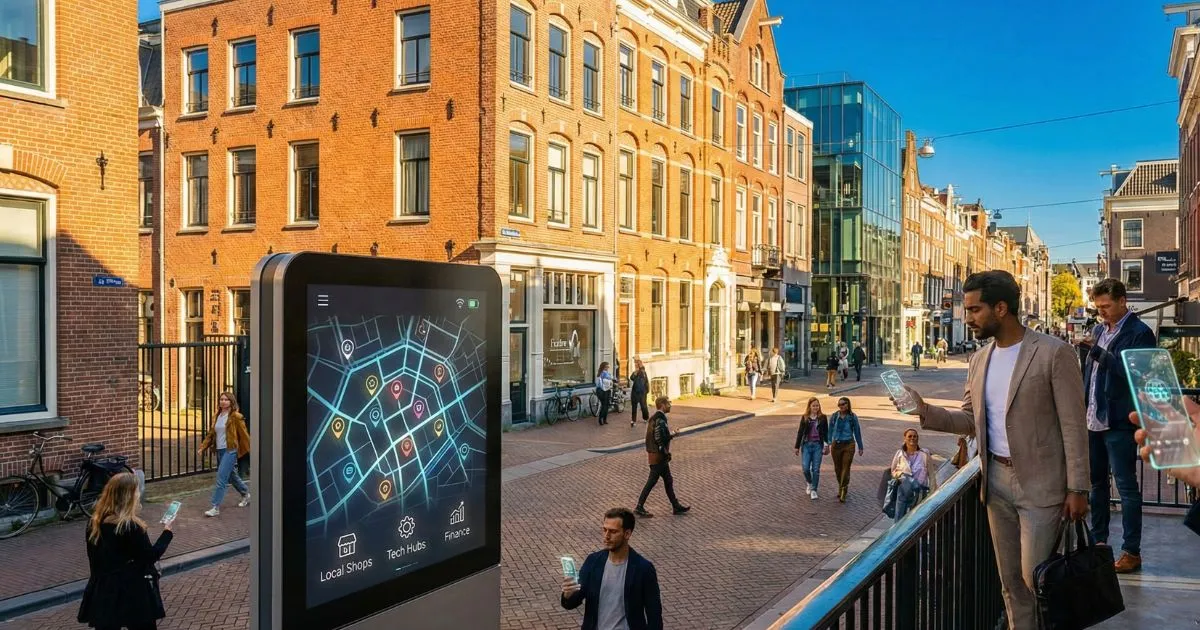
The street outside my office used to be a graveyard of quiet storefronts, a collection of fading signs and dusty windows that looked like a relic of the pre-digital age. But lately, something has shifted. Walking down that same block today, the air feels different. There is a hum of activity, a steady stream of people ducking into boutiques and local hardware stores with their phones in hand, guided by a digital breadcrumb trail that didn’t exist a few years ago. We are living through a strange, beautiful irony where the very technology that was supposed to kill the corner shop is now the only thing keeping its lights on.
The shift toward Local SEO 2026 isn’t just a technical update or a new way to organize data. It is a fundamental rewriting of how we inhabit our cities. For a long time, the internet felt like a vast, placeless void where you could buy anything from anywhere, often at the cost of the ground beneath your feet. But now, the pendulum has swung back. People are tired of the friction of global logistics, the endless waiting for packages, and the soul-set vacuum of massive marketplaces. They want to know what is happening three blocks away. They want to know if the specific shade of paint they need is sitting on a shelf within walking distance. This is the new frontier of commerce, and it is governed by a set of rules that reward presence over pixels.
The Invisible Map and Retail Survival
I spent an afternoon talking to a friend who runs a small specialized bookstore, the kind of place that should have been crushed by the giants of the early 2000s. He told me that his foot traffic has never been higher, but it is no longer accidental. People don’t just wander in because they saw his window display; they arrive because an AI agent told them he had a specific first edition in stock. This is the heart of retail survival in an era where the boundary between the physical and digital has essentially evaporated. If you aren’t visible on the invisible map that lives in everyone’s pocket, you simply don’t exist.
The struggle for relevance has moved away from broad national keywords. Nobody is searching for generic terms anymore. Instead, the intent is surgical. The search is for a solution that is physically accessible right now. I see businesses that have spent years ignoring their digital footprint suddenly realizing that their Google Business Profile is more important than their actual physical signage. It is a digital storefront that never sleeps, and in 2026, it is being judged by its “openness” and its proximity. If your hours are wrong or your location is unverified, the algorithm will treat you like a ghost. It won’t even give you the chance to fail.
What’s fascinating is how much the human element still matters within this high-tech framework. We think of SEO as a cold, mechanical process, but the current landscape is obsessed with “signals of life.” A stagnant profile with photos from three years ago tells a story of a business that is slowly giving up. Conversely, a stream of fresh, grainy, authentic photos uploaded by real customers acts as a heartbeat. It signals to the search engines, and more importantly to the people using them, that this is a place where things are happening. It’s about proving you are part of the neighborhood, not just a pin on a map.
Deciphering the Google Maps Ranking in a Neighborhood Economy
When we talk about achieving a dominant Google Maps ranking, we are really talking about trust at scale. I’ve noticed a pattern among the businesses that are actually winning. They aren’t the ones with the most polished, corporate-looking websites. They are the ones that have leaned into the messy, specific reality of their local area. They mention the cross-streets. They talk about the local festivals. They engage with reviews in a way that sounds like a person talking to a neighbor, not a PR department issuing a statement.
The algorithm has become surprisingly good at detecting this kind of authenticity. It looks for “review velocity,” which is just a fancy way of seeing if people are still talking about you. If you got a hundred reviews in 2024 and haven’t had one since, the system assumes you’ve lost your edge. It wants to see a steady, living pulse of feedback. Even the move toward anonymous reviews hasn’t dampened this; if anything, it has increased the volume of honest, raw data that the search engines use to decide who gets the top spot in the local pack.
I often think about the “city border” effect. It used to be that if you were just outside a certain zip code, you were essentially invisible to people inside it. But the new hyper-local strategies are about breaking those artificial barriers by building authority through local partnerships. A backlink from a neighborhood blog or a mention in a local community group carries more weight now than a dozen generic links from halfway across the world. It’s a return to a village economy, just one that is mediated by incredibly sophisticated artificial intelligence.
The retail landscape is no longer a winner-take-all game for the biggest spenders. It has become a game of precision. I see small shops outranking massive chains simply because they have better structured data about their specific inventory and more genuine engagement with their local community. They have turned their physical location into an asset rather than a liability. They understand that the “near me” search is a high-intent moment, a signal that someone is ready to spend money if you can just prove you are there and you are ready for them.
The transition hasn’t been easy for everyone. I see plenty of owners who are still stuck in the old ways, thinking that a newspaper ad or a flyer is enough. They are being left behind in a world that moves at the speed of a fiber-optic cable. But for those who embrace the shift, the rewards are immense. They are finding that they don’t need to compete with the entire world; they just need to own their city. They are building businesses that are resilient because they are deeply rooted in the soil of their own community.
In the end, this isn’t about gaming a system. It’s about visibility in its purest form. It’s about making sure that when someone is looking for help, or a gift, or a cup of coffee, they find the person who is actually there to provide it. The digital world has finally grown up enough to realize that the physical world matters. We are no longer trying to escape our surroundings; we are using technology to dive deeper into them. It’s a strange time to be in business, but for those who can navigate these new waters, there has never been a better time to be local.

