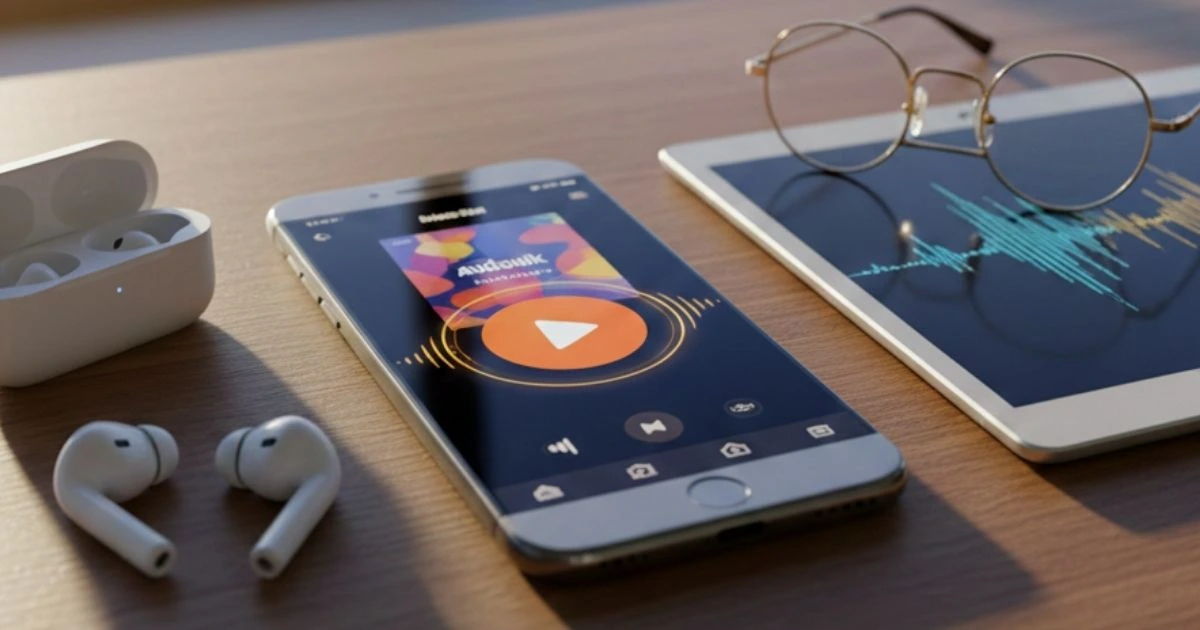
I was sitting in a coffee shop last week, the kind where everyone looks like they are either writing the Great American Novel or managing a mid-sized hedge fund, and I overheard two authors arguing. One was a traditionalist, mourning the loss of the “human breath” in narration, while the other was a self-published thriller writer who had just cleared five figures in a month from a backlist he thought was dead. The difference between them was not the quality of their prose, but a simple line item in their production budget. We have reached a point in 2026 where the barrier between a digital file and a professional-grade listening experience has effectively dissolved, and it is reshaping the entire financial landscape of the publishing world.
For a long time, the audiobook was the expensive, high-maintenance sibling of the ebook. You had to book a studio, hire a narrator who likely charged by the finished hour, and then pray the post-production didn’t eat your entire advance. If you were an indie author with a thin margin, audio was often a luxury you couldn’t afford. But the math has changed. We are seeing a massive shift toward AI Audiobook narration as the primary engine for content creation, and the reasons are as much about the bottom line as they are about the technology. It is no longer about “robotic” voices that sound like a GPS navigation system. The voices we are hearing now have texture, they have pacing, and they have an uncanny ability to understand the emotional weight of a sentence.
I remember listening to an early AI-narrated book back in 2023. It was jarring, a series of syllables stitched together with the grace of a Frankenstein monster. Fast forward to today, and the software has matured into something that feels lived-in. When we talk about why this is going mainstream, we have to look at the sheer volume of content being produced. In 2026, a writer can finish a manuscript on a Tuesday and have a retail-ready audio version by Thursday afternoon. That speed is a competitive advantage that traditional publishing, with its months-long lead times and bureaucratic bottlenecks, simply cannot match. It is a gold rush for those who understand that in a saturated market, being first and being prolific is often more important than being perfect.
Virtual Voice Audible and the New Economic Reality
The real earthquake happened when the major platforms fully embraced the tech. When Virtual Voice Audible became a standard option for creators, the gatekeeping mechanism of the traditional studio system was essentially bypassed. For years, only about five percent of self-published titles ever made it to audio. The costs were just too high, often running between three and five thousand dollars for a standard-length novel. Now, that same production cost has plummeted to a few hundred dollars, or in some cases, the price of a monthly software subscription. This is how authors are saving 90% on their production costs, and that saved capital is being funneled directly back into marketing and new acquisitions.
I’ve looked at the spreadsheets of authors who have made the jump. They aren’t just saving money, they are recovering lost revenue. Think about the “long tail” of a writer’s career. You might have ten books in your catalog that sell a few copies a month. Spending five grand to turn one into an audiobook is a bad investment. But spending five hundred? Suddenly, the ROI makes sense. It turns dormant assets into active streams of passive income. This is the logic of 2026. We are seeing a democratization of the format where the “mid-list” author is finally able to compete with the giants because they can offer their audience the same multi-format experience without the institutional overhead.
Of course, there is still a segment of the market that demands a human voice, particularly in high-stakes literary fiction or celebrity memoirs. But for the vast majority of non-fiction, genre fiction, and instructional content, the listener’s ear has adapted. We have become accustomed to the precision of synthetic speech. It is consistent. It doesn’t get tired in the eighth hour of a recording session. It doesn’t mispronounce technical terms if you give it the right metadata. From a financial perspective, the reliability of the output is just as valuable as the cost savings. You know exactly what you are going to get, and you get it instantly.
Scaling Indie author revenue through Automated Production
The true genius of this shift lies in how it scales Indie author revenue across global markets. If you have a hit in English, the cost of translating and narrating that book into Spanish, German, or Mandarin used to be a secondary hurdle that few could clear. Now, the same AI models that handle the narration can handle the localization. An author in a home office in Ohio can become a bestseller in Tokyo without ever hiring a translation firm. We are looking at a world where “local” no longer exists in the digital marketplace. Your audience is anyone with a pair of headphones and an internet connection.
I often wonder where the limit is. Is there a point where we have too much audio? Maybe. But the market seems to have an insatiable appetite for content. People are “reading” while they drive, while they exercise, and while they cook. They are consuming information at a rate that would have been impossible a decade ago. The AI isn’t just a tool for saving money, it is a tool for meeting that demand. It allows the creator to stay relevant in a fast-moving culture. If you aren’t in audio in 2026, you are essentially invisible to a third of your potential customers.
There is a certain irony in the fact that the most human of activities, storytelling, is being fueled by the most artificial of technologies. But perhaps that’s always been the way. From the printing press to the ebook reader, every leap in technology has been met with a mix of fear and excitement. The authors who are thriving today are the ones who didn’t wait for the permission of the old guard. They saw the efficiency, they did the math, and they moved. They understood that the value isn’t in the vocal cords of the narrator, but in the ideas being communicated. As we move deeper into this year, the gap between those who embrace these tools and those who resist them will only widen. The future of the book isn’t just on the page, it’s in the ear, and it’s being generated in real-time.
What happens next is anyone’s guess, but the numbers don’t lie. The overhead is gone, the quality is there, and the audience is waiting. If you are still looking at your manuscript and wondering if you can afford the audio version, you might be asking the wrong question. In this economy, the question is whether you can afford to stay silent. The tools are here, the platforms are ready, and the cost of entry has never been lower. It is a strange, fast, and incredibly lucrative time to be a creator, provided you are willing to let the machine do the heavy lifting while you focus on the next story.