


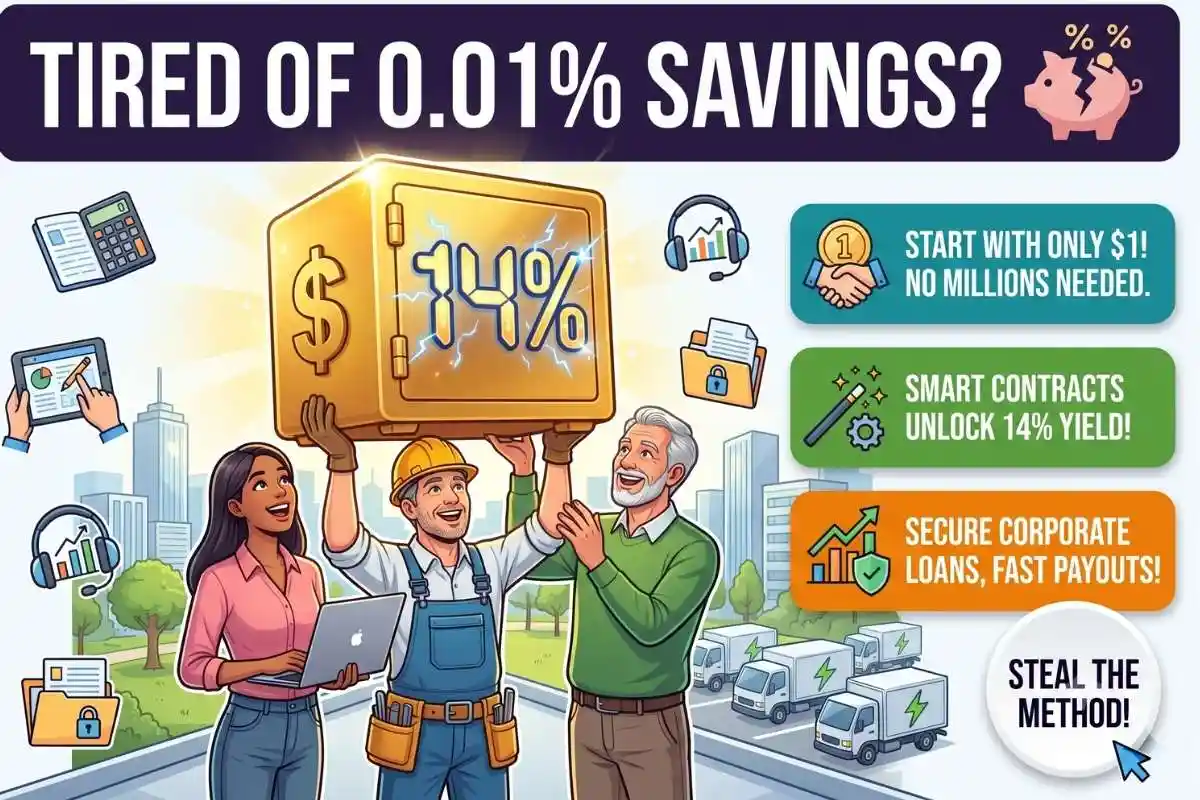
Have you ever looked at a massive, gleaming bank skyscraper and wondered how they afford such lavish architecture? The secret is surprisingly simple: they take the money you keep in your savings account, lend it out to businesses at a high interest rate, pay you a tiny fraction of a percent, and keep the massive difference for themselves. It is a business model that has worked flawlessly for centuries, enriching financial institutions while everyday savers barely beat the rate of inflation. But what if you could cut out the middleman entirely? Imagine stepping directly into the shoes of the bank, providing the capital that businesses desperately need, and pocketing the double-digit returns that typically go straight to Wall Street executives. Welcome to the rapidly expanding world of tokenized private credit, a revolutionary financial frontier where blockchain technology allows regular people to fund real-world corporate loans. This is not about trading volatile cartoon apes or betting on meme coins; it is about bringing transparency, accessibility, and serious yield to traditional corporate finance.
The Shift from Wall Street to Main Street
For decades, the lucrative world of private credit was an exclusive playground reserved solely for institutional investors, mega-banks, and ultra-wealthy individuals. When a medium-sized enterprise needed to borrow millions of dollars to expand its operations, it turned to private credit funds. These private lenders would analyze the business’s financials, secure the loan against physical assets, and charge a hefty interest rate. Historically, the barrier to entry was a minimum investment of millions, effectively locking out the general public. However, blockchain technology has completely rewritten the rulebook. By “tokenizing” these massive loans, modern financial platforms break down corporate debt into millions of tiny, digital tokens. This means an everyday investor can buy a single token for just one dollar. The underlying asset remains a strictly vetted corporate loan, but tokenization democratizes access, allowing anyone to earn yields previously hoarded by elites. To understand how this securely distributes ownership, you can read about blockchain on Wikipedia, which explains the immutable ledger system making this possible.
A Real-World Narrative Example
To truly understand how this invisible digital machinery operates, let us walk through a practical scenario involving a fictional company called SunPower Logistics. Imagine SunPower operates a profitable fleet of delivery trucks and desperately needs fifty new vehicles to fulfill surging demand. Traditional banks, weighed down by bureaucracy, might take six months to approve the paperwork. Instead, SunPower approaches a modern tokenized private credit platform. The platform’s expert risk-assessment team rigorously audits SunPower’s financial health and approves a five-million-dollar loan with a fourteen percent interest rate. Crucially, the loan is heavily collateralized; if SunPower fails to repay, the platform can legally seize the trucks. The platform does not fund this from a centralized vault. Instead, it creates five million digital tokens and offers them globally. You can purchase five hundred tokens for five hundred dollars. Every month, when SunPower makes its scheduled payment, smart contracts instantly distribute your proportional share of the interest directly to your digital wallet. It is a seamless system where the business gets expansion capital rapidly, and you act as the bank, earning passive income without intermediaries.
Understanding the Risks and Regulatory Landscape
Earning a fourteen percent interest rate sounds undeniably attractive compared to standard savings accounts, but it is essential to recognize this is not risk-free money. Higher returns are invariably accompanied by higher risk, and tokenized private credit is no exception. The primary risk is a default: the scenario where the borrowing company goes bankrupt and cannot repay its debt. Although these loans are “secure” by requiring physical collateral like real estate or heavy machinery, liquidating those assets takes time and rarely recovers one hundred percent of the original loan value. Furthermore, the platforms facilitating these transactions operate in a nascent regulatory environment. Government watchdogs are actively monitoring this space to protect consumers from potential platform mismanagement. For instance, the U.S. Securities and Exchange Commission (SEC) plays a vital role in determining whether these digital debt instruments should be regulated as traditional securities. Prudent investors must deeply research the credit platform, understand the exact nature of the collateral, and never invest money they cannot afford to lose, carefully balancing high yields with corporate default risks.
The Technological Backbone: Smart Contracts
The true magic allowing tokenized private credit to function without a centralized banking authority is the deployment of “smart contracts.” These are self-executing lines of computer code living permanently on the blockchain, containing the loan terms written directly into their programming. In traditional finance, managing a loan funded by thousands of retail investors requires a massive back-office team of accountants and administrators to calculate fractional interest, which would entirely wipe out the profitability of the arrangement. A smart contract automates this administrative burden flawlessly. When the borrowing corporation sends its monthly repayment, the smart contract mathematically divides that payment among all token holders down to the fraction of a cent. If an investor decides to sell their tokenized debt on a secondary market, the contract automatically recognizes the new owner and routes future payments to them without human intervention. This radical reduction in friction and administrative overhead is exactly why platforms can afford to pass along such unusually high double-digit yields to the end consumer.
Comparing Your Options
To put this into perspective, here is how tokenized private credit stacks up against traditional methods of growing your capital:
| Feature | Traditional Savings | Corporate Bonds | Tokenized Private Credit |
| Average Yield | 4% – 5% | 5% – 7% | 10% – 14% |
| Underlying Asset | Bank reserves | Public corporate debt | Collateralized private loans |
| Barrier to Entry | $0 Minimum | Medium ($1,000+) | Low ($1 – $50) |
| Liquidity | Instant access | High (Traded daily) | Moderate (Secondary markets) |
| Risk Level | Insured & Low | Moderate | Higher (Default risk) |
Frequently Asked Questions
How do I convert my digital credit tokens back into cash?
Most established tokenized private credit platforms feature a secondary marketplace. If you need to exit your position before the corporate loan reaches its official maturity date, you can list your tokens for sale to other investors. However, unlike traditional stocks that can be publicly sold in milliseconds on standard brokerage apps, these digital tokens can sometimes take a few days to find a willing buyer, meaning they are considered slightly less liquid than standard equities.
What happens if the tokenization platform itself goes bankrupt?
Legitimate platforms utilize a legal structure known as a Special Purpose Vehicle (SPV) to safely isolate the loans. This means that the actual corporate debt and the physical collateral are held in a separate legal entity entirely independent of the platform’s operating business. If the tech company that built the platform goes bankrupt, the smart contracts and the underlying corporate loans remain fully intact, ensuring investors are still legally owed their interest and principal repayments.
Do I need advanced technical knowledge or a complex crypto wallet to participate?
In the early days of decentralized finance, participating required managing complicated cryptographic keys and navigating highly confusing software. Today, the industry has aggressively prioritized user experience. Most top-tier platforms allow you to sign up with a standard email address, undergo basic identity verification, and fund your account using a standard bank wire or credit card. The complex blockchain technology operates entirely behind the scenes, making it as easy as using a traditional banking app.
A Final Curiosity: The Renaissance of Banking
It is fascinating to observe how history operates in cyclical revolutions. During the Italian Renaissance, the legendary Medici family completely revolutionized global commerce by creating a decentralized network of branch banks, allowing capital to flow across borders faster than ever before. Today, we are witnessing an identical financial renaissance, but instead of using stone-walled vaults and paper ledgers, we are using cryptographic tokens and immutable computer networks. Tokenized private credit is fundamentally dismantling the monopoly that traditional banks have held over high-yield commercial lending for centuries.
While it is vital to approach this new frontier with a healthy dose of caution and a clear understanding of the collateralized risks involved, the opportunity to earn a fourteen percent interest rate by acting as the bank is an undeniable paradigm shift. As technology continues to bridge the gap between traditional finance and blockchain innovation, the everyday investor is finally being invited to the most lucrative table in the financial world. You no longer have to settle for the tiny crumbs of standard savings yields; you now have the tools, the technology, and the access to become the bank yourself.

