


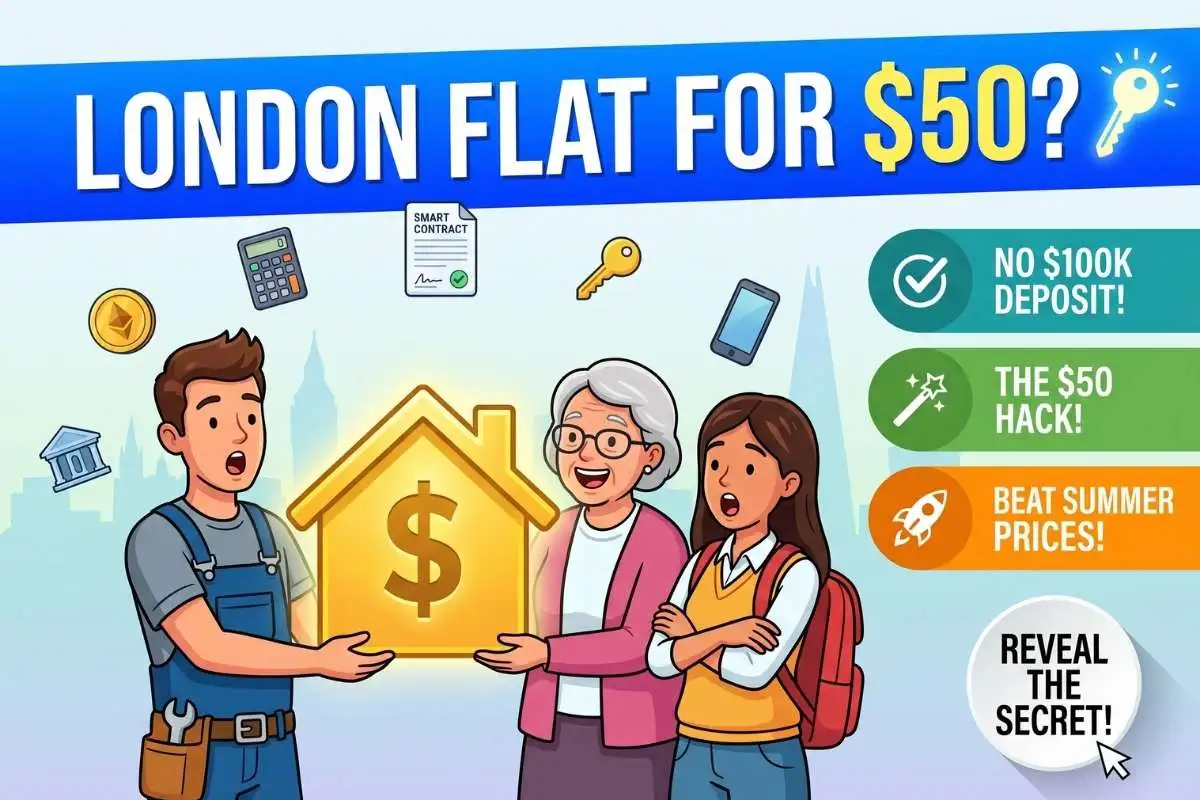
Imagine strolling through the historic streets of London, gazing up at a restored Victorian townhouse or a sleek flat overlooking the Thames. For decades, the fantasy of owning this prime real estate has been strictly reserved for wealthy investors and international tycoons. The barrier to entry was unimaginably high, requiring hundreds of thousands of pounds for a deposit, plus hidden costs of stamp duty, solicitors, and endless paperwork. But what if you could bypass the billionaire’s club and purchase a legally backed stake in a London property for the price of a simple dinner out? Enter the revolutionary world of tokenized real estate. For as little as $50, everyday people are acquiring fractional shares of premium London flats, and savvy buyers are rushing to secure their digital deeds before the notorious summer price surge officially takes effect.
Decoding Tokenized Real Estate and Its Mechanics
At its core, tokenization is the process of converting the ownership rights of a physical asset into digital tokens on a secure blockchain. Think of taking a multimillion-dollar pie and slicing it into thousands of tiny, perfectly equal pieces. If a stunning apartment in Mayfair is valued at $1 million, a tokenization platform can legally divide that property into 20,000 digital tokens priced at exactly $50 each. When you purchase one of these tokens, you are acquiring a legally binding fractional share of the actual physical property. This digital share directly entitles you to a proportional cut of any rental income generated by the flat, as well as a percentage of the profits if the property appreciates in value. It is a brilliant democratization of wealth, placing property investment directly into the palm of your hand.
The underlying technology making this system possible is the blockchain, a decentralized and immutable digital ledger that records every transaction with unparalleled security. By utilizing programmable smart contracts, the blockchain seamlessly automates the heavy administrative lifting that traditionally requires expensive intermediaries. The moment you purchase a token, the smart contract instantly verifies your funds, transfers the digital ownership right directly to your wallet, and officially updates the global ledger in mere seconds. This seamless efficiency has not gone unnoticed by major governmental institutions worldwide. In fact, the UK’s official property database is actively researching this paradigm shift. You can read more about how HM Land Registry is exploring the benefits of blockchain to make buying and selling property significantly quicker and cheaper. By replacing physical paperwork with frictionless digital infrastructure, tokenization drastically reduces transaction costs for the retail investor.
Breaking Down the London Real Estate Moat
For generations, the central London property market has operated as an impenetrable financial fortress, aggressively protecting the interests of elite institutional investors while locking out the average citizen. Traditional real estate investment is notoriously illiquid; your capital is entirely tied up in a single physical asset, meaning that if you suddenly need cash for an emergency, you face a grueling months-long process to sell the property. Tokenized property completely shatters this long-standing liquidity problem once and for all. Because your investment exists as digital tokens on a global blockchain market, you can quickly buy and sell your fractional shares almost as easily as trading a tech stock. If your London flat’s value jumps and you want to cash out, you can instantly list your tokens on a secondary exchange, finding eager buyers worldwide within minutes.
Furthermore, this innovative digital fractionalization creates incredible opportunities for sophisticated risk management through comprehensive portfolio diversification. In the old economic world, even if you miraculously managed to scrape together enough capital to buy a traditional investment property, all of your financial eggs were dangerously placed in one very expensive basket. If the neighborhood experienced a downturn, your entire life savings severely suffered the blow. Today, a retail investor with just $1,000 to spare can intelligently spread their risk across the map. You can allocate $200 to a trendy studio apartment in Shoreditch, $300 to a luxury penthouse in Chelsea, and confidently invest the remainder elsewhere. This is a brilliant example of fractional ownership, a robust strategy allowing multiple independent parties to share the heavy costs and lucrative rewards of a high-value physical asset.
The Urgency of the Summer Price Surge
While tokenized real estate represents an exciting financial prospect year-round, there is a compelling, highly time-sensitive reason why savvy digital investors are rushing to buy their tokens today. The central London real estate market operates on a remarkably predictable seasonal rhythm, and the upcoming summer months invariably bring a massive influx of international activity that drives property values upward. As winter fades, deep-pocketed foreign buyers, wealthy international expats, and affluent parents desperately securing housing for university-bound students descend upon the bustling city in droves. This sudden spike in demand creates a competitive environment where frantic bidding wars become commonplace and overall property valuations experience their most aggressive annual growth. By strategically acquiring tokenized shares in the spring, visionary investors perfectly position themselves to passively ride this powerful wave of seasonal appreciation.
Waiting until the peak months of July or August to finally enter the market means that the anticipated price jumps will have already been factored heavily into the token’s cost on the secondary trading platform. Proactive early adopters who lock in their affordable $50 tokens today are buying at a much lower baseline valuation before the seasonal shopping frenzy artificially inflates the underlying property’s intrinsic worth. Moreover, the warm summer months precisely correspond with the peak of short-term tourist rental demand, directly meaning that properties tokenized for holiday let business models will generate their highest dividend payouts of the year. If you hold digital tokens in a property that successfully capitalizes on the summer tourism boom, your digital wallet will immediately reflect the increased rental yields directly through transparent smart contract payouts.
Traditional vs. Tokenized Real Estate
| Feature | Traditional Real Estate | Tokenized Real Estate |
| Minimum Investment | $100,000+ (Large deposits and fees) | $50 – $100 (Accessible micro-shares) |
| Liquidity | Very Low (Takes several months to sell) | High (Traded 24/7 on global exchanges) |
| Transaction Time | 60 to 90 Days on average | Instantaneous via automated smart contracts |
| Intermediaries | Lawyers, brokers, and traditional banks | None (Direct peer-to-peer blockchain network) |
| Diversification | Capital severely tied to a single asset | Easy to purchase fractions of multiple properties |
Frequently Asked Questions
Is tokenized real estate legally binding and secure?
Yes, reputable tokenization platforms operate under strict regulatory frameworks to ensure that your digital tokens represent a legally enforceable right to the underlying physical asset. The real estate properties are typically placed into a Special Purpose Vehicle (SPV) or a similar corporate holding structure, and the digital tokens represent legitimate shares in that specific entity. Furthermore, because these ownership records are permanently etched onto a decentralized blockchain, they are cryptographically secure and practically impossible for hackers to maliciously alter, forge, or destroy. This provides a level of unshakeable security that outdated paper deeds simply cannot match in the modern digital age, granting absolute peace of mind to investors.
How exactly do I earn money from a $50 property token?
There are two primary avenues for consistently generating a financial return on your tokenized property investment: recurring rental yields and long-term capital appreciation. First, if the underlying London flat is actively rented out to reliable tenants, the net rental income—after standard maintenance and property management fees are deducted—is distributed proportionally to all token holders, often paid automatically in cryptocurrency directly to your secure digital wallet. Second, if the property’s overall market value naturally increases over time due to seasonal demand or neighborhood gentrification, the intrinsic value of your digital token rises right alongside it, allowing you to quickly sell your specific fraction for a handsome profit.
What happens if the physical property is damaged or destroyed?
Just like any responsible traditional real estate investment, properties that undergo the blockchain tokenization process are legally required to be fully covered by comprehensive institutional property insurance policies. In the extremely unlikely event of a catastrophic fire, severe flooding, or other major structural damage that compromises the building, the resulting insurance payout would be distributed proportionally among all the registered token holders. This fully compensates investors for the sudden loss of the physical asset. Furthermore, the designated property management company professionally handles all necessary maintenance, emergency repairs, and complex insurance claims on behalf of the digital investors, meaning you never have to worry about logistical headaches.
A Final Thought on the Future of Property
Did you know that HM Land Registry, the official UK government department safeguarding land and property ownership, was created in 1862? For over a century, it operated on a sluggish system of ink, parchment, and physical filing cabinets. Yet today, this historic institution is exploring distributed ledger technologies to prepare for a fully digitized, highly efficient future. The rapid evolution of property tokenization is not merely a passing cryptocurrency fad; it represents a fundamental restructuring of global wealth distribution. By lowering the formidable entry barrier from millions of dollars down to a single $50 bill, innovative blockchain technology is granting the average person a VIP pass into the world’s most lucrative property markets. As the summer sun prepares to heat up London’s historic streets and drive property prices aggressively skyward, the only question left to answer is: which iconic neighborhood will you choose to own a profitable piece of first?

