
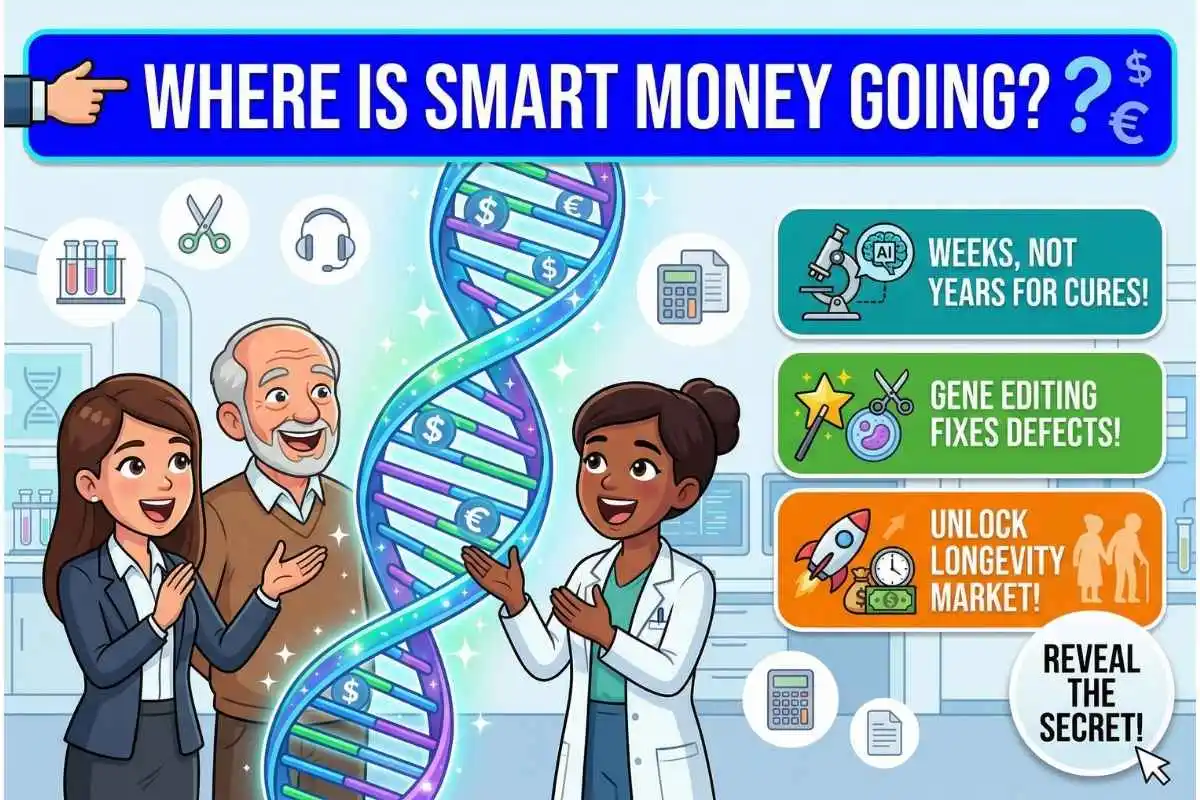
Imagine standing in the middle of a massive digital gold rush, only to realize that the most valuable treasure isn’t the gold itself, but the life-saving medicine being sold in the mining camps. For the past two years, artificial intelligence has been the undisputed darling of the financial world. Every headline, startup pitch, and venture capital dollar seemed laser-focused on the next big language model or image generator. However, as the second quarter of the year unfolds, a subtle but massive shift is taking place behind closed doors. Wall Street insiders and Silicon Valley veterans are orchestrating what is now quietly being called the “Q2 Tech Pivot.” They are taking the massive profits generated by the initial AI boom and funneling them directly into a sector that promises to fundamentally alter human existence: Biotechnology. This isn’t just a random rotation of assets; it is a calculated, strategic move driven by the realization that while AI can write our emails, biotechnology has the power to cure diseases, extend lifespans, and reprogram the very building blocks of nature.
The AI Plateau and the Search for Tangible Human Impact
To understand why the smartest investors on the planet are suddenly pivoting their massive portfolios toward biotechnology, we first have to understand the current state of the artificial intelligence market. Over the last several months, the initial euphoric hype surrounding generative AI has begun to settle into a more realistic, albeit still impressive, maturity phase. The foundational models have been built, the major tech giants have established their dominant moats, and the low-hanging fruit of basic productivity applications has largely been picked. Investors are now looking around and asking themselves a critical question: what comes next? The answer lies in tangible, physical-world impact. While faster software and automated customer service are incredibly valuable, they do not solve the fundamental, existential challenges of humanity. Smart money is highly unsentimental. It recognizes that the massive valuations of pure-play AI companies require astronomical future earnings to justify them. Consequently, these seasoned investors are searching for industries where the integration of advanced computing can unlock trillions of dollars in previously inaccessible value, finding exactly what they need in the biology labs.
The Biology Revolution Powered by Next-Generation Computing
The true secret behind the Q2 Tech Pivot is that investors aren’t actually abandoning artificial intelligence at all; instead, they are applying it to the ultimate scientific frontier. For decades, biotechnology has been a notoriously slow, wildly expensive, and highly unpredictable field. Discovering a single new drug could take well over a decade and cost billions of dollars, with a staggering failure rate that terrified all but the most specialized venture capitalists. However, artificial intelligence has fundamentally changed the underlying math of biological research. By utilizing massive neural networks, scientists can now simulate how millions of different chemical compounds will interact with human cells in a matter of hours, rather than years. This computational biology approach drastically reduces the time and cost required to discover life-saving therapeutics. For more detailed context on how computational power is reshaping medical research, you can explore the official resources provided by the National Institutes of Health (NIH), which extensively documents the integration of machine learning into modern health sciences. This fusion means biotechnology is scaling at a speed previously reserved for software companies.
Macroeconomic Tailwinds and a Rapidly Aging Global Population
Beyond the technological breakthroughs, massive macroeconomic and demographic shifts are heavily fueling this rapid rotation of capital. The global population is aging at an unprecedented, historic rate. By the year 2050, the number of people globally aged sixty-five and older is projected to more than double, creating an astronomical demand for advanced healthcare, chronic disease management, and longevity treatments. Smart money is acutely aware of this demographic time bomb and understands that governments and private citizens alike will dedicate nearly unlimited resources for extra years of healthy life. Furthermore, regulatory agencies worldwide are beginning to adapt to the incredible speed of these new technologies, actively working to streamline approval pathways for highly targeted, personalized therapies that don’t fit the traditional clinical trial mold. To understand the sheer scale of these demographic shifts driving the market, one can look at the data on global aging trends compiled by authorities like the World Health Organization (WHO). When you combine an aging population that desperately needs new medical solutions with an accommodating regulatory environment, you create the perfect, fertile ground for investment.
The CRISPR Generation and the Promise of Curative Medicine
We are also witnessing a fundamental psychological shift in how the medical and financial communities view the treatment of disease, moving away from lifetime symptom management toward actual, permanent cures. For the entirety of modern medical history, the pharmaceutical business model relied heavily on creating drugs that patients had to take every single day for the rest of their lives. While highly profitable, this model did not necessarily solve the underlying biological problems. Today, technologies like CRISPR gene editing and advanced mRNA therapies are proving that it is entirely possible to rewrite faulty genetic code and eliminate a disease at its source with a single, highly sophisticated treatment. This “one-and-done” curative approach is completely upending the traditional healthcare economics that investors have relied upon for decades. When a tiny biotech startup demonstrates the ability to functionally cure a rare genetic blindness or a debilitating blood disorder in early human trials, the financial implications are absolutely staggering. The smart money moving today recognizes that the companies holding these curative patents will become the dominant healthcare titans of the next fifty years.
What the Institutional Pivot Means for the Everyday Observer
For the everyday observer, retail investor, or casual technology enthusiast reading Google Discover, the Q2 Tech Pivot serves as a fascinating window into the future of human progress. It is a clear signal that the initial, flashy phase of the artificial intelligence boom is transitioning into a much more consequential, foundational phase. You might not interact with a biotech company’s product in the same way you chat with an AI assistant on your smartphone, but the innovations funded by this massive shift in capital will ultimately touch your life in far more profound ways. From the personalized cancer vaccines currently entering clinical trials to agricultural biotechnology designed to secure the global food supply against climate change, the fruits of this investment cycle will be deeply woven into the fabric of our everyday survival. As billions of dollars continue to flow out of redundant software applications and into cutting-edge biological research facilities, we are standing on the precipice of a golden age of medicine. The smart money has already placed its bets; now, the rest of the world gets to watch.
Market Dynamics: AI vs. BioTech Investment Profiles
To visualize why institutional funds are making this transition, it helps to look at how the underlying investment characteristics of these two sectors compare right now.
| Investment Metric | The AI Boom (2023-2024) | The BioTech Pivot (Q2 2026) |
| Primary Value Driver | Algorithmic efficiency & compute scale | Patent portfolios & clinical trial success |
| Barrier to Entry | Moderate (Capital for GPUs) | Extremely High (Scientific expertise, FDA approval) |
| Market Saturation | High in application layer (many wrappers) | Low (massive unmet medical needs) |
| Target Outcome | Productivity & automation | Human longevity & disease eradication |
| Current Focus | Monetizing existing large language models | Applying computational power to drug discovery |
Frequently Asked Questions
What exactly is the “Q2 Tech Pivot”? The Q2 Tech Pivot is an informal term used by financial insiders to describe the recent, large-scale reallocation of investment capital. Venture capitalists and institutional investors are taking the massive profits they made during the peak of the artificial intelligence boom and reinvesting them into advanced biotechnology, gene editing, and computational drug discovery companies.
Does this mean Artificial Intelligence is a bubble that is bursting? Not at all. AI is not going anywhere; it has become foundational infrastructure, much like the internet or cloud computing. However, because the foundation is largely built, the opportunity for explosive, early-stage venture returns in pure software AI has diminished. Investors aren’t abandoning AI; they are looking for industries—like biotechnology—that can be supercharged by AI to create the next wave of massive returns.
How does AI actually help discover new medicines? Traditionally, finding a new drug involved physically testing thousands of chemicals in a lab—a process taking years. Today, AI models can analyze the genetic structure of a disease and virtually simulate how millions of different chemical compounds will interact with it. The AI can predict which compounds are most likely to work, narrowing a decade of physical lab work down to a few weeks of computer processing.
The Curiosity Corner: Biology as the Ultimate Hard Drive
As we watch technology and biology merge during this Q2 Tech Pivot, one of the most mind-bending developments happening in the background isn’t even a medicine—it’s data storage. As the world runs out of physical space to build massive server farms for AI data, scientists are looking to the ultimate biological storage device: DNA. A single gram of human DNA can theoretically hold over 215 petabytes of data (that’s 215 million gigabytes). By using the four letters of the genetic code (A, C, T, G) to represent the 1s and 0s of digital code, researchers are already successfully saving entire books, movies, and operating systems inside microscopic drops of liquid DNA. It is the perfect metaphor for the current financial pivot: the realization that nature’s ancient biological machinery, when paired with modern technology, is vastly superior to anything we could build from silicon and steel.
