
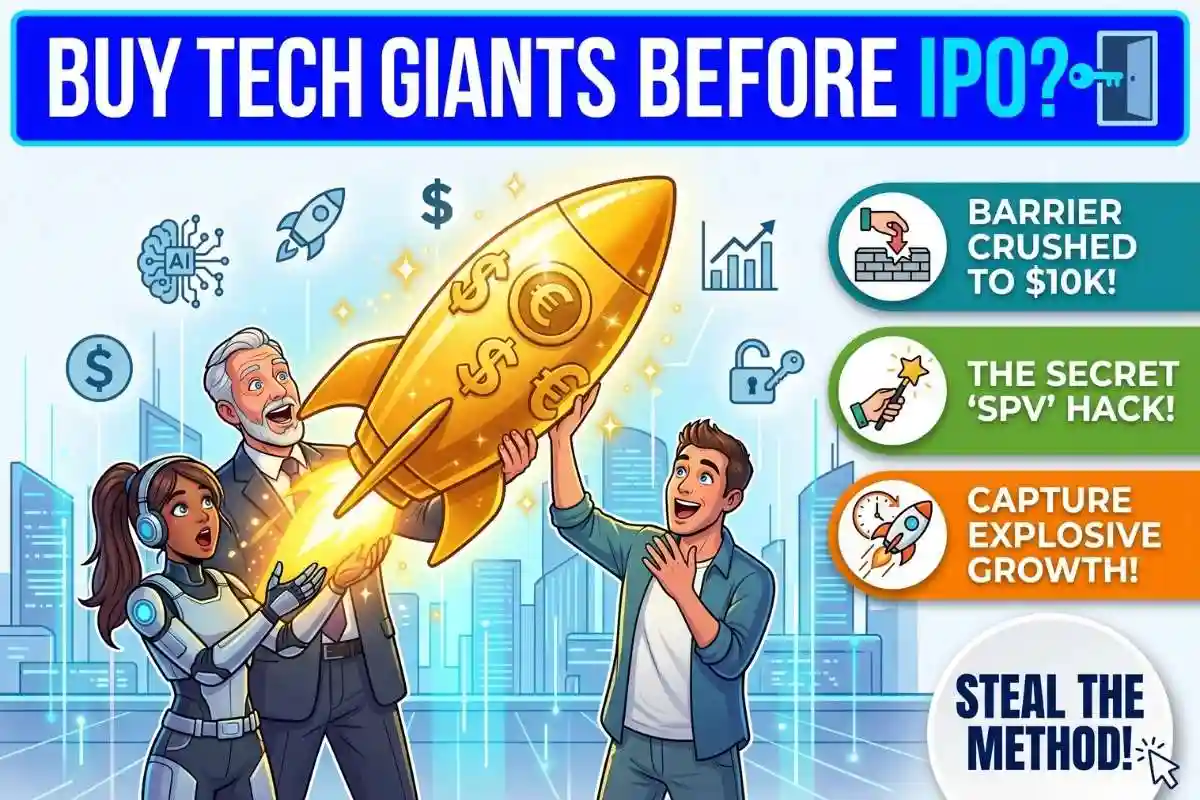
Imagine reading about a revolutionary technology company, knowing it is destined to become the next global behemoth. You want to invest, but there is a major roadblock: the stock is not available to the public. By the time the firm rings the bell at the New York Stock Exchange, early investors have already multiplied their wealth, leaving the retail investor to fight over the remaining scraps at a premium. For decades, this was the frustrating reality for anyone trying to capture the explosive growth of Silicon Valley’s brightest stars. Wealth creation happened behind closed doors, accessible only to venture capitalists and insiders. However, as we navigate 2026, a profound shift has occurred. The pre-IPO secondary market has emerged, offering a secret backdoor for investors to buy into tech giants long before they officially list.
The New Reality of Going Public
In 2010, the median time from a startup’s initial funding to a public offering was about five years. By 2026, that timeline has stretched past a decade. Companies stay private longer, avoiding the harsh regulatory glare, quarterly earnings pressure, and volatility of public stock markets. However, this prolonged incubation creates a severe bottleneck. Founders, early employees, and angel investors find their hard-earned wealth locked away in illiquid shares. They possess incredible paper wealth, yet cannot easily buy a house or fund new ventures. This is where the pre-IPO secondary market steps in. It acts as a pressure release valve, allowing stakeholders to sell equity to outside investors before the company goes public. In 2026, this market has evolved from a niche backroom space into a highly structured, multi-billion-dollar financial ecosystem.
How the Secondary Matchmakers Work
How do you actually buy these private shares? Enter specialized secondary platforms like Forge Global and EquityZen. These platforms function as modern matchmakers in the world of private equity. When an early engineer at a booming AI firm wants to cash out some stock options, they list those exact shares on a secondary marketplace. The platform then pools money from accredited buyers to legally acquire that equity. For the buyer, this means getting a rare slice of a “unicorn” long before the retail public participates. But these transactions are complex and can take months to close. The issuing company usually retains the right of first refusal, meaning they can step in and buy the shares back before an outsider does. Furthermore, you are trading on the secondary market, where the cash goes directly to the seller, not into the company’s operating balance sheet. It requires extreme patience and a strong understanding of how private valuations fluctuate.
Navigating Regulations and Hidden Risks
There is a catch: you usually have to be an “accredited investor” to legally participate. In the United States, the Securities and Exchange Commission (SEC) maintains strict guidelines on who qualifies for this status. Typically, it requires an individual to have a net worth of over $1 million, excluding their primary residence, or a consistently high annual income exceeding $200,000. The SEC enforces these rules because private markets lack the rigorous transparency of public markets. Private companies are not legally obligated to publish quarterly earnings reports, standardized financial statements, or comprehensive risk assessments. You are essentially flying blind compared to the heavily regulated experience of buying a public stock. However, for investors who can successfully stomach the lack of liquidity and high risk, the potential financial rewards are staggering. In 2026, breakthrough companies in artificial intelligence and advanced aerospace are dominating these secondary markets, offering life-changing financial gains.
Why 2026 is the Golden Era
Why is 2026 the golden era for this alternative market? The answer lies in the convergence of powerful macroeconomic trends and technological breakthroughs. After the turbulent economic cycles of the early 2020s, the global IPO market in 2026 is seeing a robust resurgence, but it has become incredibly selective. Investors are hungry for mature, heavily scaled companies rather than risky, cash-burning startups. We are witnessing the dramatic rise of massive private companies valued in the tens of billions, particularly in the AI infrastructure and commercial space sectors. Because these immense companies are taking their time to go public, ensuring they have predictable revenue streams, the pre-IPO secondary market is practically the only logical way in. Secondary trading platforms have also matured, integrating advanced data analytics to better estimate real-time private company valuations. Successfully navigating this space is now an essential strategy for capturing exponential portfolio growth.
The Rise of Special Purpose Vehicles
Another crucial development in 2026 is the innovative use of Special Purpose Vehicles (SPVs) to democratize access to these once-exclusive assets. In the past, buying private tech stock required writing a massive check, often a minimum of $1 million. Today, platforms are cleverly structuring SPVs to pool capital from dozens of smaller accredited investors, effectively lowering the entry barrier to as little as $10,000. When an SPV is formed, it smoothly purchases a large block of shares from a selling founder as a single, unified legal entity. This structure is attractive to the private company because it keeps their official shareholder count low, avoiding mandatory public reporting thresholds imposed by regulators. For the individual investor, it means they can strategically build a diversified portfolio of pre-IPO tech giants without needing the billions of a traditional venture capital firm. This massive structural innovation has breathed incredible new life into the secondary markets.
Comparing the Markets at a Glance
To better understand how this ecosystem differs from traditional investing, here is a breakdown of the primary differences between public markets and pre-IPO secondary platforms in 2026:
| Feature | Traditional Public Market | Pre-IPO Secondary Market |
| Access | Open to anyone with a brokerage account | Mostly restricted to Accredited Investors |
| Liquidity | High (can buy/sell shares in seconds) | Very low (transactions can take 60-90 days) |
| Information | High transparency (mandatory SEC filings) | Low transparency (no public disclosure rules) |
| Investment Minimum | As little as $1 (fractional shares) | Typically $10,000 to $100,000 via SPVs |
| Price Discovery | Real-time pricing via stock exchanges | Opaque, based on last funding rounds |
Frequently Asked Questions (FAQ)
What happens to my pre-IPO shares when the company finally goes public?
When the company officially executes its IPO, your privately held shares will typically convert into public shares. However, there is almost always a strict lock-up period—usually lasting around 180 days—during which early investors and insiders are prohibited from selling their newly public stock to prevent massive price drops on opening day.
Can absolutely anyone buy shares on a pre-IPO secondary marketplace?
No. Due to financial regulations aimed at protecting inexperienced retail buyers from high-risk, illiquid assets, most platforms strictly require you to be an accredited investor. This legal status is meticulously based on specific income or total net worth thresholds that are carefully verified by the trading platforms.
How do secondary trading platforms actually make their money?
Platforms typically charge substantial commission fees on transactions. This can include an upfront management fee (often around 5%) and sometimes a carried interest fee, meaning they take a percentage of the final profits when the company eventually exits through an IPO or an acquisition.
The Final Verdict: A Glimpse into the Future of Wealth
The world of investing is undergoing an irreversible metamorphosis. As we look deeper into 2026, the traditional lines between public and private markets continue to blur rapidly. The old playbook—wait patiently for a company to ring the opening bell on Wall Street, and only then buy the stock—is no longer the most profitable way to build wealth. The pre-IPO secondary market has successfully unlocked a treasure trove of early-stage opportunities, pulling back the heavy curtain on Silicon Valley’s most fiercely guarded financial secrets.
While the legal barriers to entry firmly remain high and the inherent risks of illiquidity are real, the sheer potential to financially back the next transformative AI marvel or commercial space exploration giant is simply too enticing for modern investors to ignore. As complex regulations potentially evolve and brilliant technology makes private valuations drastically more transparent, we may very soon see even greater democratization in this space. For now, fully understanding the intricate mechanics of pre-IPO trading is your ultimate secret weapon—an exclusive backstage pass to the financial future of the tech industry before the rest of the world even buys a ticket.
