


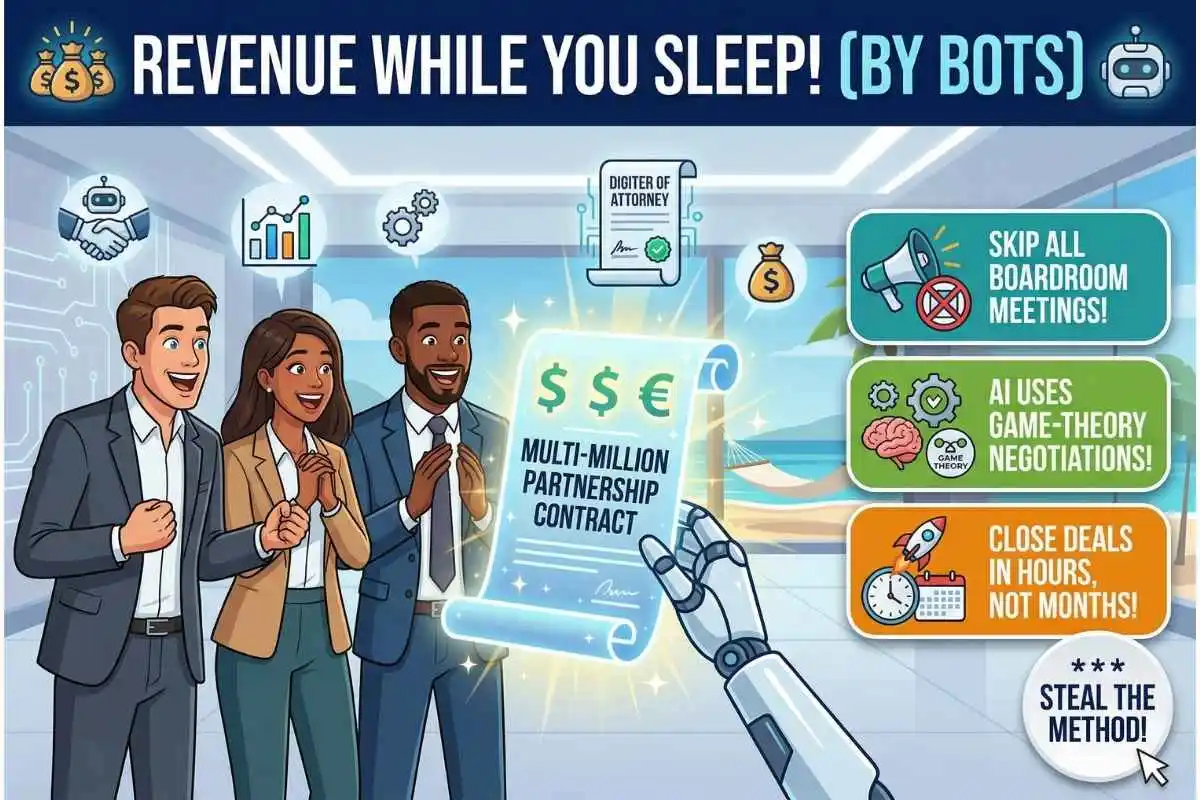
Imagine waking up, brewing coffee, and checking your phone to see a notification that your company secured a multi-million dollar partnership. You didn’t attend a meeting, draft a proposal, or shake any hands. This isn’t a futuristic fantasy; it is the reality for a growing number of executives in 2026. The traditional image of a CEO practically living in the boardroom is rapidly fading, replaced by a new era where autonomous artificial intelligence handles the heavy lifting of corporate negotiations. Welcome to the age of the “Out-of-Office” CEO, where your most aggressive and successful deal closer is a piece of software that never sleeps.
The Evolution of Autonomous Agents
To understand how we arrived at this pivotal moment in corporate history, we have to look back at the rapid evolution of artificial intelligence over the past few years. Just a half-decade ago, businesses were primarily using AI to draft emails, summarize lengthy documents, or generate marketing copy. These tools were essentially highly advanced assistants that still required constant human supervision and direct input for every major decision. However, the paradigm shifted dramatically with the introduction of truly autonomous agentic workflows. These are not your standard chatbots that rely on pre-programmed conversational pathways. Instead, today’s negotiation bots are driven by complex neural networks that can analyze market trends, evaluate the historical behavior of the opposing negotiating party, and dynamically adjust their strategies in real time. They are programmed with specific corporate goals, such as maximizing profit margins or securing long-term supply chain stability, and they pursue these objectives with relentless precision. By analyzing global market data, these bots identify mutually beneficial terms a human might overlook during a stressful meeting. The result is an efficient, emotionless negotiation process yielding better outcomes for bold businesses.
How the Tech Actually Works
Delving deeper into the mechanics of these digital executives, the underlying technology relies heavily on advanced predictive models and complex game theory applications. When two corporate bots enter a virtual negotiation room, they aren’t just exchanging text prompts; they are running thousands of simulations per second. They calculate the probability of the other party accepting various terms based on their known corporate strategies, recent financial filings, and even the sentiment analysis of their public communications. This is a massive leap from the foundational machine learning models of the early 2020s. Today’s systems utilize a sophisticated blend of reinforcement learning from human feedback and unsupervised learning algorithms to constantly refine their bargaining tactics. For those interested in the foundational mechanics of how these systems learn and adapt to opposing strategies, you can explore the extensive history and principles of Game Theory on Wikipedia. The bots simulate every possible counter-offer, mapping out vast decision trees to ensure that any concession made is strategically balanced by a gain elsewhere. Furthermore, they operate without biological constraints like fatigue, ego, or cognitive bias. A bot won’t walk away from a profitable deal due to perceived arrogance, ensuring agreements are based purely on empirical value and strategic alignment.
The Trust Factor and Legal Binding
Of course, delegating high-stakes financial decisions to an algorithm raises significant questions about trust, security, and legal liability. How can a CEO sleep soundly knowing a machine is signing away millions of dollars? The answer lies in the robust integration of blockchain technology and strictly defined smart contracts. Before a bot is ever authorized to negotiate on behalf of a company, its operational boundaries are meticulously coded by legal and financial teams. These “guardrails” dictate the absolute maximums and minimums the bot is allowed to accept, the specific legal clauses that are non-negotiable, and the exact circumstances under which human intervention is required. Once a deal is struck, the agreement is instantly codified into a mathematically verifiable smart contract, leaving an immutable audit trail. Government bodies and regulatory agencies have also had to adapt swiftly to this new reality. Frameworks for AI risk management are now essential reading for any board of directors. To understand how organizations are legally and ethically managing these advanced systems, the NIST AI Risk Management Framework provides critical guidelines that top-tier companies use to audit their autonomous agents. Adhering to strict regulatory frameworks ensures digital deal-makers operate legally and securely, mitigating risks associated with rogue algorithms making unauthorized commitments.
Real-World Success Stories
The transition from theory to practice has been startlingly rapid across several major industries, particularly in logistics, supply chain management, and enterprise software procurement. Consider the manufacturing sector, where raw material prices fluctuate wildly based on geopolitical events and environmental factors. Instead of employing a team of procurement officers to constantly monitor the global steel or silicon markets, forward-thinking manufacturing firms now deploy fleets of autonomous procurement bots. These bots continuously negotiate micro-contracts with global suppliers, locking in prices during brief market dips and seamlessly shifting vendors if a better deal emerges. In the enterprise software space, major tech companies are using “sales bots” to negotiate licensing renewals with thousands of clients simultaneously. These bots can offer personalized, dynamic pricing tiers based on a specific client’s usage data, a level of customization that would be logistically impossible for a human sales team to manage. The success stories are piling up, with early adopters reporting a dramatic decrease in the time it takes to close complex enterprise deals—shrinking what used to be a six-month back-and-forth process down to a matter of hours or days. This efficiency not only saves money but also frees up human executives to focus on creative strategy, leadership, and vision, rather than getting bogged down in the minutiae of contract redlining.
The Data: Then vs. Now
To truly grasp the magnitude of this shift, it helps to compare the capabilities of AI assistants from just a couple of years ago to the autonomous deal-closing bots of 2026.
| Feature | 2024 AI Assistants | 2026 Autonomous Bots |
| Primary Role | Drafting text, summarizing data | Executing strategy, closing deals |
| Negotiation Style | Scripted, suggestion-based | Dynamic, game-theory optimized |
| Operational Speed | Requires human approval steps | Millisecond micro-transactions |
| Emotional Bias | Subject to human operator’s mood | Zero emotional interference |
| Legal Authority | None (advisory only) | Fully authorized via smart contracts |
Frequently Asked Questions
Can an AI legally bind my company to a contract? Yes, provided the proper legal frameworks are in place. In 2026, corporate law in many jurisdictions recognizes smart contracts executed by authorized digital agents as legally binding. The key is that the company’s human leadership has explicitly granted the bot a “digital power of attorney” within strictly defined parameters, ensuring the bot cannot exceed its authorized budgetary or strategic limits.
What happens if two bots get stuck in an endless loop during negotiations? Early models occasionally suffered from this “stalemate loop,” but modern bots are equipped with sophisticated deadlock-resolution protocols. If neither bot can find a mutually agreeable mathematical middle ground within a specified timeframe, they are programmed to escalate the issue. The bots will automatically flag the impasse, summarize the blocking points, and transition the negotiation to their respective human supervisors for a final decision.
Will human salespeople and executive negotiators lose their jobs entirely? Not entirely, but their roles are radically transforming. The bots handle the tedious, data-heavy, and transactional aspects of deal-making. This shift forces human executives to pivot toward relationship building, high-level strategic planning, and nuanced dispute resolution. Empathy, trust, and creative vision remain uniquely human traits that no algorithm has managed to replicate, making human oversight more crucial than ever.
The Curiosity: Welcome to the Phantom Boardroom
As we look toward the horizon of corporate governance, a fascinating new phenomenon is emerging: the “Phantom Boardroom.” Imagine a virtual space where avatars representing the world’s top companies meet to trade resources, license software, and merge operations without a single human logging in. These digital ecosystems operate at a speed and efficiency that biological life simply cannot match, creating micro-economies that fluctuate and stabilize in fractions of a second. While you are sleeping, enjoying a weekend hike, or relaxing on a beach, your digital counterpart is out there advocating for your business interests with tireless dedication. The out-of-office CEO isn’t a symbol of neglect; it is the ultimate badge of technological optimization. The future of business isn’t about working harder, but delegating smarter to the algorithms.

