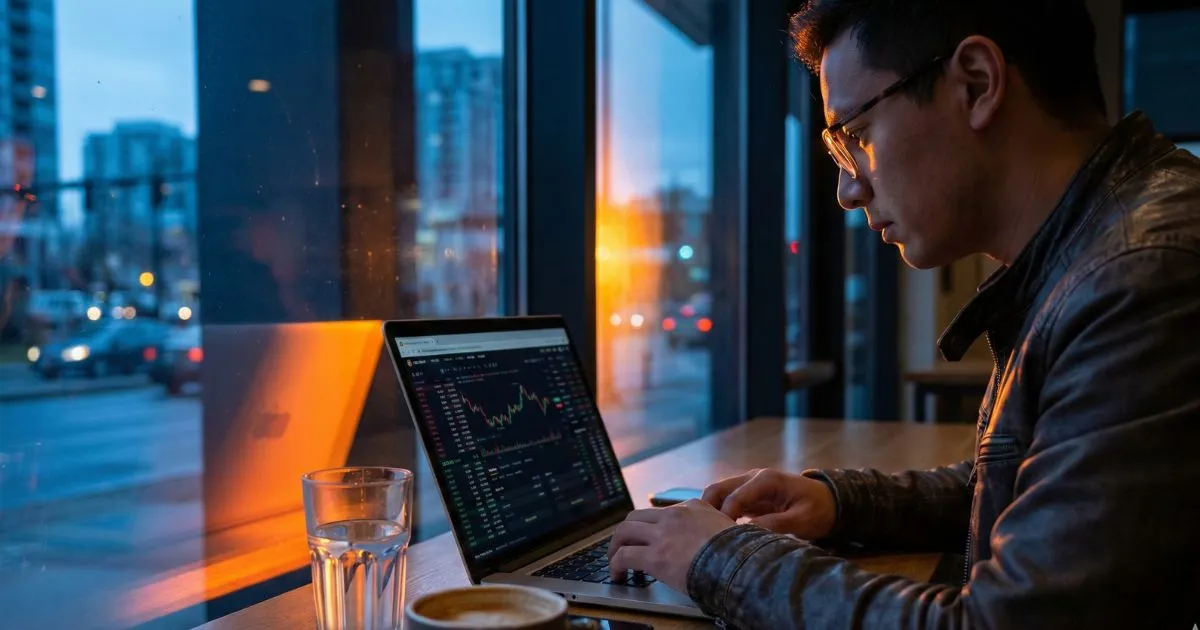
I was sitting in a dimly lit corner of a coffee shop last Tuesday, watching the sunrise flicker against the glass of my laptop, when the first alerts for the Coinbase premarket began to roll in. There is a specific kind of quiet tension in those early hours, a digital pulse that most people sleep through, where the numbers on a screen feel less like data and more like a heartbeat. We often talk about the financial markets as these monolithic, cold entities, but when you watch the way Coinbase moves before the opening bell, you realize it is more of a living organism, reacting to the whispers of global sentiment before the rest of the world has even had their first espresso.
It is no longer enough to call it a crypto exchange. That label feels dusty now, like calling a smartphone a fancy calculator. We are witnessing a transition that is far more ambitious and, frankly, a bit more chaotic than the sterile press releases suggest. The goal is clear, they want to be the primary financial account for the modern age. It is a bold, perhaps even arrogant, play to centralize a decentralized revolution. But as I watched the tickers flip, it became evident that the traditional walls between asset classes are not just cracking, they are being systematically dismantled.
The Synthetic Pulse of Coinbase Prediction Markets
There is something inherently human about a wager. Long before we had complex derivatives or high frequency trading, we had the instinct to back our own perspective on what happens next. The introduction of coinbase prediction markets feels like a return to those roots, albeit wrapped in high-grade encryption and institutional liquidity. It is not just about betting on an election or the price of a commodity, it is about the commodification of truth. When you trade on a prediction market, you aren’t buying a share of a company, you are buying a piece of a probable future.
I find myself lingering on the implications of this for hours. If the market is a giant machine for processing information, then these event-based contracts are the most direct sensors we have ever built. They strip away the noise of P/E ratios and management guidance, leaving only the raw probability of an outcome. For the modern investor, this isn’t just a new feature in an app, it is a new way to hedge against the reality of a world that feels increasingly unpredictable. You can feel the shift in the air. People are tired of being passive observers of the macro economy. They want to put their capital where their convictions are, even if those convictions are as granular as the weather in a specific shipping corridor or the next move of a central bank.
The marriage between traditional finance and these new speculative instruments is messy. It lacks the clean lines of a bond ladder or the predictability of a dividend aristocrat. But in that messiness, there is opportunity. We are seeing a generation of traders who don’t see a distinction between holding a piece of a blockchain and holding a contract on the outcome of a trade war. To them, it is all just risk, and risk is the only thing that has ever really mattered in the pursuit of growth.
Navigating the Shadow of Giants Like MSFT Stock
It is impossible to discuss the trajectory of a modern financial powerhouse without looking at the titans that paved the way. I often find myself comparing the current land grab in fintech to the way Microsoft established its dominance decades ago. When you look at MSFT stock today, you aren’t just looking at a software company, you are looking at the foundational plumbing of the global economy. They are the invisible hand in every office, every cloud server, and every AI model.
The irony is that while one represents the legacy of centralized productivity, the other represents the vanguard of the new frontier. Yet, they are beginning to rhyme. The way the market reacts to Microsoft’s earnings reports often sets the tone for the entire tech sector, creating a gravity that even the most rebellious crypto assets cannot fully escape. There is a deep, underlying correlation that most retail investors miss. When the big tech engines hum, the appetite for riskier, more innovative platforms tends to swell. It is a symbiotic relationship born of necessity. One provides the stability and the infrastructure, while the other provides the volatility and the dream of the “ten bagger.”
I remember a conversation with a mentor who once told me that the best businesses are the ones that become a habit. Microsoft became a habit for the enterprise. The current struggle for any emerging financial platform is to become a habit for the individual. This is why the pre-market movements are so telling. They show us who is still awake, who is paying attention, and who is willing to move before the safety of the herd arrives. It is a high stakes game of musical chairs played in the dark, and the music is getting faster.
There is a certain irony in the fact that we use such advanced tools to try and predict the most basic human behaviors. We build complex algorithms to parse the Coinbase premarket data, seeking some hidden signal that will tell us when to buy or when to walk away. But at the end of the day, the market is just a reflection of our collective hope and fear. It is a mirror held up to the world, and sometimes we don’t like what we see.
The shift toward a unified financial interface is inevitable, but it comes with a cost. We are trading the clarity of specialized silos for the convenience of a “do it all” dashboard. There is a risk that in trying to be everything to everyone, these platforms lose the very thing that made them special in the first place. The grit, the transparency, and the sense of being part of something outside the system are being polished away in favor of corporate compliance and user retention metrics.
Yet, I can’t help but be fascinated by the sheer scale of the ambition. To create a space where you can manage your crypto, your equities, and your bets on the future in one place is a monumental engineering feat. It is a far cry from the days of calling a broker on a landline or waiting for a physical ticker tape. We are living in the era of the instant, where a tweet can move a billion dollars and a prediction market can provide a more accurate forecast than a room full of PhDs.
As the sun finally climbs high enough to wash out the glow of my screen, the regular market session begins. The noise increases, the volume spikes, and the quiet clarity of the early morning is lost. But the questions remain. Where does the edge lie when everyone has the same tools? How do you find value in a world that is being priced to perfection in real time? Perhaps the answer isn’t in the data at all, but in the ability to step back and see the patterns that everyone else is too busy to notice.
The future of finance isn’t going to be found in a single asset or a single platform. It is going to be found in the intersections. It is in the space between the traditional stability of the old guard and the frantic innovation of the new. It is in the way we choose to navigate a world where the only constant is change, and the only certainty is that someone, somewhere, is already betting on what happens tomorrow.