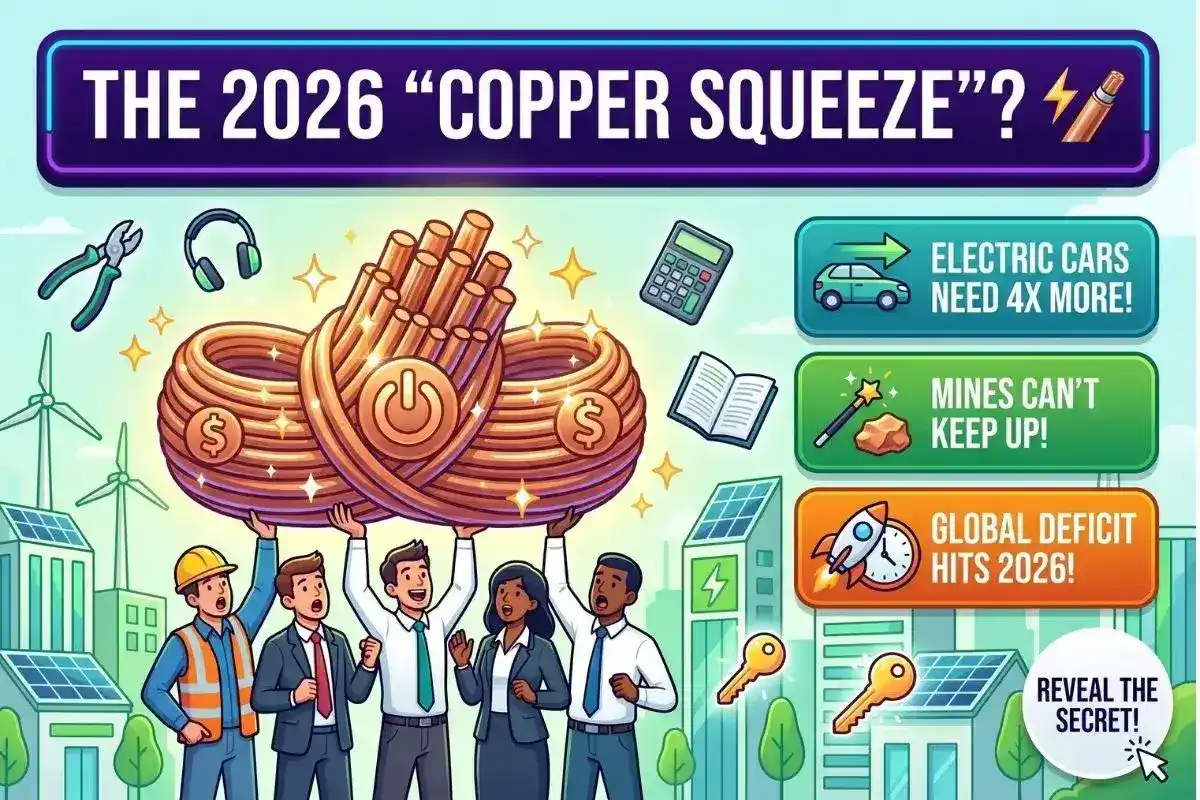
Picture the future. Sleek electric vehicles are gliding silently down the street, massive offshore wind turbines are spinning gracefully in the ocean breeze, and residential rooftops are glittering with highly efficient solar panels. It looks like a high-tech, carbon-free utopia, driven by cutting-edge software algorithms and revolutionary lithium batteries. But beneath the shiny, modern exterior of this green energy transition lies a decidedly old-school reality. The entire system—every spinning turbine blade, every fast-charging station, every mile of upgraded electrical grid—relies almost entirely on one ancient, reddish-brown element that humanity has been pulling out of the dirt for thousands of years. Welcome to the era of copper. As we hurtle toward the pivotal year of 2026, a critical timeline for global climate goals, the world is waking up to a startling mathematical problem. We desperately want to electrify everything, but we might not have enough of the very metal that makes mass electrification possible. This looming shortage, often whispered about in commodity markets as the “copper squeeze,” is threatening to turn the humble penny metal into the new digital gold, dramatically reshaping global economies in its wake.
The Invisible Backbone of the Green Economy
To truly understand why copper has suddenly become the most critical puzzle piece in our modern world, we have to look closely at what the energy transition actually entails. At its core, moving away from fossil fuels simply means moving toward electricity. Whether we are capturing the kinetic energy of the wind or harnessing the raw radiation of the sun, that power is utterly useless if we cannot move it from where it is generated to where it is consumed. Copper is the undisputed champion of moving electrical current safely, efficiently, and affordably. Second only to silver in pure electrical conductivity—but vastly more abundant and practical for industrial scale—copper is the invisible nervous system of the green economy. If you were to peel back the sleek exterior of a modern electric vehicle, you would not just find a giant battery; you would find a staggering amount of copper wiring winding its way through the motors, the charging ports, and the internal electronics. A traditional gasoline-powered car contains roughly forty pounds of copper. An electric vehicle, on the other hand, requires anywhere from three to four times that amount. Multiply that single electric car by the tens of millions expected to hit the roads by the end of the decade, add the massive underground cables required to upgrade our aging power grids, and the demand curve goes almost completely vertical.
The Geological Wall: Why We Can’t Just Dig Faster
When faced with a sudden surge in demand for any commodity, the standard economic response is simple: just produce more of it. If we need more wheat, we plant more fields; if we need more microchips, we build more factories. But the earth’s crust does not care about our economic models, our political promises, or our climate deadlines. Finding and extracting copper is an incredibly slow, capital-intensive, and geologically stubborn process. You cannot simply flip a switch and double global copper production overnight. Industry experts point out that it takes an average of ten to fifteen years to take a new copper mine from the initial discovery phase all the way to actual commercial production. Furthermore, the mines currently supplying the bulk of the world’s copper are aging rapidly. They have been heavily exploited for decades, and the easy-to-reach, high-quality ore has largely been scooped up. Today, miners are forced to dig deeper, process significantly more rock, and use vastly more energy just to extract the exact same amount of refined copper. According to the authoritative mineral data provided by the U.S. Geological Survey (USGS), the economic and environmental costs of extracting these vital reserves are rising exponentially. We are hitting a harsh geological wall just as our need to scale over it reaches a fever pitch.
The 2026 Collision Course
So, why is the year 2026 repeatedly circled in red ink on the calendars of energy analysts, commodity traders, and government planners? The answer lies in a perfect storm of delayed investments, accelerating climate mandates, and the unforgiving math of supply deficits. During the mid-2010s, global copper prices experienced a prolonged slump, which severely discouraged major mining conglomerates from investing in expensive new exploration and infrastructure projects. Because of that decade-long lag in development, the pipeline of new major copper projects slated to come online in the near future is alarmingly thin. Fast forward to the present day, and governments around the world are pouring trillions of dollars into green infrastructure, setting aggressive legal mandates to phase out combustion engines. By 2026, the compounding effect of these massive, government-backed infrastructure pushes will begin drawing down global copper reserves at an unprecedented rate. Analysts predict this is the precise window where the structural deficit—the undeniable gap between what the world absolutely needs and what the mining industry can physically deliver—will widen past the point of no return. As detailed in historical overviews of global copper extraction, when a critical commodity enters a severe deficit, the cost of everything from household solar panels to new electric cars can spike violently, threatening to stall the transition.
The Geopolitical Chessboard
As the reality of this impending “copper squeeze” sets in, the metal is rapidly transforming from a simple industrial building block into a critical strategic asset, fundamentally redrawing the map of global geopolitics. Currently, the geography of raw copper is highly concentrated and uniquely vulnerable. The lion’s share of the world’s raw copper is pulled from the earth in just two countries: Chile and Peru. Political instability, labor disputes, or changing environmental regulations in either of these South American nations can instantly send shockwaves through the global supply chain. However, pulling the raw rock out of the ground is only half the battle. The raw ore must be smelted and refined into the pure, conductive metal required for advanced electronics. Over the past two decades, China has aggressively positioned itself as the undisputed king of copper processing, handling a staggering percentage of the world’s refining capacity. The United States and Europe are suddenly realizing that their dreams of green energy independence rely heavily on a supply chain beginning in the volatile Andes and funneling directly through refineries controlled by a major economic rival. As 2026 approaches, Western nations are fiercely scrambling to secure domestic supplies and build local processing facilities to avoid being left empty-handed.
The Green Copper Demand Data
Understanding the magnitude of the “copper squeeze” is easiest when you look directly at the raw data. The table below illustrates the stark difference in copper requirements between traditional technologies and their green alternatives.
| Technology Type | Average Copper Required | Primary Reason for Usage |
| Conventional Gas Car | ~48 lbs (22 kg) | Starter motor, standard electrical wiring. |
| Electric Vehicle (EV) | ~183 lbs (83 kg) | Large electric drive motors, heavy-duty battery wiring. |
| Fossil Fuel Power Plant | ~1 ton per Megawatt | Traditional generators and basic plant infrastructure. |
| Offshore Wind Farm | ~8 tons per Megawatt | Massive turbine generators, extensive undersea transmission cables. |
Frequently Asked Questions About the Copper Squeeze
Can we substitute copper with other, cheaper metals like aluminum? While aluminum is significantly cheaper and lighter than copper, it is only about 60% as conductive. To carry the same amount of electrical current, an aluminum cable must be much thicker than a copper one. This makes aluminum entirely unsuitable for the compact, high-efficiency motors needed in electric vehicles, wind turbines, or small consumer electronics, though it is sometimes used in overhead power lines.
Is recycling the ultimate answer to the copper shortage? Recycling is a crucial part of the puzzle, but it simply isn’t enough on its own. Global demand is growing at such an aggressive pace that even if humanity managed to perfectly recycle 100% of the copper currently in circulation, we would still fall dramatically short of the massive new quantities required to build out the infrastructure for the global energy transition.
Will the 2026 copper squeeze completely stop the green energy transition? It will not stop the transition entirely, but a severe shortage will undoubtedly slow it down. When copper prices skyrocket due to a supply squeeze, the cost of manufacturing green technologies rises in tandem. This makes electric vehicles and renewable energy installations more expensive for everyday consumers, which is why securing new, reliable supply chains is now considered a top national security priority for many nations.
Curiosity and Conclusion: The Ultimate Renewable Metal
Did you know that copper is practically immortal? It is infinitely recyclable without losing a single drop of its original physical or chemical properties. It is estimated that nearly 80% of all the copper ever mined throughout the entirety of human history is still in active use today. The very same copper atoms that were once shaped into ancient Roman coins or utilized in early Egyptian plumbing could literally be spinning inside the motor of your brand-new electric vehicle right now.
As we look toward 2026 and beyond, the narrative is crystal clear. Our high-tech, low-carbon future is tethered to a very old, very terrestrial reality. Navigating the impending “copper squeeze” will require incredible technological innovation, delicate geopolitical diplomacy, and a deep, renewed respect for the earth’s absolute limits. The reliable reddish metal that helped bring humanity out of the Stone Age is now, quite literally, the only thing that can successfully carry us into the green age.