


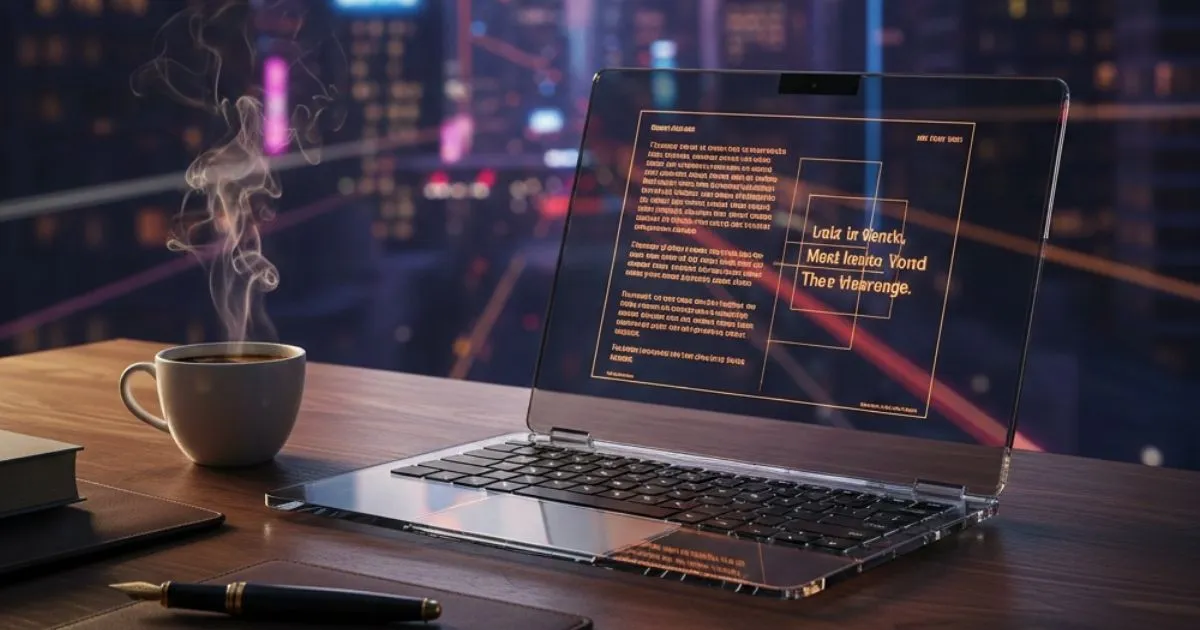
I remember sitting in a dimly lit corner of a Soho cafe back in 2024, watching a colleague try to “fix” a memoir using the early, clunky versions of generative text. The result was a sterile, plastic-wrapped version of a life that deserved better. Fast forward to early 2026, and the landscape has shifted so violently it is hard to recognize. We have moved past the era of the robot-sounding assistant into something far more seductive and dangerous: the era of the invisible editor. These days, The Clean Prose AI is not just a tool, it is a whisperer that can smooth out your rough edges until there is nothing left for a reader to grab onto. It is a strange time to be a writer in the finance space or even a novelist, where the pressure to produce is immense, but the cost of losing your soul to an algorithm has never been higher.
The temptation is real. You have a massive manuscript, maybe a deep dive into the shifting liquidity of decentralized markets or a complex historical narrative, and it feels like a tangled mess of fishing line. You plug it into an AI Prose Editor, and within seconds, the syntax is perfect. The cadence is rhythmic. The grammar is beyond reproach. But something is missing. That jagged, idiosyncratic spark that makes a person trust your voice is gone, replaced by a mathematically averaged version of “good writing.” I have spent the last few months trying to find the middle ground, that thin line where technology serves the story without becoming the storyteller. It is a delicate dance between the efficiency of a machine and the messy reality of a human mind.
Mastering the AI Prose Editor Without Losing the Spark
The secret to using these high-level tools effectively in 2026 is to treat them like a brilliant, slightly literal-minded intern rather than a master architect. When I load a chapter into a modern AI Prose Editor, I am not looking for it to tell me what to say. I am looking for it to show me where I am being lazy. We all have those linguistic crutches, those phrases we lean on when we are tired or uninspired. The machine is incredible at spotting those patterns. However, if you let it “optimize” the text without a firm hand on the wheel, it will strip away the very things that make you, well, you. It might see a long, wandering sentence that mimics the confusion of a market crash and try to break it into three neat, tidy boxes. You have to be willing to tell the machine no.
One of the most effective ways I have found to keep the human element alive is to feed the editor specific instructions about my “anti-logic.” I tell it to preserve my sentence fragments. I demand that it leaves my occasional run-on sentences alone if they serve a specific emotional beat. In the finance niche, where everything can so easily become dry and academic, these stylistic choices are the only things that keep a reader engaged. If your prose is too clean, it feels like a corporate earnings report. People do not buy books or hire agencies because they want perfection; they do it because they feel a connection to a specific perspective. That perspective is found in the imperfections, the slight tilts in tone, and the unconventional metaphors that an algorithm would never choose on its own.
Author Productivity and the New Era of Book Editing 2026
We are seeing a massive surge in author productivity because of these tools, but I often wonder if we are just producing a higher volume of forgettable content. In the current market, especially as we look at the listings on platforms like Flippa or the portfolios of high-end content agencies, the value is shifting. It is no longer about who can write the most words; it is about who can provide the most unique insight. Book editing 2026 is less about fixing commas and more about preserving the “voice-print” of the creator. When I work on a manuscript now, I spend more time auditing what the AI changed than I do writing the original draft. It is a process of reclamation. I am looking for the moments where the software smoothed over a sharp opinion or softened a controversial take to make it more “marketable.”
The most productive writers I know this year are the ones who use technology to handle the structural heavy lifting. They use it to track character arcs across eight hundred pages or to ensure that a complex financial theory is explained consistently from chapter one to chapter twenty. They are not letting the AI touch the “skin” of the prose until the very end, and even then, it is with a light touch. There is a specific kind of fatigue that sets in when you read a book that has been over-edited by an algorithm. It is like looking at a face that has had too much plastic surgery; you can tell it is supposed to be beautiful, but it feels uncanny and cold. To avoid this, I always do a final “voice pass” entirely by hand, reading the words aloud to make sure they still sound like they came from a human throat, not a server farm in Virginia.
The future of writing isn’t about human versus machine; it is about how we integrate these systems without becoming secondary to them. We are in a transition period where the ability to “de-clutter” a manuscript is a superpower, but only if you know what to keep. The clutter is often where the personality lives. If you strip away every digression and every unusual word choice in the name of clarity, you end up with a text that is easy to read but impossible to remember. As we move deeper into 2026, the real winners in the publishing and finance world will be the ones who can use a Clean Prose AI to sharpen their tools while keeping their hands dirty.
There is a strange comfort in knowing that despite all the processing power at our fingertips, the most valuable thing we have is still our own flawed, biased, and brilliantly messy way of seeing the world. The machine can simulate many things, but it cannot simulate the weight of a lived experience or the specific way a heart sinks when a long-shot investment fails. It can’t feel the humidity of a summer afternoon that sets the scene for a pivotal chapter. It can only guess. And as writers, our job is to make sure the reader never has to guess if there is a person on the other side of the page.
How do we decide which parts of our work are “safe” to hand over to the algorithms? Perhaps the answer lies in the parts we are most afraid to show anyone else. Those are the parts the machine will never understand, and those are the parts that matter most.

