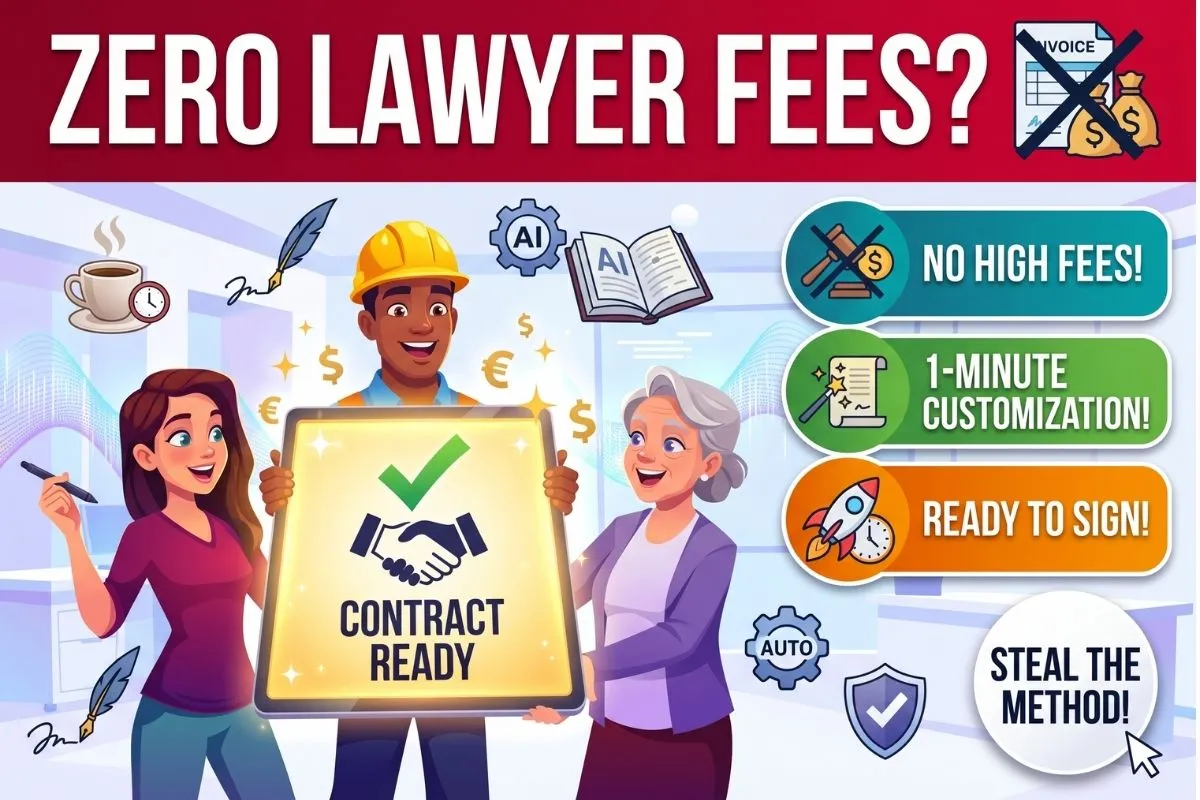
Imagine needing a non-disclosure agreement, a freelance service contract, or a commercial lease, and having it perfectly tailored, accurately formatted, and completely ready to sign before your morning coffee finishes brewing. For decades, the legal world was a walled garden guarded by high hourly rates and incomprehensible jargon. Everyday people and small business owners were forced to choose between risking their livelihoods with flimsy internet templates or emptying their wallets for basic legal protection. Today, a revolution is underway. The era of the “1-minute contract” has arrived, completely transforming how we handle everyday legal tasks and giving everyone the power to generate reliable, customized legal documents without spending a dime.
The Rise of the Everyday Legal Assistant
To truly understand the impact of modern AI Legal Tech, let us look at the story of an everyday entrepreneur. Picture a freelance graphic designer named Sarah who just landed the biggest client of her career. In the past, the moment of celebration would be instantly overshadowed by a dark cloud of anxiety. She needs a solid contract to protect her intellectual property, ensure timely payments, and define the scope of her work. Hiring a traditional lawyer to draft this specific agreement could cost her upwards of five hundred dollars—money she desperately needs to invest in new software and equipment. Instead, Sarah turns to an artificial intelligence platform designed specifically for legal drafting. By simply typing a plain-English prompt like, “I need a freelance design contract for a branding project in California, with a 50% upfront deposit and a kill fee,” the AI goes to work. Within sixty seconds, the platform generates a comprehensive, legally sound document that addresses her specific state laws and personal requirements. This isn’t just a generic template with blank spaces; it is a dynamic, context-aware document that understands the nuances of her request. This breakthrough in AI Legal Tech is leveling the playing field, ensuring that independent workers and everyday citizens have the exact same foundational legal protections as massive corporate entities, all without the traditional financial barriers that once kept them vulnerable.
Navigating the Maze of New Business Rules
Beyond simple freelance agreements, the landscape of starting and running a company is notoriously fraught with regulatory landmines. For new founders, the concept of startup compliance can feel like an impossible puzzle designed to ensure they fail. You have to worry about employee classification, data privacy policies, terms of service, and a myriad of local and federal regulations that seem to change by the day. Historically, a simple oversight in a privacy policy or a poorly worded employment contract could lead to devastating fines or crippling lawsuits that would end a business before it even got off the ground. The modern 1-minute contract generators are specifically trained on vast databases of case law, regulatory frameworks, and compliance standards. When a founder uses these systems to draft their initial paperwork, the AI acts as an invisible shield, automatically embedding the necessary compliance clauses based on the company’s location and industry. It takes the terrifying, abstract concept of startup compliance and distills it into an actionable, automated checklist. Founders no longer have to spend sleepless nights wondering if their terms of service violate a newly passed digital privacy act; the AI continuously updates its knowledge base, ensuring that the documents it generates reflect the most current legal realities, saving founders both their sanity and their startup capital.
A Shift in the Corporate Paradigm
As we look toward the future of work and business management, the traditional model of keeping an expensive attorney on a permanent retainer is rapidly becoming obsolete. We are currently witnessing the massive rise of fractional legal 2026, a trend where companies only pay for the exact legal expertise they need, precisely when they need it, rather than paying for idle hours. Artificial intelligence is the primary engine driving this massive shift. Because AI handles the heavy lifting of drafting routine contracts, drafting boilerplate agreements, and conducting basic legal research, the role of the human lawyer is fundamentally changing. Businesses are now utilizing AI for ninety percent of their standard legal paperwork—things like vendor agreements, basic NDAs, and standard employment offers. When they do need a human attorney, they hire them on a fractional, part-time basis purely for complex strategy, high-stakes negotiation, or nuanced legal counseling that requires a human touch. This hybrid approach of fractional legal 2026 means that high-level legal strategy is no longer a luxury reserved for Fortune 500 companies. Small to mid-sized businesses can now afford elite legal guidance because they are no longer wasting their budget paying an attorney to manually type out a standard non-compete clause. The AI handles the busywork, and the fractional human lawyer handles the strategy.
The Mechanics Behind the Magic
You might be wondering how a machine can possibly understand the complexities of the law well enough to draft a binding agreement. The secret lies in advanced natural language processing and deep learning algorithms that have ingested millions of court documents, established contracts, and legal statutes. When you ask the AI for a specific document, it doesn’t just copy and paste paragraphs; it fundamentally understands the semantic relationship between different legal concepts. According to Wikipedia’s comprehensive overview of Artificial Intelligence and Law, these systems utilize computational models of legal reasoning, allowing them to structure arguments, recognize precedents, and assemble clauses that are logically sound and legally consistent. The AI evaluates the entities involved, the jurisdiction, the obligations, and the potential liabilities, weaving them together into a cohesive document. Furthermore, these platforms often use decision trees that prompt the user with clarifying questions if their initial request is too vague. If you ask for a “sales contract,” the AI will politely ask what you are selling, where the buyer is located, and what your return policy is before it generates the text. This interactive process ensures that the resulting 1-minute contract is not just fast, but highly accurate and deeply tailored to the specific factual scenario of the user.
Safety, Enforceability, and Human Oversight
Despite the incredible convenience and speed of these tools, it is vital to understand their limitations and how to use them responsibly. A contract generated by an AI is indeed legally binding once signed by all parties, provided it meets the basic elements of a contract under the law: offer, acceptance, and consideration. However, artificial intelligence is not a licensed attorney, and using it does not constitute formal legal advice. For highly complex, multi-million dollar mergers or deeply contentious legal battles, relying solely on a free AI tool would be incredibly risky. Furthermore, users must ensure they are operating within the actual legal requirements of their specific jurisdiction. The Small Business Administration (SBA.gov) provides extensive guidelines on staying legally compliant, reminding business owners that while tools can assist in drafting, the ultimate responsibility for compliance rests on the human running the company. The best way to view AI legal drafting is as an immensely powerful first draft. It gets you 95% of the way there in one minute, completely for free. For standard, low-risk agreements, that 95% is usually more than enough. For high-stakes situations, you take that AI-generated draft to your fractional attorney, saving them hours of billing time and saving yourself a small fortune.
Data Comparison: Traditional vs. AI Drafting
To illustrate just how transformative this technology is, let’s look at a direct comparison between the traditional method of obtaining a basic contract and the new AI-driven approach.
| Feature | Traditional Lawyer Drafting | AI Legal Tech Drafting |
| Average Cost | $250 – $1,000+ per document | $0 – $20 (Subscription) |
| Turnaround Time | 3 to 14 days | Less than 1 minute |
| Customization | Very High (Human tailored) | High (Prompt tailored) |
| Accessibility | Low (Requires appointments) | Immediate (24/7 online access) |
| Best Used For | Complex negotiations, bespoke strategy | Standard NDAs, simple leases, freelance terms |
Frequently Asked Questions
Is a contract written by AI actually legally binding in court? Yes. In the eyes of the law, what makes a contract binding is not who (or what) typed the words, but whether the document contains an offer, acceptance, mutual agreement, and consideration (something of value exchanged). As long as the AI-generated text meets these criteria and is properly signed by the parties, it is fully enforceable.
What happens if the AI makes a legal mistake in my document? This is why human review is still encouraged. Because AI platforms are software tools and not licensed attorneys, they do not carry malpractice insurance. If a clause is poorly drafted and costs you money, you cannot sue the AI. It is highly recommended to read the generated document carefully and ensure it reflects your actual intentions before signing.
Will AI entirely replace human lawyers? No. While AI is rapidly replacing the administrative and drafting portions of legal work, human lawyers are still essential for courtroom litigation, nuanced negotiations, emotional intelligence, and high-level strategic counseling. AI handles the paperwork so humans can handle the people.
A Final Curiosity
Did you know that the history of the contract dates back to ancient Mesopotamia, over 4,000 years ago? Back then, agreements for the sale of livestock or grain were painstakingly etched into heavy clay tablets using a stylus, baked in the sun, and stored in temples. It could take days to finalize a simple trade agreement. Today, we are essentially doing the exact same thing—defining the rules of our human interactions and trades—but instead of clay and sun, we are using neural networks and cloud computing to do it in under sixty seconds. The medium has changed drastically, but the human need for clarity, protection, and agreement remains exactly the same.