


The Shockwave: How Headline Beats Failed to Mask Financial Rot at Sunrun
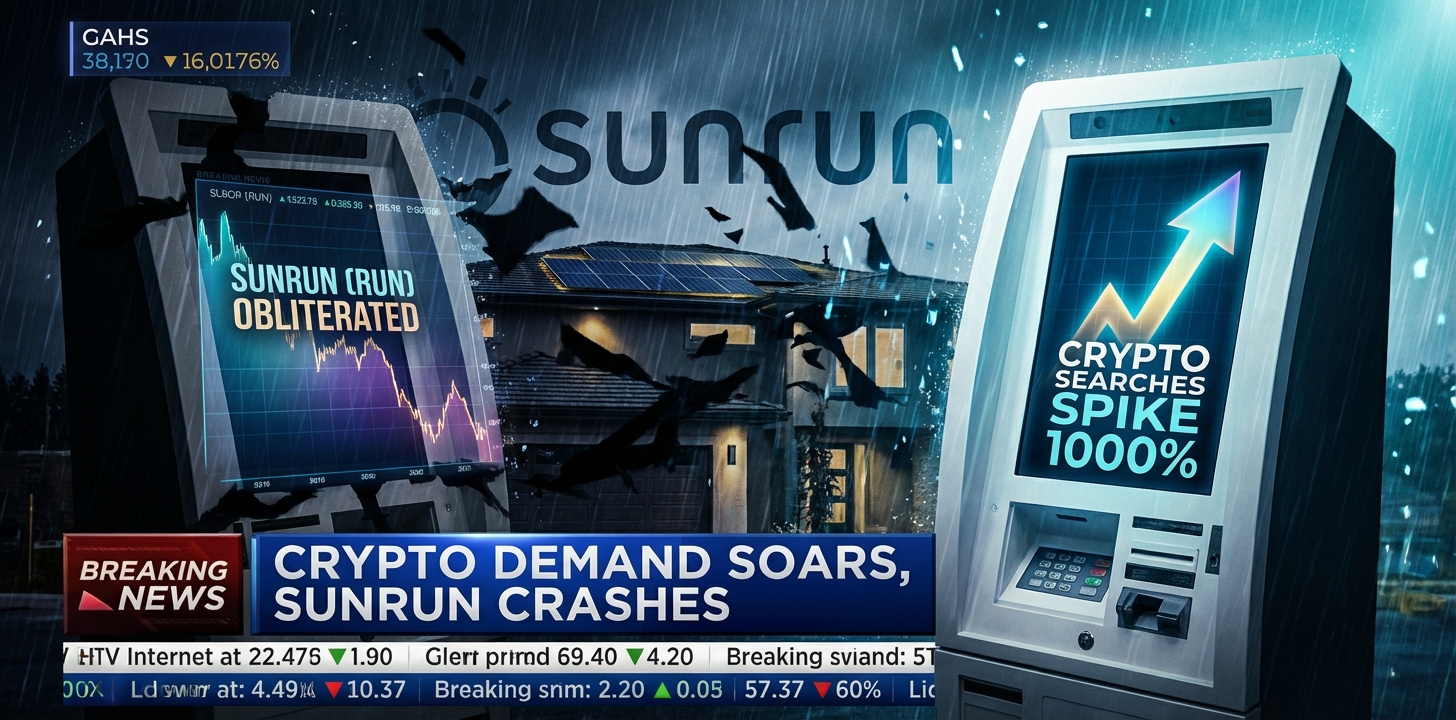
The financial world witnessed a spectacular midday implosion for Sunrun (RUN) shares this week, a dramatic 36.1% plunge that served as a brutal reminder that in modern markets, narrative often loses to the ledger. On the surface, the numbers looked like a victory lap for the residential solar titan. They posted fourth-quarter revenue soaring 124% year-over-year to an impressive $1.16 billion, even managing a surprise profit of $0.38 per share against Wall Street’s expectations for a loss. This should have been a catalyst for celebration, a confirmation that the green energy revolution was finally hitting peak monetization. Instead, the market, possessing an unnerving foresight, zeroed in on the fine print—or rather, the terrifying trajectory of the forward guidance and the immediate cash drain.
Investors, the hardened observers of market physics, swiftly discarded the fleeting thrill of the beat and anchored themselves to the frightening projections. Analysts forecast a significant 13% revenue decline over the coming year, signaling a sharp deceleration in growth that few anticipated after such explosive headline figures. More critically, they expected Sunrun to revert to negative earnings per share, suggesting the momentary profitability was an anomaly, not a sustainable trend. The real poison pill, however, was buried deep in the cash flow statement: negative free cash flow ballooning to $312.7 million for the quarter. For a company relying on massive upfront capital to install solar infrastructure and secure customer contracts, burning through cash at this accelerated rate, especially while saddled with significant existing debt, paints a picture of acute financial stress. This single dynamic—the discrepancy between present revenue success and future solvency fears—is what wiped out billions in market capitalization in a single afternoon.
This incident highlights a crucial divergence in evaluating high-growth sectors like renewable energy versus traditional industrial sectors. While an energy company dealing in \*\*petroleum\*\* might be punished for missing earnings expectations, a solar firm might be punished even harder for showing that the scaling required to achieve market share demands unsustainable amounts of immediate, non-recoverable capital. Sunrun is now navigating a treacherous valley where the required investment for the next phase of growth is outpacing the immediate returns, forcing the market to price in a significant equity risk premium. The stock’s volatility, characterized by 82 moves exceeding 5% in the past year, tells a story of a security oscillating between utopian visions of decentralized power and the harsh, immediate reality of capital allocation.
Flipping the Grid: Sunrun’s Astonishing Scale Versus Liquidity Nightmare
To truly understand the severity of the market reaction, one must appreciate the immense operational success Sunrun achieved just weeks prior. The narrative that temporarily buoyed the stock involved the company transforming into one of the nation’s largest sources of flexible, decentralized energy. They announced the success of their distributed power plant programs, where they aggregate energy stored in customer batteries. In a dazzling display of technological integration, Sunrun dispatched nearly 18 gigawatt-hours of energy to support stressed grids. This output was substantial enough to power 15 million homes for a full hour, with a peak capacity of 416 megawatts—a capacity rivaling that of many established fossil-fuel power stations. Customer enrollment surged from approximately 20,000 participants to over 106,000 in a single year, a transformation that CEO Mary Powell rightly framed as achieving necessary scale when grid operators were desperate for help.
This operational feat is undeniable proof of concept. Sunrun is effectively building a virtual power plant that can provide valuable ancillary services to utilities, often at a lower cost than firing up traditional peaking plants fueled by natural gas or, historically, \*\*petroleum\*\*. This scaling success should, in theory, translate into massive future revenue streams as grid operators become increasingly reliant on this distributed resource. However, the problem is the upfront cost of acquiring the customer, installing the equipment, financing the battery storage, and enrolling them in these complex programs. The market determined that the cost of building this future grid is currently too high relative to the stability of the capital funding it. If the infrastructure requires burning through $300 million quarterly just to keep the lights on for the next stage of growth, the narrative of clean energy dominance becomes secondary to the immediate threat of running out of runway.
The psychology at play here is one of immediate gratification versus long-term potential. Investors are not buying a promise of what Sunrun might do in five years when battery costs drop and grid contracts are secure; they are trading the stock based on the balance sheet they possess today. When the cash burn worsens alongside projected revenue contraction, the perceived maturity of the business model is suddenly downgraded. It’s the difference between a promising startup receiving its Series B funding and a mature, publicly traded company facing covenant breaches or requiring dilutive emergency financing. The market punishes the latter far more severely, regardless of outstanding achievements like the 416-megawatt dispatch capability.
Historical Echoes: Learning from the Dot-Com Capital Burn
This dramatic repricing of Sunrun is not an isolated incident; it echoes historic market corrections where narrative excitement outpaced fundamental justification, particularly concerning capital deployment. We saw this pattern vividly during the late 1990s Dot-Com bubble. Companies achieving breathtaking user growth or market penetration—the virtual equivalent of Sunrun’s distributed power plant scale—were rewarded with sky-high valuations, even as their operating cash flow remained deeply negative. The belief was that once critical mass was achieved, profitability would effortlessly follow, much like flipping a switch.
The subsequent bust taught investors a painful lesson: growth necessitates sustainable funding. Many seemingly invincible tech leaders of that era faltered or vanished because they could not bridge the gap between massive subscriber acquisition and the reality of generating positive cash flow. Sunrun appears to be experiencing a micro-version of this phenomenon in the green tech space. The market is implicitly asking, how many more quarters of $300 million cash burns will the balance sheet sustain before debt becomes burdensome or equity holders must swallow massive dilution? This kind of market skepticism is often reserved for pre-profit tech firms, not established entities boasting a billion dollars in quarterly revenue.
Furthermore, consider the impact of rapid technological shifts, which share a parallel with the uncertainty surrounding legacy energy. When the price of \*\*petroleum\*\* suddenly drops due to geopolitical shifts or massive supply increases, the entire capital structure of oil producers is challenged because their asset value and future cash flows are immediately impaired. Similarly, if the cost of residential energy storage—the battery component central to Sunrun’s model—were to fall significantly faster than anticipated over the next 18 months, existing, higher-cost installations might become economically disadvantaged, further complicating Sunrun’s projected revenue stability.
The Debt Multiplier: Why Cash Burn Becomes an Existential Threat
The market’s focus on the rising negative free cash flow is directly tied to the company’s existing debt load. Free cash flow is the lifeblood of any capital-intensive business; it represents the money left over after all necessary operating expenses and capital expenditures—like installing solar panels and storage units—are paid. When this number turns sharply negative, the company must find external funding, typically through issuing more debt or equity, or by drawing down credit facilities.
In an environment of higher interest rates, which has characterized the recent financial landscape, borrowing money becomes significantly more expensive. Debt that seemed manageable when rates were near zero suddenly demands a much larger portion of operational revenue just to cover interest payments. When Sunrun already committed capital to multi-year customer contracts based on prior financing assumptions, a sudden spike in operational cash burn combined with high debt costs creates a dangerous feedback loop. The company needs more cash to facilitate the growth needed to satisfy future revenue predictions, but obtaining that cash is now more costly and riskier for lenders and investors.
This is where the concept of asset quality versus liquidity risk intersects. Sunrun possesses high-quality assets in the form of contracted future power sales and installed systems. However, these assets are illiquid and tied up in long-term customer agreements. They cannot be quickly liquidated to cover a $312 million quarterly shortfall. The market is valuing the immediate liquidity risk—the chance of covenant breach or insolvency before those long-term contracts mature—far more highly than the value of the locked-in future cash flows.
The Scenarios Ahead: Navigating the Solar Trough
The path forward for Sunrun is now bifurcated, hinging entirely on their ability to staunch the cash bleed while maintaining the critical scale they have built. We must consider three primary outcomes as the stock trades far below its 52-week peak.
The first scenario is a swift, painful strategic pivot. Sunrun aggressively cuts its non-core expenses, perhaps halting expansion into less profitable geographic regions or significantly tightening customer acquisition incentives. This would stabilize the negative free cash flow, potentially bringing it closer to neutral within two quarters. While this strategy would satisfy the immediate concerns of debt holders and value investors, it would almost certainly trigger a significant earnings disappointment in the following year, validating the analysts’ bearish forecasts on revenue decline. The stock price might settle into a lower, less volatile trading range, reflecting a utility-like valuation rather than a hyper-growth stock.
The second, and perhaps most likely near-term scenario, involves aggressive refinancing or strategic asset sales. Given their successful creation of dispatchable power assets, Sunrun could package and sell a portion of their already-installed solar-plus-storage assets to institutional infrastructure funds that prioritize stable, long-term yield over growth potential. This injects a significant capital buffer, immediately alleviating cash flow concerns and potentially leading to a sharp, short-term rebound in the stock as short sellers cover. However, this comes at a cost: foregoing a portion of the long-term revenue generated by those specific guaranteed customer contracts, essentially trading future profits for present peace of mind.
The third, most concerning scenario, involves persistent market deterioration coupled with failure to adjust spending rapidly enough. If the forecasted revenue decline materializes faster than anticipated—perhaps due to sustained high consumer interest rates making new installations prohibitive—the cash burn will continue unabated. In this feedback loop, Sunrun would be forced to execute a heavily dilutive capital raise, selling new shares at depressed prices to cover operational shortfalls. This directly punishes existing shareholders, effectively erasing the value of their initial investment, as seen in the stark reality that $1,000 invested five years ago is now worth barely $200 in this framework. For a company whose entire appeal rests on financing the future energy grid, running out of immediate cash is the ultimate failure in market confidence, regardless of the stability of global energy prices or the fluctuating cost of \*\*petroleum\*\* derivatives.
FAQ
What was the immediate market reaction to Sunrun’s earnings report?
Sunrun shares experienced a dramatic plunge of 36.1% midday, driven by investor focus shifting from headline revenue beats to negative forward guidance and severe cash burn projections.
Despite reporting a surprise quarterly profit, what was the primary financial metric that alarmed investors?
The primary alarm signal was the negative free cash flow, which ballooned to $312.7 million for the quarter.
How did Wall Street analysts forecast Sunrun’s revenue trajectory for the coming year?
Analysts forecast a significant 13% revenue decline over the coming year, signaling a sharp deceleration in growth following the positive Q4 results.
How does the required capital expenditure for solar growth contrast with the punishment for traditional energy companies like those dealing in petroleum?
While petroleum companies might be punished for missing earnings, solar firms like Sunrun are punished more severely when the scaling required for market share demands unsustainable upfront capital.
What operational achievement demonstrated Sunrun’s successful scaling of distributed energy resources?
Sunrun aggregated energy from customer batteries and dispatched nearly 18 gigawatt-hours of energy to support stressed grids, with a peak capacity rivaling established fossil-fuel power stations.
What critical metric in Sunrun’s operations is providing valuable services to utilities?
Sunrun is providing valuable ancillary services to utilities by aggregating energy from its distributed network, often at a lower cost than firing up traditional natural gas peaking plants.
Why is the upfront cost associated with customer acquisition problematic for Sunrun’s current valuation?
The market is concerned because the cost of acquiring the customer, installing equipment, and financing battery storage currently outpaces the immediate, realized returns needed to cover quarterly shortfalls.
How does the current situation at Sunrun compare thematically to the Dot-Com bubble?
Sunrun is experiencing a micro-version of the Dot-Com phenomenon where breathtaking market penetration and scale were rewarded while operating cash flow remained deeply negative.
What painful lesson from the Dot-Com bust is the market implicitly applying to Sunrun?
The market is applying the lesson that growth necessitates sustainable funding, questioning how many more quarters of high cash burns the balance sheet can sustain before dilution or debt stress occurs.
What external energy price factor, relevant to traditional energy, is mentioned as a parallel risk to Sunrun’s asset value?
The text mentions the risk of rapidly falling petroleum prices impairing the capital structure of oil producers, paralleling uncertainty in energy tech.
What specific technological cost decline could negatively impact Sunrun’s existing contracts?
If the cost of residential energy storage, specifically the battery component, falls significantly faster than anticipated, existing higher-cost installations may become economically disadvantaged.
Why does a sharp negative free cash flow trigger an existential threat for a capital-intensive business like Sunrun?
Negative free cash flow forces the company to seek external funding via debt or equity, which is more expensive and riskier in the current high-interest-rate environment.
How do higher interest rates exacerbate Sunrun’s pre-existing debt concerns?
Higher rates mean borrowing money becomes significantly more expensive, forcing a much larger portion of operational revenue to cover interest payments on existing commitments.
Why are Sunrun’s contracted future power sales considered illiquid assets in the context of immediate cash needs?
These assets are tied up in long-term customer agreements and cannot be quickly liquidated to cover an immediate $312 million quarterly shortfall.
What is the likely outcome if Sunrun aggressively cuts non-core expenses to stabilize cash flow?
This strategic pivot would satisfy debt holders by stabilizing free cash flow, but it would almost certainly lead to significant earnings disappointment next year, resulting in a lower, utility-like stock valuation.
What is the second, potentially most likely, strategic path Sunrun could take to buffer its liquidity?
The company could package and sell a portion of its already-installed solar-plus-storage assets to institutional infrastructure funds seeking stable, long-term yield.
What is the trade-off for Sunrun if it chooses to sell off existing, contracted assets to raise immediate capital?
While raising a capital buffer, the company must forfeit a portion of the long-term revenue generated by those specific guaranteed customer contracts for present financial stability.
What defines the most concerning scenario for Sunrun shareholders moving forward?
The most concerning scenario involves the forecasted revenue decline materializing faster than spending adjustments, forcing a heavily dilutive capital raise at depressed share prices.
According to the text, what factor concerning existing shareholders is highly penalized during a highly dilutive capital raise?
Heavily dilutive capital raises directly punish existing shareholders by effectively erasing the value of their initial investment, as evidenced by the historical stock depreciation example.
How many customers were enrolled in Sunrun’s distributed power plant programs in the last year?
Customer enrollment surged from approximately 20,000 participants to over 106,000 within a single year.
What is the core divergence in market evaluation between Sunrun and a traditional industrial sector company?
The core divergence is that high-growth solar firms are scrutinized for demanding unsustainable, non-recoverable capital during scaling, whereas traditional sectors are primarily judged on meeting immediate profitability forecasts.

