


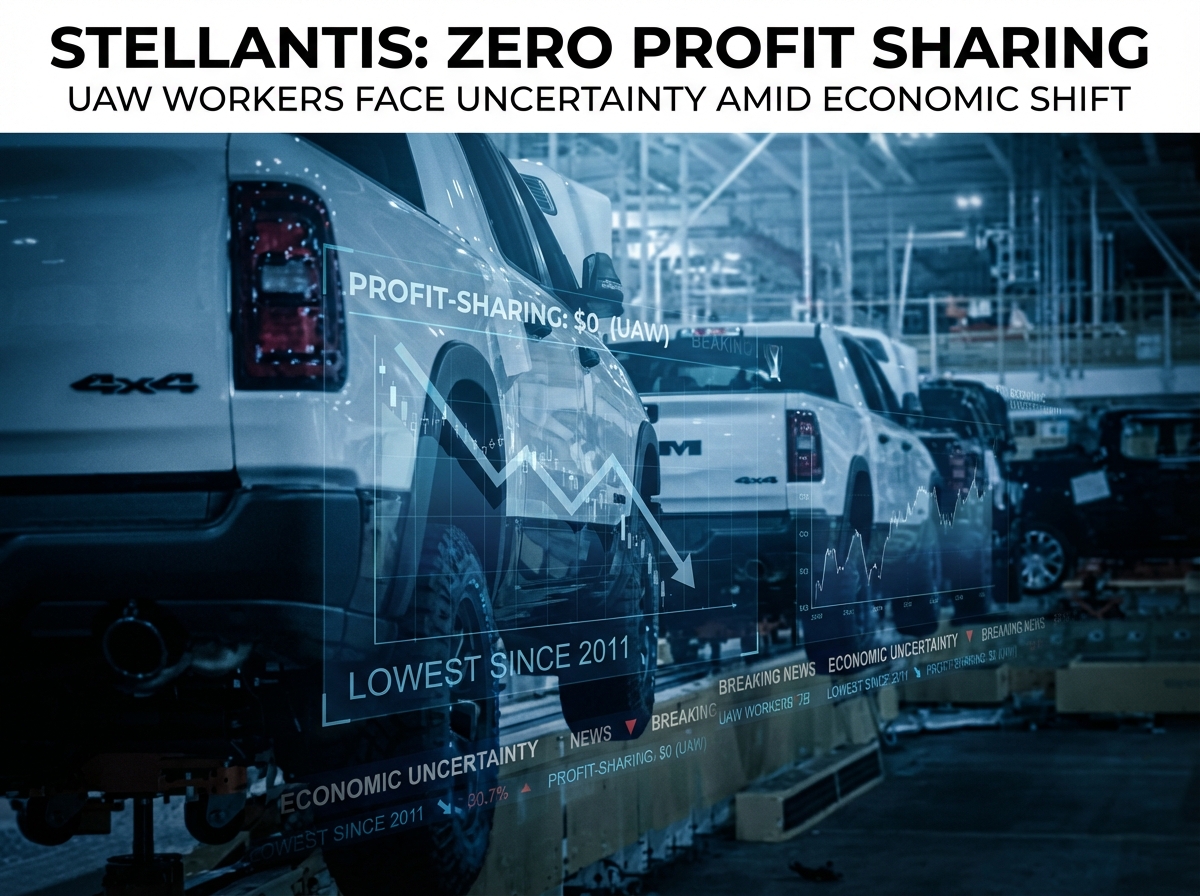
The financial landscape for the American auto sector is always a tightrope walk, balancing massive capital expenditures with volatile consumer demand and the ever-present threat of global trade friction. This week, that tightrope snapped for thousands of United Auto Workers members at Stellantis. For the first time in over a decade, hourly employees represented by the UAW will receive absolutely no profit-sharing bonus. A zero payout. This isn’t just a dip in expected earnings; it represents a profound shift in the immediate economic reality for these workers and signals deeper turbulence within the North American operations of one of the world’s largest automakers. When the checks fail to materialize, the market notices, and the Superintendent overseeing labor relations certainly faces a new challenge.
The Unprecedented Zero Check shockwave
The notification that Stellantis North American operations were unprofitable enough to trigger zero profit sharing is a seismic event for UAW membership. Since 2011, following the recovery years after the financial crisis, these workers have grown accustomed to an annual windfall tied directly to the profitability they help generate. That consistency bought a certain level of financial planning, allowing for major purchases or solid savings contributions. To go from a expected bonus to staring at a $0 payment is more than just a missed raise; it’s a psychological blow that reverberates through entire communities supported by these assembly plants. This outcome sharply contrasts with previous years where substantial payouts, often running into the thousands of dollars, were celebrated as a cornerstone of the UAW-Stellantis agreement, highlighting just how dramatically business conditions have deteriorated.
The automaker has been transparent about the headwinds faced, specifically citing the crushing weight of tariffs and a noticeable softening in overall sales volumes across its key North American brands. While Stellantis remains profitable globally, the localized failure in the crucial, high-volume North American division means that regional losses wipe out potential bonuses specifically tied to that area’s performance under the current contract structure. This is a stark illustration of how rapidly macroeconomic policy, specifically trade barriers, can directly translate into lost compensation for frontline workers whose productivity might be entirely sound. The company’s hands, despite the powerful brand portfolio they manage, are demonstrably tied by external policy decisions.
This zero-payout scenario immediately puts pressure on the relationship between the UAW and Stellantis leadership heading into the next contract negotiation cycle. While the current incentive structure is designed to reward success, its complete absence during a period of high inflation and rising cost of living can breed resentment far faster than steady wages ever could. Workers correctly measure their year’s effort against the tangible rewards, and when that measurement comes up empty—especially when they see executives maintain high compensation—the trust required for smooth operations begins to erode rapidly. The role of the chief labor relations Superintendent has never been more delicate.
Why Tariffs and Slow Sales Are a Toxic Combination
To understand the magnitude of this loss, one must dissect the twin pressures cited by the company: tariffs and declining sales. Tariffs, particularly those emerging from escalating global trade tensions, act as a direct tax on imported parts and vehicles. In the modern automotive supply chain, nearly every vehicle built in North America relies on components sourced globally. These tariffs inflate the cost of goods sold, compressing margins immediately, even before those costs are passed on to the increasingly price-sensitive consumer. This effectively forces the manufacturer to absorb a significant percentage of the trade war fallout.
Compounding this margin squeeze is the reality of subdued demand. Consumers, facing their own economic pressures—higher interest rates driven by inflation fighting, and general uncertainty—have become far more cautious about large purchases like new vehicles. When sales volumes dip, the fixed costs inherent in running massive assembly plants and R&D operations suddenly represent a much larger percentage of each dollar earned. Stellantis is caught in a pincer movement: costs rise due to external trade policy, and revenue growth stalls due to macroeconomic softness. The resulting loss isn’t a failure of production efficiency; it’s a failure of the operating environment.
Furthermore, we must consider the strategic diversification required in the current EV transition. While Stellantis is committed to electrification, this pivot demands astronomical investment in new battery plants, retooling existing facilities, and developing entirely new vehicle platforms. These upfront capital expenditures create significant book losses in the short term, losses that are supposed to be offset by strong traditional vehicle profitability. When the traditional profit engine sputters due to tariffs and softening demand, the resulting regional loss is magnified precisely when the company needs maximum residual cash flow to fund the costly transition to electric mobility. This is effectively a self-inflicted wound on their futureproofing efforts.
A Decade of Dividends: Contextualizing the Absence
Going back to 2011 places this event squarely in the context of the post-recession recovery. That year marked a period of intensive restructuring, where nearly every major automaker was leveraging government support or undergoing aggressive reorganization to survive the Great Recession’s fallout. For Stellantis’ predecessor companies, generating any profit significant enough to share was an achievement. Since then, the North American auto market has enjoyed a long, albeit sometimes bumpy, expansionary phase characterized by high transaction prices and robust unit sales, fueled in part by favorable economic conditions and relatively low interest rates compared to today.
The pattern established over the past twelve years—consistent, though fluctuating, profit sharing—became embedded in worker expectations and union bargaining power. It served as a visible, quantifiable metric that alignment between labor effort and corporate success was real. Investors viewed this stability as a sign of healthy labor relations and operational control. Consequently, for the bonus to vanish completely is not just a deviation; it is a complete erasure of a reliable fixture in the company’s compensation landscape, signaling that the environment has fundamentally shifted away from the predictable prosperity of the 2010s.
This historical absence contrasts particularly sharply with the performance of competitors who might have managed inventory slightly better or faced marginally less exposure to the specific tariff structures plaguing Stellantis vehicles or components. While every automaker deals with these broader issues, being the company that stops payments entirely sends a strong message regarding relative competitive positioning within the domestic market. It forces analysts and workers alike to probe deeper into operational differences and strategic vulnerabilities rather than attributing the outcome to universal industry headwinds.
The Ripple Effect: Beyond the Plant Gate
The impact of nullifying the profit-sharing pool extends far past the balance sheets of the individual workers receiving none of the cash. This direct reduction in discretionary income hits local economies hard. Areas surrounding major Stellantis plants in Michigan, Ohio, and Indiana rely heavily on the predictable influx of bonus cash to support car dealerships, home improvement projects, and local service industries during the early part of the year. When that predictable liquidity vanishes, local retailers feel the contraction immediately. This is the multiplier effect of a major manufacturing downturn hitting the community level.
Moreover, this development impacts talent acquisition and retention across the entire manufacturing spectrum. In an industry desperate for skilled welders, engineers, and technicians, a substantial, hard-earned financial incentive disappearing can persuade experienced workers to seek employment at competitors who might offer a more reliable payout structure or, critically, those who are not facing the same local operational losses. Stellantis needs to demonstrate a clear path back to profitability, not just for shareholders, but to convince skilled labor they are still the employer of choice.
Globally, this localized stumble might fuel skepticism among international investors regarding the resilience of U.S. operations amid evolving trade policies. While the parent company is diversified across Europe and other regions, the North American market remains vital for overall revenue generation. A public failure to meet internal profit targets due to these external factors could color perceptions of their ability to navigate future political and economic uncertainties, potentially affecting their borrowing costs or even the valuation applied to their strategic partnerships, such as those concerning EV technology development.
Three Paths Forward for Automaker Stability
Given this sharp jolt, Stellantis faces three primary strategic paths moving forward, each carrying significant risk. The first, and most aggressive, path involves doubling down on cost reduction and lobbying efforts. This would mean accelerated plant efficiencies, potentially slowing down or trimming less profitable models, and engaging in high-level advocacy to secure favorable adjustments to current tariff structures. Success here relies on external policy shifts and ruthless internal optimization, aiming to restore regional profitability fast enough to restore some faith before the next negotiation cycle.
The second pathway involves strategically reallocating resources away from the challenged North American legacy combustion engine production toward future platforms where they see clearer regulatory and consumer advantages. This means bringing forward new electric vehicle model launches, potentially absorbing larger short-term losses in the short term—similar to what Rivian is attempting, albeit on a different scale. This strategy banks on the idea that the market for traditional vehicles will continue to decline faster than anticipated, making current operational losses an acceptable write-off against future EV market share gains. It requires absolute confidence from the board that their EV roadmap is superior.
The final, more cautious path involves retrenchment and consolidation, perhaps pulling back on expensive investments or slowing capacity expansion until sustained North American profitability demonstrably returns. This approach prioritizes stability over capturing aggressive market share in the short term. While it addresses the immediate financial pain and would likely reassure the more conservative elements of the creditor base, it risks ceding vital technological ground to rivals who continue to push aggressively in electrification and software integration. The challenge for the Superintendent tasked with workforce management through this period is that whichever path is chosen, employee morale will need significant repair work to ensure execution remains flawless.
Ultimately, the zero profit sharing check is a harsh, public marker indicating that the era of easy profits derived from legacy North American operations is over. Stellantis must now prove that its structure is resilient enough not just to survive trade wars and economic slowdowns, but to fund the revolutionary shift in automotive technology while keeping its workforce financially stable. The coming quarters will be less about sales volume and more about strategic resilience.
FAQ
What is the primary reason Stellantis workers are receiving zero profit-sharing this year?
The primary reason is that the North American operational division of Stellantis recorded local losses, which nullified any potential profit sharing tied specifically to that region’s performance. This outcome is directly attributed to the crushing weight of tariffs and a noticeable softening in overall sales volumes.
How long has it been since UAW members at Stellantis last received a zero profit-sharing payout?
This is the first time hourly employees represented by the UAW have received absolutely no profit-sharing bonus in over a decade. This breaks a consistent trend of annual windfalls that began following the recovery years after the 2008 financial crisis, around 2011.
How do tariffs specifically contribute to compressing Stellantis’ margins in North America?
Tariffs act as a direct tax on imported parts necessary for North American vehicle assembly, immediately inflating the cost of goods sold. This forces the manufacturer to absorb a significant percentage of the trade war fallout, directly compressing margins before costs are passed to consumers.
What psychological impact does the zero bonus have on long-term UAW-Stellantis labor relations?
Going from thousands in expected bonuses to zero creates a swift erosion of trust, especially when paired with high inflation and persistent costs of living. This outcome places immediate, significant pressure on leadership heading into the next contract negotiation cycle.
Besides tariffs, what macroeconomic factor cited in the article is hurting North American sales volumes?
The compounding factor is subdued consumer demand, driven by broader economic pressures such as higher interest rates implemented to fight inflation. Cautious consumers are delaying large purchases like new vehicles, leading to stalled revenue growth.
Why is the combination of rising costs (tariffs) and falling revenue (slow sales) so damaging to an automaker’s finances?
This creates a pincer movement where rising external costs cannot be offset by increasing sales revenue, leading to magnified regional losses. These losses are particularly problematic when the firm needs maximum cash flow to fund the costly transition to electric mobility.
How does the current profit-sharing situation impact Stellantis’ ability to attract and retain skilled manufacturing talent?
A substantial, hard-earned financial incentive disappearing can persuade experienced workers to seek employment at competitors offering more reliable payout structures. Stellantis needs to quickly demonstrate a clear path back to profitability to convince specialized labor they remain the employer of choice.
What historical context does the 2011 benchmark for profit sharing provide regarding the current situation?
The 2011 timeframe marks the beginning of a long, generally expansionary phase for the North American auto market following the financial crisis restructuring. The current zero payout signals a fundamental reversal from the predictable prosperity seen throughout the 2010s.
If Stellantis is profitable globally, why does the regional North American loss still result in zero worker bonuses?
The current profit-sharing contract is strictly tied to the performance of the North American division; therefore, localized operational losses wipe out any potential bonus pool generated in the region. This highlights the contractual dependency on regional health despite the parent company’s overall diversification.
What is the immediate ‘ripple effect’ of the zero discretionary income on local economies near assembly plants?
Local economies surrounding plants in manufacturing states, such as Michigan, Ohio, and Indiana, rely on this predictable cash infusion for local spending. Retailers, home improvement stores, and car dealerships will feel an immediate contraction in liquidity.
What is the most aggressive strategic path Stellantis could take to restore profitability quickly?
The most aggressive path involves sharply accelerating cost reductions alongside intensified high-level lobbying efforts aimed at securing favorable adjustments to current tariff structures. This path relies heavily on both ruthless internal optimization and external policy shifts.
What strategic risk is associated with the path of retrenchment and consolidation?
While retrenchment prioritizes immediate financial stability and reassures conservative creditors, it carries the significant risk of ceding vital technological ground to rivals who are aggressively pushing electrification and software development.
How are upfront capital expenditures for the EV transition linked to this current profit-sharing struggle?
The massive investments required for new battery plants and retooling create significant short-term book losses, which are meant to be offset by strong traditional vehicle profits. When the traditional profit engine falters, it jeopardizes the funding required for the future-proofing EV pivot.
How might this localized financial stumble affect international investor perceptions of Stellantis’ U.S. operations?
A public failure to meet internal profit targets due to trade policy volatility could fuel skepticism among global investors regarding the resilience of the U.S. market. This may negatively color perceptions of their ability to navigate future political and economic uncertainty.
What specific responsibility does the labor relations Superintendent face following this financial announcement?
The labor relations Superintendent faces the delicate challenge of managing significant workforce resentment and deteriorating trust ahead of the next negotiation cycle. They must work to repair morale while the company executes its chosen recovery strategy.
How does the current market environment, characterized by high interest rates, affect consumer behavior regarding new vehicle purchases?
High interest rates place greater strain on monthly payments, making consumers far more cautious about committing to large purchases like new automobiles. This macroeconomic pressure directly contributes to the softening sales volumes Stellantis is experiencing.
In the context of the article, what is the difference between a missed bonus and a failure of production efficiency?
The article suggests the losses are less a failure of workers’ productivity and more a failure of the overall operating environment, citing external factors like tariffs and macroeconomic softness. Workers are delivering output, but external policy costs are wiping out the resulting regional profit.
What is the potential strategic benefit of the second pathway—accelerating EV model launches despite short-term losses?
This strategy banks on the idea that the market for traditional vehicles will decline faster than anticipated, making short-term operational losses an acceptable write-off against securing vital future market share in electric mobility. It requires deep confidence in their EV roadmap.
What visible metric did the consistent profit sharing between 2011 and the present serve as for investors?
The consistent payout served as a visible, quantifiable metric signaling healthy labor relations and operational control within the company. Its erasure removes a reliable fixture that demonstrated stability in the compensation landscape.
Why are modern automotive supply chains particularly vulnerable to unexpected tariff implementation?
Nearly every vehicle built in North America relies on a complex network of globally sourced components. Tariffs on these incoming parts inflate costs immediately, meaning the supply chain structure itself amplifies the impact of trade friction.
What fundamental shift must Stellantis prove regarding its structure to satisfy investors and workers moving forward?
Stellantis must prove that its existing corporate structure is resilient enough not just to withstand trade wars and economic slowdowns, but also to simultaneously fund the revolutionary shift to electrification while maintaining worker financial stability. The focus shifts from sales volume to strategic resilience.

