


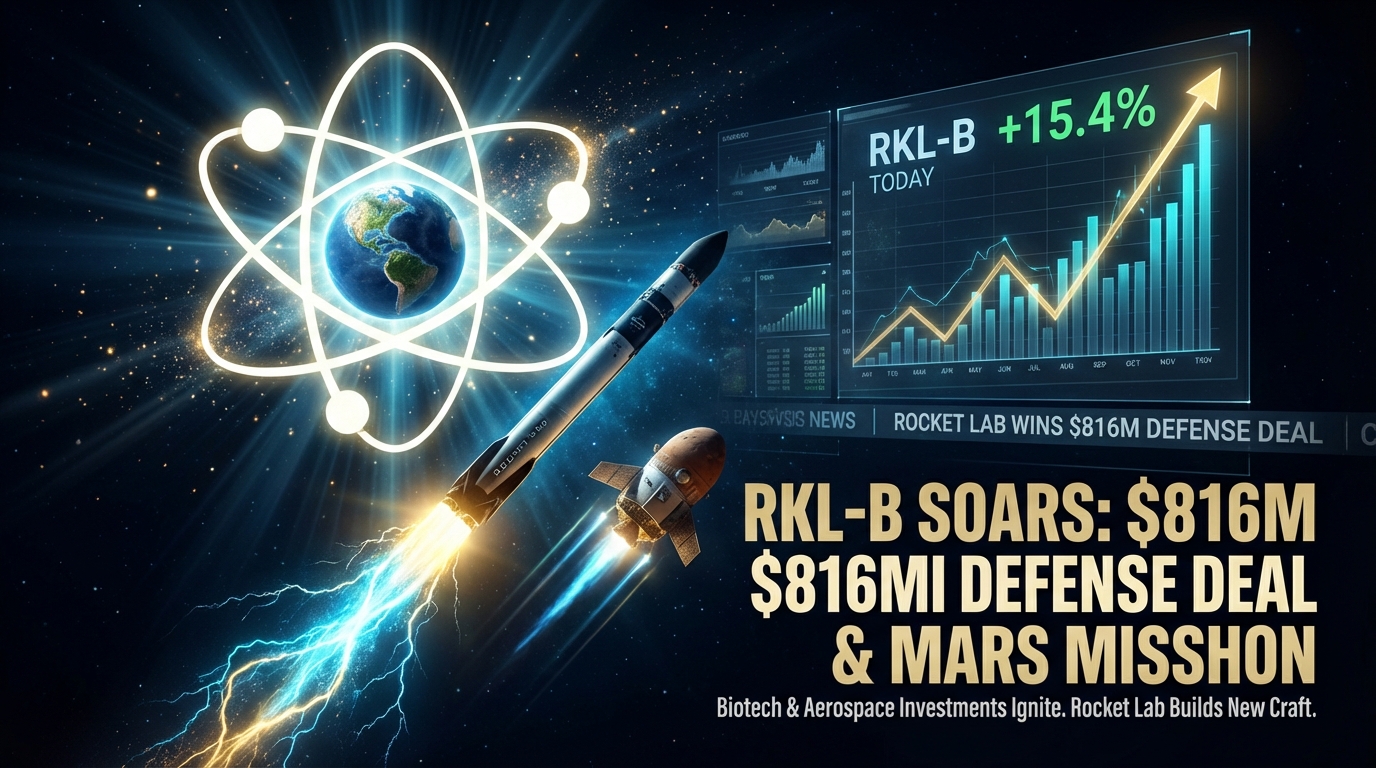
The Rocket Lab Earnings Explosion: More Than Just Launches
The financial markets are witnessing a seismic shift in the aerospace sector, and Rocket Lab Corporation, ticker symbol RKLB, is squarely at the epicenter. While many investors still associate the company primarily with its dependable Electron rocket services, the recent financial disclosures paint a picture of a burgeoning defense prime contractor and a vertically integrated space behemoth. The figures reported for the fourth quarter and the full year of 2025 are nothing short of spectacular, solidifying the company’s trajectory toward mainstream market relevance. We are staring down a record annual revenue haul of $602 million, showcasing an impressive 38% year-on-year growth. This isn’t the slow burn of traditional aerospace; this is venture-capital velocity applied to orbital mechanics, and the stock movement reflects this newfound authority.
However, the true headline grabber, the metric that should have defense analysts and growth stock hunters salivating, is the backlog. Propelled by massive, strategic government contracts, Rocket Lab closed the year with a staggering $1.85 billion in contracted work visibility. That represents a colossal 73% year-on-year expansion in their order book. This massive backlog acts as an ironclad revenue shield, providing predictability that few rivals in the small-to-medium launch arena can currently match. When a company secures contracts historically reserved for legacy giants, as Rocket Lab has done with the recent $816 million Missile Warning System deal from the Space Development Agency, it signals a fundamental change in how national security assets are procured. This is disruption coded in highly classified compliance standards.
The narrative surrounding Rocket Lab has always been dual-pronged: launch capabilities and space systems development. The 2025 performance shows that the space systems segment is maturing into a full-fledged, high-margin revenue driver. The successful launch of the ESCAPADE mission to Mars, built entirely by Rocket Lab in partnership with UC Berkeley, wasn’t just a scientific win; it was a proof of concept proving the company can execute complex, decadal-class interplanetary missions affordably. This capability unlocks a different tier of government spending, moving them from being a mere service provider to an integral technology partner for the Department of Defense and NASA exploring the solar system.
Defense Dominance: The True Engine of the Current Surge
When we look closely at the operational highlights from late 2025 and early 2026, the defense contract awards stand out as the primary catalyst for the current positive sentiment surrounding RKLB stock. Securing the $816 million prime contract to build 18 satellites for the Space Development Agency’s Tracking Layer Tranche 3 program is a game-changer. This type of win moves Rocket Lab out of the small satellite bus market footnotes and places them directly in competition with established defense prime contractors. This signals trust from the highest levels of national security regarding their ability to deliver classified, robust, and agile space architecture.
The strategic acquisitions fueling this vertical integration cannot be overstated. The purchase of Optical Support Inc. is a tactical masterstroke, bringing high-precision optical and optomechanical instrument manufacturing in-house. In the world of advanced missile warning and defense constellations, optics are the eyes of the entire system. By owning this capability, Rocket Lab shortens supply chains, enhances intellectual property control, and, crucially, improves margin capture on these lucrative defense systems. This move mirrors the strategies employed successfully by other vertically integrated tech giants navigating complex hardware requirements.
Furthermore, the company is aggressively targeting foundational national security infrastructure expansion. The selection for the Missile Defense Agency’s SHIELD program opens the door to potential future contracts nearing the billion-dollar mark. When combined with the ongoing development of the Neutron launch vehicle—their medium-lift rocket intended for larger constellation deployment—Rocket Lab is positioning itself as the end-to-end solution provider: they can design, build, launch, and operate the entire mission infrastructure.
The optics of high-level government engagement, exemplified by Secretary of War Pete Hegseth’s visit, are not trivial. These visits validate the company’s role as part of the critical domestic technology base, often referred to as the Arsenal of Freedom. For investors navigating an era of geopolitical tension, association with such critical infrastructure provides a powerful, if somewhat insulated, revenue stream resistant to standard cyclical downturns. This is why the emerging opportunities in this space investment niche are so compelling right now.
Historical Context: Emerging from the Small Launch Niche
To truly appreciate the current RKLB valuation and momentum, one must benchmark it against the early days of private rocketry. In the previous decade, access to orbit was dominated by a binary choice: either utilize the massive, slow-moving legacy providers tied to government cycles or rely on boutique, early-stage startups burning cash with high failure rates. Rocket Lab initially carved its niche beautifully with the Electron rocket, becoming the world’s most frequently launched orbital small rocket. This achievement was vital—it proved repeatability, reliability, and rapid production capability, establishing them as the premier small-lift provider.
However, small launch alone has capacity limitations and ceiling constraints on total addressable market size. The historic challenge for companies like this was transitioning from reliable service providers to platform builders. Think of the early transition of Amazon from purely retail to AWS; it was shifting from selling goods to selling infrastructure that enables others to sell goods. Rocket Lab is executing a similar pivot. They mastered getting small things into space consistently. Now, with Neutron and the major satellite prime status, they are attempting to command the larger, higher-velocity contracts that dictate long-term contractor success.
This current financial inflection point resembles similar moments seen in disruptive industrial technology plays, though the timeline is compressed. For example, observing the maturation curve of earlier defense technology suppliers that successfully transitioned from component makers to system integrators reveals that the market rewards revenue visibility and control over critical path technology. Rocket Lab is demonstrating both: 73% backlog growth signals visibility, and the Optical Support acquisition signals control over key path technology necessary for modern sensing platforms.
The pressure in the aerospace sector is unrelenting due to global competition and national security demands. Unlike platform technologies, space hardware development is capital intensive and faces long qualification cycles. For Rocket Lab to achieve 38% annual revenue growth while simultaneously investing heavily in Neutron development and integrating new acquisitions speaks to significant operational leverage. It bypasses the typical multi-year trough where smaller aerospace firms stagnate between small contracts and medium-lift readiness.
The Neutron Bet: Medium Class Launch Capacity Unlocked
The successful deployment of the Neutron vehicle is the next major unlock for Rocket Lab’s long-term stock valuation story. While revenue numbers are climbing steadily on the back of Electron and space systems, Neutron promises to significantly increase the size and frequency of missions they can service. It is designed for medium-lift capabilities, a segment critical for deploying next-generation, large satellite constellations servicing 5G, global internet, and advanced defense networks—all areas experiencing hyper-growth.
The company has provided key updates on Neutron’s progress, including the qualification of the Hungry Hippo fairing and progress on the thrust structure. These are tangible engineering milestones validating months of rigorous testing. A setback was acknowledged though, with the Stage 1 tank test causing a slight delay, pushing the inaugural launch target to the fourth quarter of 2026\. While delays are never welcome, the transparency in the reporting of this specific issue, coupled with clear forward guidance, reassures the market that the program management remains disciplined.
The significance of Neutron is not just its lifting capacity; it is the intended operational cadence and reusability architecture designed to drive down marginal launch costs. If Neutron can achieve high-cadence, near-full reusability as implied by its design philosophy, it fundamentally changes the economics of accessing medium orbit, potentially undercutting competitors who rely on expendable or less efficient recovery methods. This vehicle, combined with their established satellite manufacturing base, creates a synergistic moat.
The near-term financial projections for Q1 2026 offer a mixed but manageable outlook, guiding toward an Adjusted EBITDA loss within a specific range. This reinforces that the company is still prioritizing aggressive investment and growth over immediate GAAP profitability, a common and often necessary strategy for infrastructure plays poised for long-term monopoly-like returns in specialized sectors. Prudence suggests scrutinizing the path from this expected loss to positive cash flow once Neutron enters regular service, but the massive backlog suggests the foundational contracts are already compensating for current R&D burn.
Future Scenarios: What Catalysts Could Move RKLB Next
Looking ahead, the path for Rocket Lab stock hinges on executing three primary strategic pillars. The first and most immediate scenario involves the successful qualification and first launch of Neutron in late 2026\. Achieving this milestone will validate the company’s capability to operate across the small and medium launch classes simultaneously, transforming their market perception from a niche player to a serious full-spectrum launch provider. A successful maiden flight would likely trigger a significant re-rating of the stock multiple, as the risk premium associated with the development phase dramatically decreases.
The second major scenario centers on contract execution within the space systems division, particularly the fulfillment of the massive SDA missile warning contract. If Q1 and subsequent quarters show robust growth in the space systems revenue line, signaling that the complexity of manufacturing 18 advanced satellites is being managed smoothly and profitably, investor confidence in their non-launch revenue stability will solidify. Any announcements regarding future phases of the SHIELD program or similar large-scale defense architecture awards would serve as powerful accelerants, confirming their status as a defense prime for the next decade.
The third, more speculative but potentially highest reward scenario involves international market penetration and new technology deployment. Rocket Lab’s introduction of advanced silicon solar arrays designed for future gigawatt-scale orbital data centers hints at a play for future space-based computing infrastructure. While nascent, establishing early leadership in components essential for orbital power generation in the AI era positions them for massive scale if that market materializes. Think of the early positioning of chip manufacturers before the data center boom. Any forward indication that they are securing design wins for future large-scale constellations will further cement their competitive moat. These overlapping vectors—launch readiness, defense fulfillment, and technological diversification—are what make the current valuation an inflection point rather than just a typical earnings bump. The foundational resilience provided by the $1.85 billion backlog ensures that even if one area bumps, the ship remains steady. This is why attention must remain fixed on RKLB.
FAQ
What is the primary driver behind the recent surge in Rocket Lab (RKLB) stock mentioned in the article?
The primary driver is the massive $1.85 billion contracted backlog, fueled largely by strategic government and defense wins, signaling a shift beyond just launch services. This backlog represents a 73% year-on-year expansion in their order book, providing significant revenue predictability.
How did Rocket Lab’s annual revenue growth rate compare in fiscal year 2025?
Rocket Lab achieved a record annual revenue haul of $602 million in 2025, representing an impressive 38% year-on-year growth. This velocity is attributed to the success across both their launch and burgeoning space systems divisions.
What is the significance of the $816 million Missile Warning System deal?
This deal, secured from the Space Development Agency (SDA), is crucial because it positions Rocket Lab as a prime contractor building 18 satellites for the Tracking Layer Tranche 3 program. It moves them directly into competition with established large defense prime contractors.
How has Rocket Lab strategically changed its role according to the article?
Rocket Lab is transitioning from being primarily a service provider for small launches to becoming a vertically integrated space behemoth and a defense prime contractor. This shift is evidenced by securing major satellite manufacturing wins rather than just launch contracts.
What role did the ESCAPADE mission play in validating Rocket Lab’s capabilities?
The successful launch of the ESCAPADE mission to Mars demonstrated Rocket Lab’s ability to execute complex, decadal-class interplanetary missions affordably. This acts as essential proof of concept for securing high-tier government spending beyond routine orbital access.
How does the recent acquisition of Optical Support Inc. benefit Rocket Lab’s defense segment?
The acquisition brings high-precision optical instrument manufacturing in-house, shortening the supply chain and enhancing intellectual property control for critical defense systems. This is vital for advanced sensing platforms like those in missile warning constellations.
What is the projected timeline for the inaugural launch of the Neutron rocket?
The projected timeline for the inaugural flight of the medium-lift Neutron vehicle has been slightly delayed due to an issue with a Stage 1 tank test. The current target for the first launch is now set for the fourth quarter of 2026.
In what way is Rocket Lab executing a ‘platform shift’ analogous to Amazon’s transition to AWS?
Rocket Lab is evolving from mastering small launch services (selling a good) to commanding larger contracts and building infrastructure (selling the enabling platform). The Neutron vehicle and major prime contracts represent this shift to commanding larger infrastructure play.
What does the ongoing development of the Neutron rocket primarily aim to achieve economically?
Neutron is designed for medium-lift capabilities and high-cadence, near-full reusability to fundamentally drive down the marginal cost of accessing medium orbit. This economic efficiency is intended to undercut competitors in the constellation deployment market.
What specific defense program, besides SDA’s Tracking Layer, is Rocket Lab targeting that could offer massive future contracts?
Rocket Lab has been selected for the Missile Defense Agency’s SHIELD program. This selection opens the door to potential future contracts that could reach nearly the billion-dollar mark.
What is the immediate financial guidance for Q1 2026, and what does it indicate about the company’s strategy?
For Q1 2026, the company is guiding toward an Adjusted EBITDA loss within a specified range. This signals that Rocket Lab is prioritizing aggressive R&D investment and growth over immediate GAAP profitability, typical for infrastructure plays.
How does the significant backlog shield Rocket Lab from typical cyclical downturns in the broader aerospace market?
The $1.85 billion backlog locks in future revenue visibility across several years, providing an ‘ironclad revenue shield’ unmatched by many small-launch rivals. Contracts tied to national security infrastructure tend to be more insulated from cyclical economic pressures.
What historical challenge for small launch providers is Rocket Lab attempting to bypass with the Neutron vehicle?
Rocket Lab is bypassing the ‘capacity limitations and ceiling constraints on total addressable market size’ inherent in relying solely on small launch services. Neutron allows them access to the lucrative medium-lift segment for next-generation large constellations.
What tangible engineering milestones have recently been achieved for the Neutron rocket system?
Recent tangible milestones include the successful qualification of the Hungry Hippo fairing and significant progress on the critical thrust structure assembly. These validate the extensive testing required for the new vehicle architecture.
Why is Secretary of War Pete Hegseth’s visit highlighted as a significant, non-financial indicator?
The visit validates Rocket Lab’s status as part of the critical domestic technology base required for national security, often termed the ‘Arsenal of Freedom.’ It signals official confidence and deep governmental integration.
What is the
The third catalyst involves international market penetration and securing design wins for future large-scale orbital power generation infrastructure, specifically mentioning advanced silicon solar arrays for future gigawatt-scale data centers.
What is the primary implication if Rocket Lab successfully executes the 18-satellite SDA contract smoothly?
Successful execution will solidify investor confidence in the stability and profitability of their non-launch, space systems revenue stream. This confirms their operational capability to handle complex, high-margin defense manufacturing.
What is the primary implication if Rocket Lab successfully executes the 18-satellite SDA contract smoothly?
Successful execution will solidify investor confidence in the stability and profitability of their non-launch, space systems revenue stream. This confirms their operational capability to handle complex, high-margin defense manufacturing.
What is the key strategic advantage of owning capabilities like precision optics (via Optical Support Inc.) for defense contracts?
Owning these capabilities shortens supply chains, enhances intellectual property control, and crucially, improves the margin capture on complex and lucrative defense systems. This level of vertical integration is key for prime contractors.
What event would likely trigger a significant re-rating of the RKLB stock multiple based on the article’s analysis?
The successful qualification and first launch of the Neutron vehicle in late 2026 would trigger a major re-rating. Achieving this reduces the substantial risk premium associated with the vehicle’s multi-year development phase.
How does Rocket Lab’s $1.85 billion backlog compare to its 2025 annual revenue?
The $1.85 billion backlog is equivalent to approximately 3.07 times their entire 2025 annual revenue of $602 million. This highlights the substantial forward visibility provided by long-term government contracts.
What does it mean for RKLB to be positioning itself as an ‘end-to-end solution provider’?
Being end-to-end means Rocket Lab can design, build, launch, and operate the entire mission infrastructure for clients. This synergy, combining Neutron, Electron, and their satellite manufacturing, creates a unique competitive moat.

