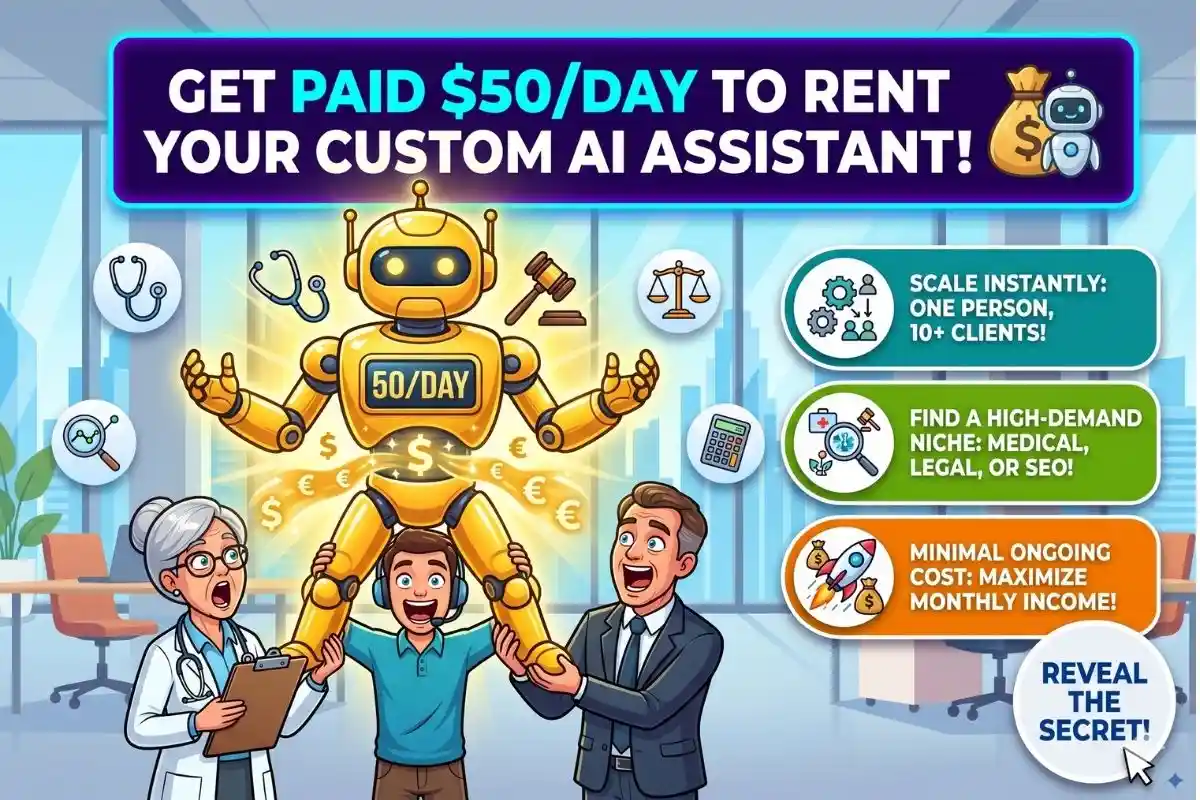
Imagine spending weeks meticulously training an artificial intelligence program to handle your customer service, schedule appointments, and draft highly technical emails perfectly. Now, imagine realizing that this brilliant digital employee spends most of its day sitting idle while you focus on other strategic tasks. What if you could take that custom-built, highly efficient tool and loan it out to other small businesses who desperately need the help but cannot afford to build their own? Welcome to the rapidly expanding world where you can rent your AI assistant to others. This innovative approach is completely changing how independent creators and small business owners operate, turning a simple productivity tool into a lucrative, recurring revenue stream that works even while you sleep.
The Rise of the Fractional AI Assistant
The concept of a fractional executive—someone who offers their high-level expertise, such as a Chief Financial Officer or a Chief Marketing Officer, to multiple companies on a part-time basis—has been a staple in the corporate world for decades. Now, this exact same operational framework is being applied to artificial intelligence, giving birth to the highly sought-after Fractional AI Assistant. Instead of a human consultant dividing their week among different boardrooms, a specialized algorithmic bot divides its processing power and highly tuned knowledge base among several paying clients simultaneously. This emerging AI business model is particularly appealing in today’s market because it democratizes access to advanced, enterprise-grade technology. A local plumbing company, a boutique healthcare clinic, or a regional law firm might not have the in-house technical skills or the massive budget required to develop a custom machine learning model from scratch. However, they can easily afford to pay fifty dollars a day to access a pre-trained, highly specialized bot that seamlessly handles their appointment booking, patient triage, or complex invoice processing without ever calling in sick or taking a vacation. For the ingenious creator of the bot, this means an asset built perfectly once can be monetized infinitely across different markets, creating a truly scalable income stream that operates continuously around the clock without demanding direct human intervention.
Solopreneur Scaling in the Digital Age
For independent workers, freelancers, and small business owners, finding sustainable ways to grow revenue without taking on massive financial risk is the ultimate entrepreneurial challenge. This is precisely where the concept of Solopreneur scaling perfectly intersects with the rented AI model, creating unprecedented opportunities for single-person enterprises. Traditionally, scaling a service-based business meant hiring more human employees, which immediately introduced a host of complexities like payroll management, office space overhead, human resources compliance, and extensive training periods. By pivoting to an AI-first approach, a single individual can build a highly effective bot tailored to a specific, high-demand niche. Consider a bot that specializes in editing and formatting self-published books for independent authors, or one that optimizes local search engine rankings by analyzing thousands of data points for regional real estate agents. Once that highly specialized digital tool is perfected, the solopreneur can lease access to it across dozens of clients simultaneously. You are no longer selling your limited daily hours; you are selling the immense, parallel-processing output of your custom technology. This powerful paradigm shift allows a one-person business to serve dozens of enterprise clients at once, bringing in substantial daily revenue while maintaining the extreme agility and incredibly low overhead of a solo operation.
Building a Custom Bot That Commands a Premium
To successfully convince another business to rent your AI assistant for fifty dollars a day, the bot must offer undeniable, instantly measurable value that far exceeds its daily subscription cost. You cannot simply package a generic chat interface, slap a logo on it, and expect companies to pay a premium. The secret to this business model lies in deep specialization and seamless integration into existing, often clunky, corporate workflows. Your bot needs to be trained on highly specific industry data, proprietary frameworks, or unique problem-solving protocols that make it an absolute expert in a very narrow field. For example, a bot trained exclusively to navigate complex medical billing codes, translate technical engineering documents, or resolve specific supply chain logistical errors will easily command top dollar from desperate managers. Furthermore, ensuring that your custom AI strictly adheres to data security standards is paramount to gaining client trust. If you are handling sensitive corporate information, you must thoroughly understand the regulations governing data privacy in your target sector. For foundational knowledge on how machine learning algorithms process, learn from, and store information, you can explore the comprehensive resources available on Wikipedia’s Artificial Intelligence page, which details the rapid evolution and current functional capabilities of these advanced computational systems.
The Economics of the Fifty-Dollar-a-Day Model
At first glance, fifty dollars a day might seem like a relatively modest amount for access to cutting-edge technology, but the underlying economics of this model are incredibly powerful when effectively scaled. Fifty dollars a day translates to roughly one thousand five hundred dollars a month per single client. If you can secure just ten non-competing businesses to lease your Fractional AI Assistant, you are suddenly generating fifteen thousand dollars in monthly recurring revenue from a single digital asset. The primary costs involved in this venture are the initial time investment required to build and train the model, ongoing API usage fees paid to the foundational AI providers, and minor routine maintenance to keep the bot updated with the latest industry information. Compared to traditional software-as-a-service businesses, the profit margins are exceptionally high and the barrier to entry is continuously lowering. However, setting this infrastructure up securely requires a solid understanding of digital networks and cloud computing standards. For a deeper, highly authoritative dive into the governmental perspective on robust digital infrastructure and the economic impact of technological adoption, the National Institute of Standards and Technology (NIST) provides excellent, publicly available guidelines and extensive research on securing and scaling digital technologies in modern global commerce.
Navigating Trust, Security, and Future Trends
As this lucrative AI business model continues to gain widespread traction across various industries, the biggest immediate hurdle for ambitious solopreneurs is building concrete trust with potential clients. When another company integrates your custom bot into their daily, mission-critical operations, they are actively trusting you with their proprietary data, their sensitive customer interactions, and ultimately, their hard-earned brand reputation. To succeed in this space, you must establish crystal-clear boundaries regarding data usage, ensuring beyond a shadow of a doubt that client A’s information is completely siloed and never influences the training or the responses given to client B. Transparency about exactly how the bot operates, what its strict limitations are, and how you securely handle long-term data retention is just as important as the bot’s actual generative capabilities. Looking forward, the market for rented AI is only going to expand exponentially. As foundational models become increasingly capable of taking autonomous actions—rather than just generating text or images—these rented assistants will evolve into complete digital workers that can execute complex software tasks. Those who start building and renting out specialized, highly secure bots today will be perfectly positioned to dominate this massive paradigm shift in how global businesses manage their daily operations.
Data Table: Potential Revenue by Niche
| AI Assistant Niche | Typical Client Profile | Suggested Daily Rate | Potential Monthly Revenue (10 Clients) |
| Medical Billing AI | Independent Clinics, Dentists | $65/day | $19,500/month |
| SEO Content Optimizer | Marketing Agencies, Publishers | $50/day | $15,000/month |
| E-commerce Customer Support | Shopify Store Owners | $40/day | $12,000/month |
| Legal Document Triage | Boutique Law Firms | $75/day | $22,500/month |
| HR & Onboarding Bot | Mid-size Tech Startups | $45/day | $13,500/month |
Frequently Asked Questions (FAQ)
Do I need to be a programmer to build a Fractional AI Assistant? No, you do not need to be a traditional software engineer. Many modern AI platforms offer no-code or low-code environments that allow you to build custom bots by simply uploading documents, defining specific rules, and integrating existing tools. However, a strong understanding of logic, workflows, and prompt engineering is highly beneficial.
Who owns the data generated by the rented bot? This is determined by the service level agreement (SLA) you create with your client. Generally, the client retains ownership of their specific inputted data and the outputs generated for them. You retain ownership of the underlying custom instructions, system prompts, and the unique architecture of the bot itself.
How do I handle the computing costs if my clients use the bot heavily? Most fractional AI creators pass the API costs (the microscopic fees charged per word or query by the foundational AI company) onto the client, either by capping the daily usage within the $50 fee or by charging a base rental rate plus a variable usage fee for extreme volume.
A Final Curiosity: The Future of Bot-to-Bot Commerce
While renting a custom AI to a human business owner is today’s frontier, tomorrow’s reality is even more fascinating. We are rapidly approaching an era of “bot-to-bot” commerce. In the near future, the Fractional AI Assistant you build might not even interface with a human manager. Instead, a company’s overarching management AI might independently identify a gap in its capabilities, search a digital marketplace, and automatically negotiate a short-term lease to rent your specialized bot for a few hours to solve a specific problem. By establishing your presence in the fractional AI market now, you are effectively laying the groundwork to become a key supplier in the impending autonomous economy, where digital entities buy, sell, and rent services from one another at the speed of light.