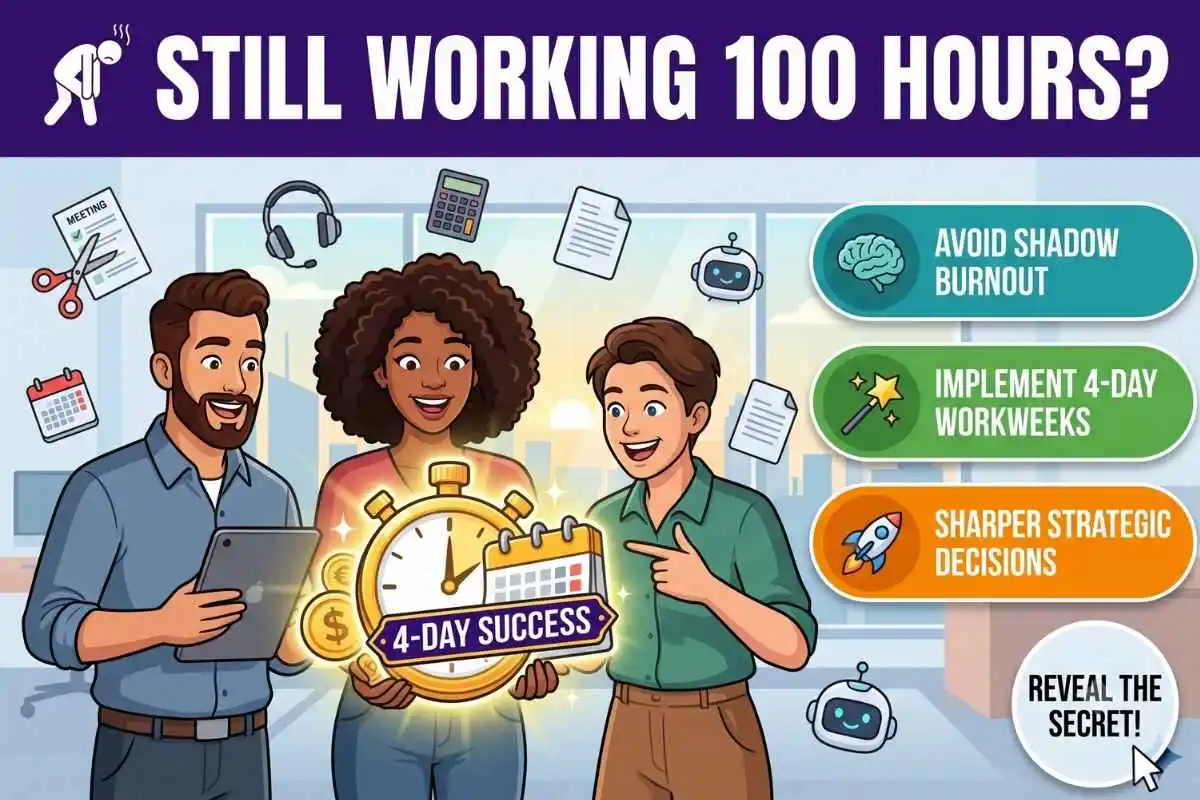
For generations, the mythology of entrepreneurship was defined by exhaustion. Silicon Valley icons were celebrated for sleeping under their desks, pulling consecutive all-nighters, and wearing chronic fatigue as a badge of honor. But as we navigate 2026, a quiet revolution has reshaped the global startup landscape. The era of brute-force hustle is officially over, replaced by a sophisticated philosophy known as rest-based productivity. Today’s most celebrated founders are deliberately stepping away from their desks, compressing their workweeks, and treating recovery as an essential business strategy. Grounded in neuroscience and validated by global workplace trials, this new approach proves that working fewer hours builds faster, smarter, and more resilient companies.
The Rise of “Shadow Burnout” and the Breaking Point
For over a decade, the startup ecosystem ran on an unchallenged gospel: building a successful company required sacrificing sleep and mental health. Hustle culture was celebrated as an essential badge of honor. But by late 2025, that relentless paradigm reached a breaking point. According to clinical data, 73 percent of tech founders suffered from a hidden crisis called shadow burnout. Unlike traditional burnout, which manifests in missed deadlines and obvious operational failures, shadow burnout hides behind record revenue, successful fundraises, and glowing investor updates. Founders were quietly collapsing internally while external metrics climbed. In Europe, the crisis became so acute that one in three startup CEOs seriously considered quitting due to chronic stress. When a founder burns out, overall productivity drops by up to 25 percent, and valuations can plunge by 60 percent following an executive departure,. In response, the smartest founders of 2026 abandoned the 100-hour workweek forever.
The Neuroscience of Strategic Judgment
To understand why working fewer hours improves entrepreneurial output, one must examine the biological reality of human cognition. Continuous execution depletes our mental reserves and actively impairs the prefrontal cortex—the precise brain region responsible for strategic planning, emotional regulation, and complex risk assessment. When founders operate in a chronic state of sleep deprivation, their executive functioning deteriorates exactly when their startups need clarity most. Analytical data reveals that top-performing entrepreneurs spend roughly 68 percent of their weekly schedule on high-leverage strategic thinking, whereas struggling founders remain buried in administrative tasks. By stepping away from daily fire-fighting and scheduling structured recovery windows, leaders allow their brains to enter the default mode network. This subconscious state is where human creativity thrives, synthesizing complex ideas into breakthrough innovations. Your best business strategy will rarely happen while staring exhausted at a screen or fighting decision fatigue at your desk,. In 2026, rest is recognized as the fundamental prerequisite for high performance.
The 100-80-100 Rule and the Four-Day Workweek
The personal evolution of startup founders reflects a massive structural shift across the corporate world: the widespread adoption of compressed schedules. Much of this movement is grounded in the pioneering research of sociologist Juliet Schor, who studied more than 200 companies and 8,000 employees worldwide. Her findings validated the now-famous 100-80-100 model: workers deliver 100 percent of their traditional output, work only 80 percent of their previous hours, and receive 100 percent of their regular compensation. As documented in Wikipedia’s comprehensive overview of the four-day workweek, these global trials resulted in an overwhelming success. Organizations experienced dramatically better employee retention, a sharp reduction in sick days, and remarkable improvements across twenty distinct well-being metrics, including significantly lower levels of workplace stress. Seeing these empirical results, startup founders realized that if compressed schedules could eliminate wasted time and boost productivity for corporate employees, the exact same efficiency principles should apply to executive leadership,.
Clinical Evidence: Why Less Work Means Healthier Companies
The clinical evidence supporting shorter workweeks has grown too robust for the business community to ignore. Recent workplace studies highlighted by the American Psychological Association (APA) reveal that organizational adoption of four-day schedules has surged as leaders recognize the undeniable link between rest and sustainable revenue. This operational shift is heavily reinforced by medical data published in the National Institutes of Health (NIH) repository on employee well-being and workability. In these comprehensive evaluations, an astounding 97 percent of participants evaluated the four-day workweek positively, with 70 percent experiencing enhanced emotional health and 42 percent reporting physical vitality gains. Workers also reported sleeping significantly better, exercising more frequently, and achieving a sustainable work-life balance that insulated them from professional exhaustion. For startup founders dealing with high-stakes uncertainty, these health benefits are transformative. By adopting compressed work schedules paired with mandatory recovery periods, founders protect their physical vitality and maintain emotional stamina without crashing,.
The Daily Rhythm of the 2026 Founder
So how does the rest-based founder actually structure their life in 2026? It begins with ruthless boundary-setting and the intelligent deployment of modern automation. Empirical research confirms that entrepreneurs who establish strict boundaries between work and personal life are nearly three times less likely to suffer from severe burnout compared to those who let work consume their evenings and weekends. To achieve this separation, today’s leaders leverage artificial intelligence and virtual assistants to delegate routine administrative tasks, which can yield a threefold output multiplier while freeing up cognitive bandwidth. The typical 2026 founder operates on a compressed four-day schedule—dedicating Monday through Thursday to uninterrupted, deep-focus strategic work. Friday is designated as a disconnected gap day reserved for reading, physical fitness, family time, or solitary reflection. During these recovery windows, notifications are silenced, and inbox checks are strictly forbidden. By normalizing rest at the executive level, these founders preserve their own longevity and prevent anxiety contagion from spreading throughout their startup culture.
Comparing the Paradigms: Hustle vs. Rest
To grasp why 2026 founders are rewriting the rules of leadership, examine how their daily practices contrast with the outdated hustle era. The shift represents a fundamental rethinking of how human energy translates into enterprise value.
| Metric | The Hustle Era Founder (2010s–2024) | The Rest-Based Founder (2026) |
| Weekly Schedule | 70 to 100 hours across 6 or 7 days | 32 to 40 hours across 4 focused days |
| Primary Metric | Hours spent sitting at a desk | High-leverage strategic decisions made |
| Mental State | Chronic fatigue and shadow burnout | Sharp cognitive clarity and emotional resilience |
| Task Management | Doing everything manually to retain control | Ruthless delegation using AI and virtual assistants |
| Recovery Style | Reactive time off only after physical collapse | Proactive rest scheduled weekly as a priority |
| Company Impact | High employee turnover and stress contagion | Strong retention and sustainable growth |
Frequently Asked Questions
What is “shadow burnout” in entrepreneurship?
Shadow burnout is a condition where an individual suffers from severe exhaustion, cynicism, and cognitive depletion while maintaining high external performance. Unlike traditional burnout that causes obvious work failures, shadow burnout is concealed behind successful business metrics and thriving financial quarters. It is dangerous because founders push through mental exhaustion until they suffer an abrupt physical collapse.
Does working fewer hours actually lower a startup’s output?
No. Global trials show that when working hours are reduced with clear boundaries, overall productivity remains steady or increases. By cutting out performative meetings and focusing purely on high-leverage tasks, founders and teams eliminate wasted time. Furthermore, well-rested leaders make superior strategic decisions, avoiding costly errors that derail overworked entrepreneurs.
What is the 100-80-100 model mentioned in workplace research?
The 100-80-100 model is a framework where workers deliver 100 percent of their expected output while working only 80 percent of traditional hours, all while receiving 100 percent of their normal compensation. It relies on operational efficiency rather than sheer time spent at a desk.
How can early-stage founders with limited budgets afford to take breaks?
Early-stage founders achieve rest-based productivity by ruthlessly prioritizing core revenue drivers and delegating administrative noise. In 2026, founders utilize affordable AI tools and virtual assistants to handle operational overhead, saving money compared to full-time hires and freeing cognitive bandwidth for strategic growth.
The Curiosity Factor: Why Stopping is the New Speed
A profound paradox sits at the heart of modern innovation: to move your company at lightning speed, you must master the art of coming to a complete stop. For decades, we treated the human brain like a combustion engine—believing that running the motor longer would automatically yield more distance. But human beings are biological organisms, not machines. When you push a human brain past its cognitive threshold, it loses the capacity for genius.
The most successful founders of 2026 recognize that in an era where artificial intelligence executes routine tasks in seconds, the true value of human leadership lies in wisdom, empathy, and vision,. Those qualities are not manufactured in the eightieth hour of a grueling workweek; they are forged in the quiet moments of detachment,. By stepping back, today’s leaders are stepping up, proving that the ultimate secret to doing more is officially doing less.