


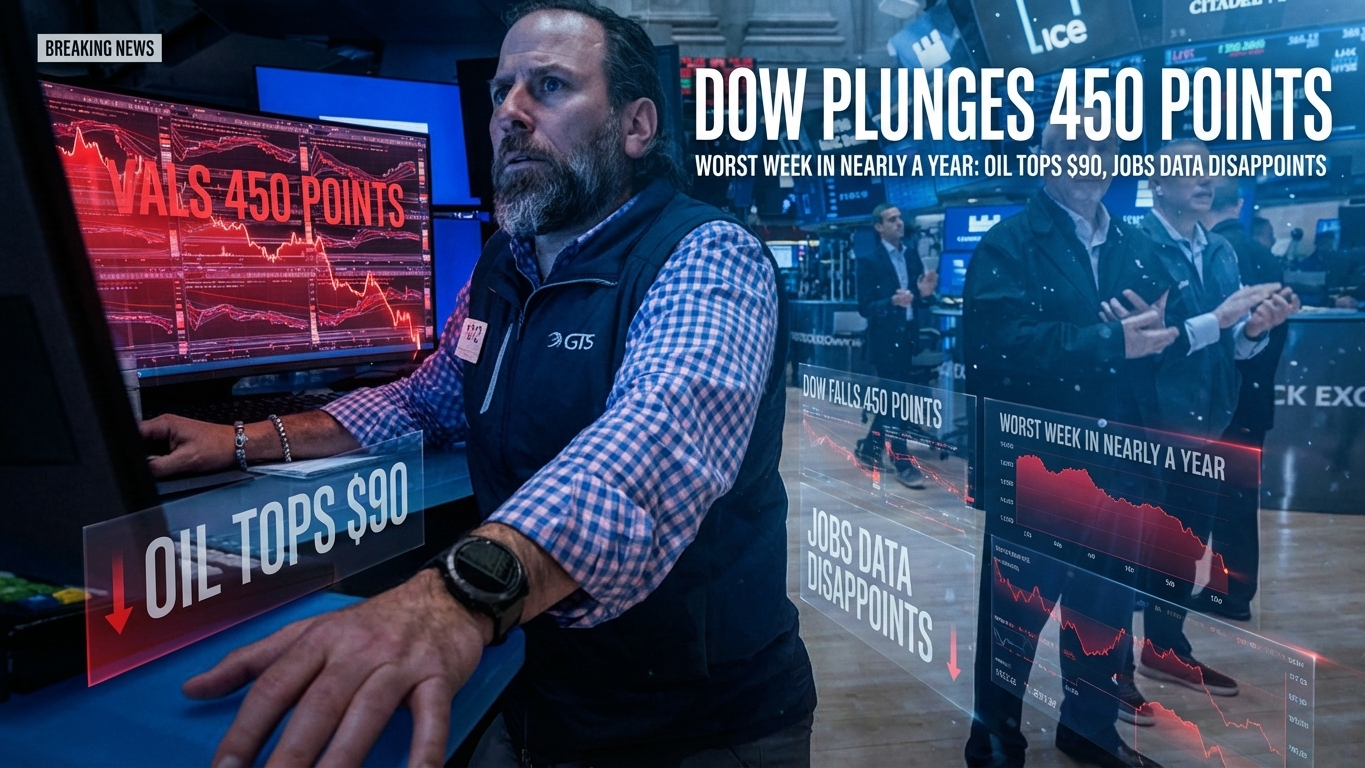
The market floor just turned ice cold. In a brutal week that has shaken investor confidence to its core, the Dow Jones Industrial Average shed over 450 points on Friday alone, finalizing its worst week in nearly a calendar year. This seismic shift wasn’t fueled by a typical earnings miss or a minor policy tweak; it was a dangerous cocktail of geopolitical upheaval and deeply flawed economic data. When West Texas Intermediate crude blasted past $90 a barrel, closing the week with an unprecedented 35% gain—the largest surge since oil futures trading commenced in 1983—the market finally blinked. For those watching the delicate balance of global finance, this week felt like watching a Jenga tower lean dangerously far to one side, waiting for a single wrong pull to send the whole structure tumbling into a recessionary abyss.
The Triple Threat Punishing Wall Street Right Now
The severity of Friday’s sell-off was a direct reaction to three distinct, yet perfectly synchronized, negative forces. First, the escalating conflict in the Middle East, specifically concerning the U.S. and Iran, is creating genuine panic regarding energy security. Crude oil’s trajectory is no longer about quarterly demand; it’s about immediate supply interruption fantasies being discussed by powerful figures. When Qatar’s energy minister warns of potential force majeure declarations—the contractual clause used to invoke circumstances beyond anyone’s control—the implied message is a massive supply squeeze that could propel oil toward $150 a barrel, according to some analysts. This isn’t noise; this is a direct threat to every corporation that needs fuel, meaning every corporation, period. This fear, exacerbated by geopolitical unpredictability, caused traders to flee economically sensitive stocks, preferring to sit on cash over the weekend rather than hold positions vulnerable to overnight escalations.
The second prong of the attack came directly from the Bureau of Labor Statistics. Far from showing a robust labor market capable of absorbing inflation shocks, the latest jobs data disappointed spectacularly. Nonfarm payrolls fell by 92,000 in February, a dramatic reversal from prior monthly gains and significantly worse than pre-report expectations of modest growth. Coupled with a tick up in the unemployment rate to 4.4%, the narrative shifted instantly from stable recovery to softening underlying economic activity. This dampens consumer spending expectations, which forms the backbone of corporate revenue. Investors are now grappling with the nightmare scenario of slow growth paired with rapidly accelerating input costs.
The third factor, which ties the first two together, is the volatility injected by political statements. When a major world leader makes definitive, maximalist demands regarding a foreign conflict, as President Trump did regarding an “unconditional surrender,” it removes any incentive for diplomacy in the short term. Investors hate clarity when that clarity points toward sustained conflict and guaranteed rising energy prices. This unpredictability makes risk modeling impossible. Jed Ellerbroek of Argent Capital Management articulated this perfectly, noting that no trader is excited about owning cyclical stocks over a weekend defined by such high-stakes geopolitical tension.
Echoes of the 1970s: The Return of Stagflation Fears
To understand the current gravity, we must look back decades. The fear gripping the market this week is not merely a cyclical recession dread; it is the specter of stagflation—that toxic mixture of high inflation and stagnant economic growth that defined the majority of the 1970s. During that era, two major oil crises triggered massive price shocks that rapidly increased the cost of living while simultaneously choking industrial output. The current spike, driven by geopolitical tensions rather than cartel agreements, mirrors that initial pressure cooker environment.
Historically, when energy prices surge like this, they act as a massive tax on consumers and businesses alike. Companies like Royal Caribbean, whose operational costs involve vast amounts of fuel, see their margins evaporate almost instantly. The more pronounced the oil surge, the faster those profits decline. What makes this period potentially worse than some past episodes is the initial underlying softness in the labor market, indicated by the surprise job losses. In the 70s, inflation often grew amidst full employment, masking some underlying weakness. Here, the weakness is already showing while the inflationary feedstock—oil—is shooting skyward. This convergence puts central banks in an impossible bind, forced to combat inflation with rates while risking deepening the already visible economic slowdown.
We must also consider the psychological impact on corporate decision-makers. When oil prices are relatively stable, companies invest, hire, and project future growth with confidence. But when prices swing wildly, as WTI has done, planning horizons shrink to mere weeks. Capital expenditures slow down, hiring freezes proliferate, and the overall velocity of the economy grinds to a halt. This uncertainty is what analysts mean when they talk about market behavior “seeping in”—it moves from affecting stock prices to affecting real-world economic decisions, further cementing a sluggish outlook. Even the perceived reliability of historical inflation hedges feels shaky when the underlying catalyst is a conflict rather than a simple mismatch of supply chains.
Decoding the Market Contagion: Beyond Energy Stocks
While oil producers and airlines feel the immediate pain, the contagion spreads far wider. Investors who favor growth stocks, particularly in the tech sector, are extremely sensitive to rising long-term interest rate expectations, which higher inflation often triggers. The Nasdaq’s drop on Friday underscores this vulnerability. Furthermore, industrial giants whose stock prices are closely correlated with global growth expectations, such as Caterpillar, saw significant declines as investors priced in reduced global manufacturing and construction activity due to higher energy input costs.
The investment world is currently undergoing a massive re-pricing of risk, moving away from assets sensitive to cyclical economic activity and toward defensive positioning. This is why we discussed the recent fashion shift toward quieter, less flashy companies, perhaps even those whose branding rivals the muted tones of \*\*Off-White\*\* apparel, suggesting a preference for established, less volatile value propositions over high-momentum plays that thrive only in perfect economic conditions. The transition away from riskier assets is marked by sharp technical breakdowns across major indices, as seen by the Dow, S&P 500, and Nasdaq all posting substantial weekly losses.
Another critical but often overlooked area of contagion is the corporate debt market. Higher oil prices translate directly into higher operational costs, squeezing corporate free cash flow. Simultaneously, the fear of stagflation implies that the Federal Reserve might have to maintain a hawkish stance longer than anticipated, keeping borrowing costs elevated. This combination—squeezed cash flow and high debt servicing costs—is a recessionary multiplier force, making default risks slightly higher for companies carrying significant leverage, even those that seem financially sound on the surface today. This is the hidden layer of risk brewing beneath the surface of the stock market volatility.
What Happens Next: Three Divergent Scenarios for the Market
The market now faces a weekend defined by tense negotiations and geopolitical uncertainty. We are positioned at a critical fulcrum, meaning the next 48 hours could dictate the next quarter’s trajectory. Three distinct paths emerge, each carrying significant weight for the average investor.
Scenario One: The De-escalation Mirage. A sudden, unexpected diplomatic breakthrough over the weekend, perhaps through back channels, signals a quick return to baseline energy security expectations. Oil prices fall sharply back toward the $80 mark. In this optimistic, albeit perhaps naive, scenario, the market experiences a massive relief rally early Monday. Investors would rush back into cyclicals that were oversold Friday, hoping to capture the rebound. The jobs data disappointment would be chalked up to a temporary anomaly, allowing the market to reset and test previous highs, though likely under careful scrutiny regarding future energy volatility.
Scenario Two: The Grinding Instability. This is the most likely scenario based on historical precedent and current rhetoric. No major breakthrough occurs, but no immediate, catastrophic kinetic escalation either. Oil remains elevated, perhaps hovering near $95 or creeping toward $100, as predicted by Professor Jeremy Siegel if no weekend breakthrough occurs. The jobs data remains a persistent worry. In this setting, the Dow continues its slow grind downward, characterized by high volatility and failed rallies. We would see sector rotation accelerate. Defensive sectors, utilities, and companies with massive pricing power that can pass along their higher, \*\*Off-White\*\*-like muted costs would outperform the broad market. This is the classic slow-burn stagflation scenario: painful, frustrating, and characterized by sideways-to-down performance for the general indices.
Scenario Three: The Full Crisis Break. Diplomatic efforts collapse entirely, or a significant kinetic event occurs that directly imperils major shipping lanes or production facilities. Oil prices spike to $110 or higher, and the market begins pricing in a deep, immediate recession. This would trigger margin calls and forced liquidations across leveraged portfolios. In this extreme scenario, the market drop of 450 points on Friday would look quaint. We would see swift moves to cash, a breakdown of technical support levels across the board, and potentially regulatory halts. Equities would essentially become toxic as the focus shifts entirely to preserving capital against inflationary collapse combined with economic contraction, hitting vulnerable stocks hardest.
For now, the market has priced in enough fear to justify the worst week in a year. The danger lies not in the panic itself, but in the underlying economic realities—soft jobs and hard oil—that validate that panic. Until inflation expectations are brought back under control or geopolitical stability is restored, the downward pressure on asset valuations is likely to persist, forcing a disciplined, cautious approach from every portfolio manager navigating this turbulent air.
FAQ
What was the immediate catalyst for the Dow Jones Industrial Average’s worst weekly drop in nearly a year?
The primary catalyst was a massive surge in West Texas Intermediate (WTI) crude oil prices, which surpassed $90 a barrel and recorded its largest weekly gain since futures trading began in 1983. This oil shock, combined with negative economic data, triggered widespread investor panic.
What geopolitical tensions are specifically mentioned as fueling investor panic regarding energy security?
The escalating conflict in the Middle East, particularly concerning the strained relationship between the U.S. and Iran, is creating major concerns. Warnings from figures like Qatar’s energy minister about potential force majeure declarations suggest a highly volatile supply outlook.
How did the recent jobs data disappoint market expectations?
The Bureau of Labor Statistics reported a loss of 92,000 nonfarm payrolls in February, which was a significant reversal from prior gains and much worse than forecasts for modest growth. This surprising contraction suggested underlying economic activity was softening unexpectedly.
Define the concept of ‘stagflation’ as described in the article and why it is a major fear now?
Stagflation is the toxic economic combination of high inflation coexisting with stagnant economic growth. The current fear stems from high input costs (oil) hitting a market already showing weakness in employment figures.
What is the historical parallel being drawn regarding the current market conditions?
The current situation is explicitly being compared to the 1970s, an era defined by stagflation triggered by two major oil crises that simultaneously choked industrial output and raised living costs.
How does the current inflation catalyst differ from past market shocks?
Past energy price surges were often driven by cartel agreements or simple supply chain mismatches; however, the current spike is predominantly fueled by immediate geopolitical conflict and maximalist political rhetoric.
What is the triple threat punishing Wall Street that led to Friday’s severe sell-off?
The triple threat includes (1) escalating geopolitical conflict threatening oil supply, (2) disappointing jobs data indicating softening economic activity, and (3) unpredictable and maximalist political statements removing diplomatic confidence.
According to some analysts mentioned, how high could oil prices potentially reach given the current supply disruption fears?
Some analysts suggest that if force majeure declarations materialize, crude oil could surge toward $150 a barrel due to the implied massive and immediate supply squeeze.
Why are growth stocks, particularly in the tech sector, highly sensitive to the current inflationary environment?
Growth stocks are sensitive because rising inflation expectations often lead the Federal Reserve to anticipate maintaining higher long-term interest rates, which depresses the present value of future earnings.
How does high oil volatility impact corporate decision-making and capital expenditure?
Wild swings in oil prices cause corporate planning horizons to shrink significantly, leading to a slowdown in capital expenditures and the proliferation of hiring freezes. This uncertainty grinds the overall velocity of the real economy to a halt.
What specific operational risk arises for companies like Royal Caribbean due to soaring fuel costs?
Companies with high operational fuel needs see their profit margins instantly evaporate as energy costs rise faster than they can adjust ticket pricing or operational budgets. This directly erodes their profitability.
What is the hidden risk in the corporate debt market accelerated by these economic conditions?
The combination of squeezed free cash flow from high operational costs and elevated borrowing costs due to hawkish Fed expectations increases default risks for highly leveraged companies.
What did Jed Ellerbroek of Argent Capital Management highlight as a reason traders avoided cyclical stocks over the weekend?
Ellerbroek noted that no trader is excited about owning cyclical stocks over a weekend defined by high-stakes geopolitical tension because volatility makes modeling risk nearly impossible.
Which economic scenario—high inflation with full employment or high inflation with job weakness—might be argued as potentially worse than the 1970s?
This period could be worse because the signs of weakness are already visible in the labor market, whereas in the 70s, high inflation often grew while employment masked underlying issues.
What are the three divergent scenarios outlined for the market’s trajectory over the next 48 hours?
The scenarios are: (1) The De-escalation Mirage resulting in a sharp relief rally, (2) The Grinding Instability indicating a slow downward grind and sector rotation, and (3) The Full Crisis Break leading to an immediate recessionary pricing in.
In Scenario Two (Grinding Instability), which types of sectors are predicted to outperform the broad market?
Defensive sectors, utilities, and companies possessing significant pricing power that can successfully pass along their increased costs to consumers are expected to outperform.
What would cause the market to shift into Scenario Three (The Full Crisis Break)?
This scenario is triggered if diplomatic efforts completely collapse or if a significant kinetic event directly imperils major global shipping lanes or production facilities, causing oil prices to spike above $110.
Why does the recent stock market behavior suggest a shift toward less volatile assets, referencing the ‘Off-White’ analogy?
Analysts observe a fashion shift toward established, less volatile value propositions over high-momentum plays, mirroring a preference for muted, reliable branding over flashy concepts.
How do rising oil prices act as a systemic economic drag, according to the article?
Rising oil prices function as a massive, immediate tax on both consumers and businesses, reducing consumer spending power and corporate margins simultaneously.
If Scenario One (De-escalation Mirage) occurred, what would investors rush back into on Monday?
Investors would likely rush back into the oversold cyclical stocks that were sold off on Friday, attempting to capture the massive relief rally anticipated from restored energy security.
What single factor is identified as the major persisting danger keeping downward pressure on asset valuations?
The primary danger is the underlying economic reality characterized by soft job growth combined with the high and volatile feedstock of rising oil prices. Pressure will persist until either inflation expectations stabilize or geopolitical stability is restored.

