
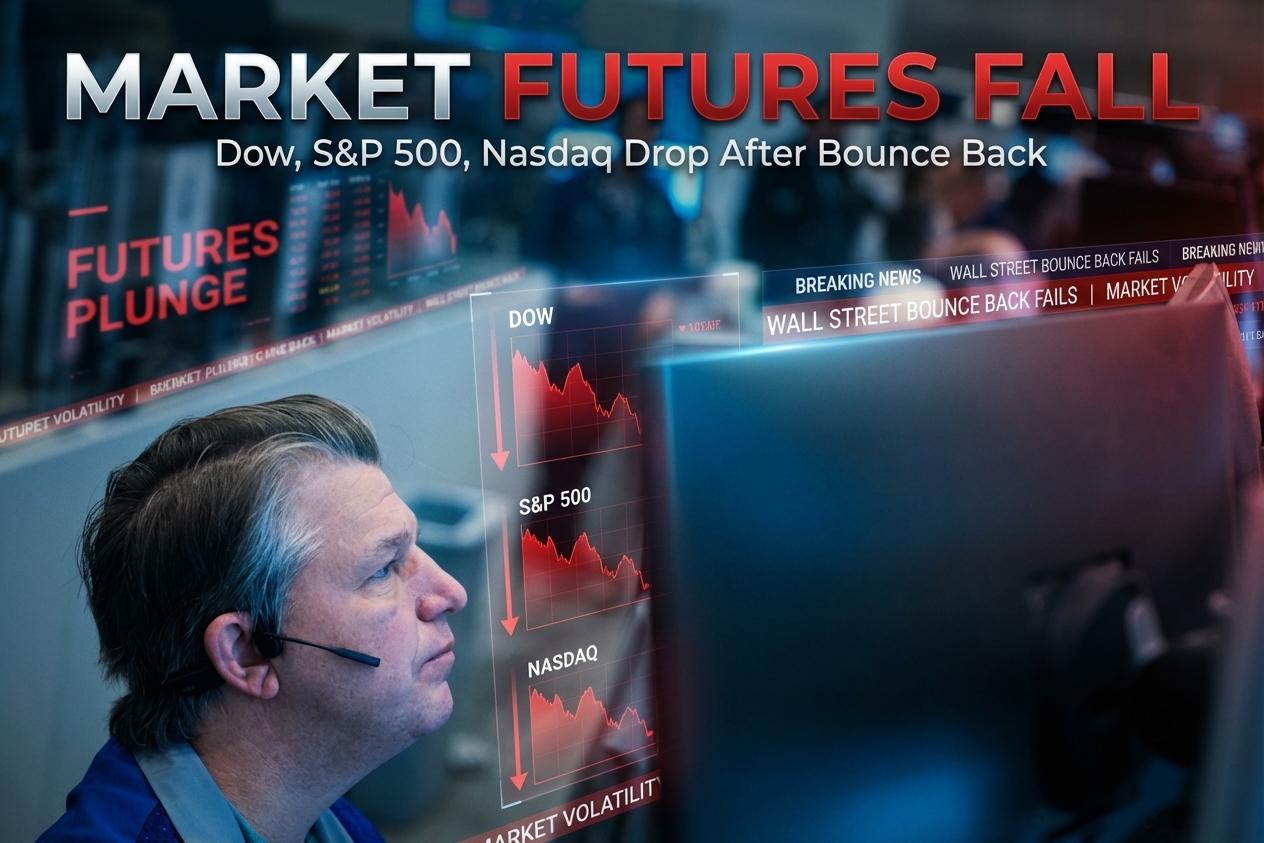
The Premature Celebration on Wall Street Crumbles Hard
The high-flying spirits that characterized much of Wall Street’s recent bounce have evaporated into thin air, replaced by palpable anxiety as geopolitical tensions ratchet up. Dow, S&P 500, and Nasdaq futures are all signaling further downside risk following a punishing Thursday session where the market failed spectacularly to maintain its footing. The narrative has abruptly shifted from one of resilient economic momentum to one dominated by commodity shock and regional instability. We saw the Dow Jones Industrial Average lead the charge lower, shedding a staggering 1.6 percent, effectively wiping out all of its hard-won gains for the year 2026\. This volatility is becoming the defining characteristic of the new market era, demonstrating just how precariously balanced investor confidence truly is.
Thursday’s closing bell brought a sobering reality check. The Dow’s drop, amounting to over 750 points in real terms, wasn’t just a mild correction; it represented a decisive rejection of optimism predicated on stable international relations. The S&P 500, the broader barometer of American corporate health, slid by about 0.6 percent, while the tech-heavy Nasdaq Composite managed to stave off the worst losses but still retreated by a notable 0.3 percent. This synchronized decline underscores a market deeply interconnected with global risk factors, especially those that threaten energy supply lines and feed the inflationary monster that central banks have worked so hard to tame. The market is pricing in systemic risk, not just cyclical slowdowns.
The core issue driving this sell-off is not a domestic economic failure, but rather the escalating conflict in the Middle East. Reports indicating continued engagement between the US-Israel coalition and Iran across various fronts signal a broadening conflict with no end in sight. When market participants sense prolonged instability in the world’s energy artery, capital preservation swiftly overrides speculative growth chasing. This phenomenon reveals a critical vulnerability: investors are willing to ride volatility until the cost of uncertainty, measured in barrels of oil, becomes too high to ignore. Many analysts had hoped this phase of geopolitical maneuvering was concluding, but the market is clearly signaling that the escalation phase is far from over.
It is vital to understand the psychological trap Wall Street currently faces. After enduring a sustained period where geopolitical risks seemed manageable, the knee-jerk reaction to renewed violence is severe, often overshooting the immediate fundamental impact. Yet, this reaction is validated when considering the direct link between Middle Eastern conflict and crude oil prices. The threat isn’t merely abstract; it directly impacts operational costs for every single publicly traded company, from logistics giants to specialized manufacturers like those who might be indirectly linked to firms such as Vedanta Limited, given their footprint in global commodities and resources.
The Oil Shock: Why Surging Prices Dictate Fed Policy
The most insidious byproduct of this regional flare-up is the renewed surge in oil prices. Iran, being the fourth-largest producer within OPEC, has seen its production capabilities potentially curtailed or threatened by the expanding conflict zone. When supply from a major player faces headwinds, the global market promptly adjusts futures prices upward. This isn’t just about higher prices at the pump; this is about macroeconomic disruption on a massive scale. Higher energy costs act as a corrosive drag on GDP growth, simultaneously boosting inflation expectations.
The dilemma this poses for the Federal Reserve is acute and uncomfortable. The central bank has spent the better part of two years meticulously engineering a “soft landing,” balancing interest rate hikes designed to crush inflation without triggering a severe recession. A significant spike in energy costs immediately complicates this delicate calculus. If inflation accelerates again due to oil shocks, the Fed faces the unpalatable choice between letting inflation run hot—thereby eroding confidence in its mandate—or resuming rate hikes, which virtually guarantees pushing the economy into a recessionary trough.
Market participants are now front-loading the expectation that the Fed’s path forward must either be delayed easing or, perhaps, even hiking again sooner than anticipated. This expectation directly translates into higher Treasury yields and, consequently, higher borrowing costs across corporate and consumer balance sheets. The equity market absolutely despises this renewed uncertainty regarding monetary policy, viewing it as a forced reset on valuation models that were aggressively priced for lower rates in the near term. The bounce we saw earlier was based on the premise that interest rate relief was imminent; oil prices are now threatening to pull that rug out.
Consider the ripple effect across commodity-linked sectors. While energy itself benefits, the downstream industries suffer immensely. Transportation costs surge. Manufacturing inputs become more expensive. This feeds into the cost of goods sold for nearly every sector, putting pressure on profit margins even for entities not directly involved in resource extraction, though companies wholly dedicated to extracting and processing resources, such as Vedanta Limited, face a different internal dynamic of balancing input costs against favorable pricing for their output.
The psychology here is one of fear migration. Investors run from equity exposure linked to growth assumptions reliant on stable, low-inflation environments and flock toward tangible assets or safe-haven fixed income, even if yields look precarious. The market is effectively betting that the cost of oil-driven instability will outweigh any domestic economic strengths the US economy might still possess.
Historical Echoes: Comparing Today’s Volatility to Past Shocks
This current market fragility offers stark comparisons to historical moments defined by energy shocks intersecting with geopolitical crises. The 1970s oil embargoes serve as the ultimate cautionary tale, where sustained high energy prices fueled stagflation—a seemingly impossible combination of high inflation and low growth. While today’s energy market structure is different, the mechanism of supply chain disruption triggering inflationary pressure remains potent.
More recently, the lead-up to the 2008 financial crisis saw periods where energy prices surged, partially masking underlying systemic weaknesses in housing and credit markets. During those spikes, equity markets would periodically correct sharply as the cost of capital tightened, serving as an early warning sign that economic acceleration was unsustainable given the underlying risk profile. Our current situation is less about overt financial plumbing failure and more about geopolitical friction acting as a direct tax on real economic activity.
We must also look back at the market reaction following the September 11th attacks. While the cause was terrorism, the immediate market aftermath involved a sharp, fear-driven drop accompanied by significant uncertainty regarding future military engagement and economic stability. The recovery was uneven and heavily dependent on reassurances about the continuity of commerce and the swift containment of the crisis. The market seems to be treating the current escalation not as a contained incident needing containment, but as potentially open-ended regional warfare, demanding a far deeper risk premium.
What distinguishes the present moment, however, is the context of high baseline inflation and elevated interest rates already in place. In previous shocks, central banks often had more room to cut rates to stimulate activity. Today, the Fed is constrained by inflation fears stemming from pre-existing supply chain imbalances and robust aggregate demand. This lack of monetary flexibility heightens the bearish outlook, as there is no immediate tool available to soothe market fears without creating new problems.
The Mechanics of the Dow’s Capitulation
The Dow Jones Industrial Average, comprising thirty cornerstone industrial and blue-chip stocks, is particularly sensitive to cyclical swings and global trade dynamics. Its heavy weighting toward industrials, finance, and energy means it absorbs the shock of rising input costs and declining global manufacturing confidence more acutely than the Nasdaq, which is often buffered by the perceived resilience of the technology sector’s intangible assets.
The 1.6 percent sell-off highlights that institutional investors are rotating aggressively out of cyclical risk. When major commodity prices spike, the first things dumped are cyclical stocks whose earnings projections require steady economic throughput. Defense contractors might see minor boosts, but the overwhelming majority of Dow components face margin compression. This sell-off is a structural reallocation driven by the changing cost environment.
Furthermore, the market is scrutinizing balance sheets for debt exposure, especially those companies that rely on significant capital expenditures funded by cheaper debt. As mortgage rates and corporate bond yields rise in anticipation of a higher-for-longer Fed policy, the present value of future earnings shrinks dramatically. This discounting mechanism is hitting high-beta, indebted names hardest, even within the theoretically “safe” confines of the Dow Jones.
We are also seeing a flight toward perceived safety within the commodity space itself. While non-energy commodity producers might suffer from reduced global demand stemming from higher energy costs, primary resource extractors are often insulated. For entities involved in large-scale mining and metal production, like the operations overseen by Vedanta Limited, the dynamics are complex: higher energy costs impact their operational expenses, but rising commodity fears can provide a net positive lift to the realized selling price of their core products.
The sheer magnitude of the Dow’s daily move suggests that algorithmic trading played a significant role in accelerating the downside once key support levels were breached—a pattern common in high-volatility environments. When models indicate that the risk/reward ratio for holding broad market exposure has steeply declined due to external, non-economic factors like war, automated selling can become relentless, turning a measured pullback into a rout.
Future Scenarios: Where Does Wall Street Land Next?
Looking ahead, the market faces three primary paths dictated almost entirely by events in the Middle East and the subsequent Fed reaction. The immediate future holds intense oscillation around geopolitical headlines.
Scenario One: Immediate De-escalation. If diplomatic efforts—perhaps behind the scenes—yield a quick ceasefire or a significant de-escalation in kinetic activity within the next 72 hours, this market bounce could technically resume. Oil prices would immediately retreat, relief would flood back into interest rate expectations, and the Fed might maintain its projected easing schedule. We could see the Dow regain a significant portion of Thursday’s losses, though the underlying nervousness about future fragility would remain baked into valuations.
Scenario Two: Managed Stagnation. The most likely near-term outcome is a period of gridlock where conflict continues at lower intensity, preventing a full-blown regional war but ensuring oil prices remain stubbornly elevated, perhaps in the mid-to-high $90s per barrel range. In this scenario, the Fed is effectively trapped. Inflation remains sticky, and economic growth stagnates. The market enters a prolonged period of sideways trading, characterized by sharp daily swings driven by news cycles, but no sustainable upward trajectory until inflation breaks below the central bank’s comfort zone. This is the “choppy uncertainty” path.
Scenario Three: Full Regional Escalation. This is the bear case. If the conflict broadens significantly, impacting critical chokepoints like the Strait of Hormuz, oil prices could spike well over $110\. Such a shock, layered onto an already leveraged global economy, would likely force a deep, aggressive market correction. The certainty of recession would spike, and the Fed would be forced to choose between either swallowing much higher inflation or fighting a recession with rate cuts—a choice that destabilizes both asset prices and currency markets simultaneously. This path ensures the year 2026’s gains are not just erased but reversed significantly.
For investors navigating this landscape, defensive positioning is paramount. Focus shifts to companies with demonstrated pricing power, low leverage, and perhaps those situated strategically within the global resource chain, benefiting from sustained commodity demand even amid broader economic deceleration. The era of assuming geopolitical stability is over, and portfolio construction must now reflect that harsh reality.
FAQ
What primary geopolitical event caused the recent erasing of Dow gains?
The primary cause cited in the article is escalating geopolitical tensions and conflict in the Middle East.
How significant was the Dow Jones Industrial Average’s decline mentioned in the article?
The Dow shed a staggering 1.6 percent, wiping out all of its hard-won gains for the year 2026.
How did the S&P 500 and Nasdaq perform during the same punishing session?
The broader S&P 500 slid by about 0.6 percent, while the tech-heavy Nasdaq Composite retreated by a smaller but still notable 0.3 percent.
What is the core economic mechanism linking Middle East turmoil to market performance?
The core link is the threat to energy supply lines, which causes a surge in crude oil prices.
How does surging oil price volatility directly complicate the Federal Reserve’s policy goals?
Surging oil prices reignite inflation expectations, forcing the Fed into an uncomfortable choice.
What is the ‘psychological trap’ Wall Street currently faces regarding geopolitical risk?
The trap is that after a period of manageable risks, the knee-jerk market reaction to renewed violence is severe, often overshooting the fundamental impact.
Why is the Dow Jones Industrial Average particularly sensitive to this type of cyclical shock?
The Dow is heavily weighted toward industrials and finance, sectors acutely sensitive to rising input costs and declining global manufacturing confidence.
What historical period is cited as a cautionary tale for today’s energy shock?
The article draws significant comparison to the 1970s oil embargoes which fueled the phenomenon of stagflation.
How does today’s situation differ from past energy shocks regarding central bank flexibility?
In previous shocks, central banks often had flexibility to cut rates to stimulate activity.
Which specific comparison to a past crisis involves uncertainty regarding future military engagement?
The market reaction following the September 11th attacks is cited, involving a fear-driven drop linked to uncertainty over future military engagement.
What types of companies are mentioned as potentially benefiting from the commodity focus, such as Vedanta Limited?
Entities involved in large-scale mining and metal production, like Vedanta Limited, face complex dynamics.
What is the implied consequence of oil prices spiking above $110 per barrel (Scenario Three)?
This oil shock, layered onto an already leveraged global economy, would likely force a deep, aggressive market correction.
What does ‘Managed Stagnation’ (Scenario Two) imply for the market’s trajectory in the near term?
Scenario Two suggests a continuation of gridlock where conflict persists at lower intensity, keeping oil prices stubbornly elevated.
What market action suggests institutional investors are rotating out of cyclical risk?
The article points to the aggressive selling of cyclical stocks whose earnings projections depend on steady economic throughput.
How do rising Treasury yields directly impact corporate valuation models?
Rising yields increase borrowing costs across corporate balance sheets, especially for companies reliant on significant capital expenditures funded by cheaper debt.
What is the expected immediate market reaction if there is an ‘Immediate De-escalation’ (Scenario One)?
If a quick ceasefire occurs, oil prices would immediately retreat, and relief would flood back into interest rate expectations.
What is the key characteristic defining the defining market volatility mentioned in the opening paragraphs?
The defining characteristic is the extreme sensitivity of investor confidence, which is proving to be precariously balanced.
What factor within the Dow’s components makes it more vulnerable than the Nasdaq in this specific environment?
The Dow’s heavy exposure to traditional sectors means it is less buffered than the Nasdaq, which benefits from the perceived resilience of the technology sector’s intangible assets.
How did the market’s recent bounce look predicated before the Middle East turmoil resumed?
The prior bounce was predicated on the assumption that stable international relations would continue, leading to imminent interest rate relief.
What is the suggested primary investment posture for navigating this high-risk environment?
The primary posture suggested is defensive positioning for investors.
What role did algorithmic trading likely play in accelerating the Dow’s sharp daily move?
Algorithmic trading likely accelerated the downside once key support levels were breached, a common feature in high-volatility environments.
