
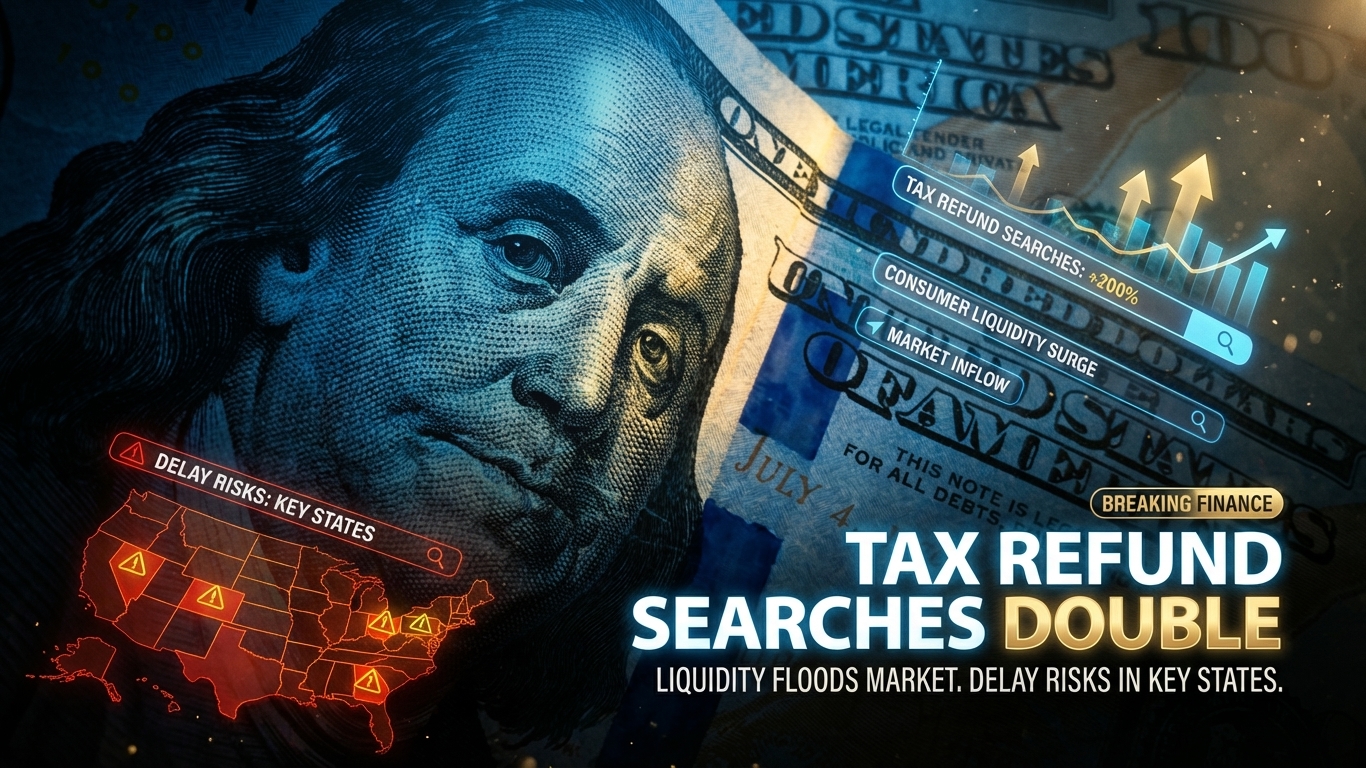
The annual economic heartbeat of millions of Americans is usually marked by the arrival of the federal and state tax refund. For many households, this influx of cash is less a bonus and more a critical component of their monthly budget, often earmarked for debt reduction, necessary repairs, or finally tackling that long-overdue vacation. This year, however, a curious signal is flashing across the financial radar: searches for tax refund information have dramatically doubled, coinciding with unexpected delays in state disbursements across several key jurisdictions. This isn’t just bureaucratic clumsiness; it’s a powerful, albeit messy, indicator suggesting a massive injection of consumer liquidity is poised to hit the market, and the timing of its arrival could rewrite near-term spending patterns.
The immediate context paints a picture of regulatory friction meeting operational backlog. States from Idaho to South Carolina, alongside the District of Columbia, are wrestling with the fallout from sweeping federal tax law changes initiated under the Trump administration. These changes, intended to offer new breaks like extra senior deductions or favored treatment for tips and overtime income, require software updates, form revisions, and rigorous state conformity tests. In states that have been slow to adopt these complex shifts, or where budget cuts have crippled processing teams, the delay is palpable. Budgetary constraints in Idaho, for instance, mean a reduced seasonal workforce, potentially stretching the wait time for some residents to six weeks or more, costing taxpayers millions in accrued interest payments on delayed funds. This localized chaos is the friction that confirms the underlying trend: a large pool of money is currently sitting idle.
This situation is certainly generating headaches for individuals, but the sheer breadth of the delay warrants a closer look at the macroeconomic implications. When consumers anticipate a refund, their spending behavior often shifts preemptively. They might delay a major purchase or put off paying down high-interest credit card debt, waiting for that lump sum to clear the books. The doubling of search volume, as reported, vividly illustrates this anticipation across the broader populace. This suggests a significantly larger pool of retained capital than analysts might have otherwise modeled for the first half of the year. The market might already be anticipating this spending wave, but the actual delivery timeline creates a strange lag effect. Will consumers rush to spend when the money finally arrives, or will inflationary concerns temper their enthusiasm?
The Conformity Crisis: How Federal Shifts Grounded State Returns
The core of the current state-level slowdown lies in the imperfect synchronization between federal and state tax codes. When Congress introduces significant tax legislation, states face a monumental task to conform, which means deciding whether to incorporate the federal changes wholesale, reject them entirely, or adopt them selectively. This decision process isn’t instant; it involves legislative votes, software integration, and extensive auditing procedures. As certified public accountant Richard Pon noted, state conformity presents the “biggest hurdle.” States like South Carolina are actively requiring taxpayers to manually “add back” federal deductions for items like overtime wages or specific auto loan interests that are not recognized at the state level, creating complex filing scenarios that invite errors and subsequent refund freezes.
The District of Columbia represents the most politically charged version of this conformity struggle. An ongoing legal face-off between the DC Council and the federal government over the applicability of recent tax changes has thrown filings into genuine chaos. With potential reform ranging from the standard deduction amount to the local child tax credit value depending on which legislative body prevails, the Office of Tax and Revenue has been forced to delay issuing forms entirely. This uncertainty is forcing an extraordinary choice upon filing software and, ultimately, the taxpayer. When the stakes involve potentially $400 million in DC cash flow disruption and forcing possibly 60,000 filers to amend returns, the operational paralysis becomes an active economic drag on that specific region, even as the underlying funds await disbursement.
Consider the operational failures adding to the federal conformity challenge. In Idaho, the delay isn’t political but purely logistical, stemming from budget cuts that whittled down the necessary seasonal workforce to process returns. This specific issue highlights a vulnerability in governance that directly impacts consumer finance: when critical services are under-resourced, the largest annual cash transfer to citizens stalls. Furthermore, even seemingly minor software glitches, such as the one reported in New York involving TurboTax, can cascade throughout the system, proving that reliance on complex digital pathways means a single bug can hold up vast sums of money destined for consumer pockets nationwide.
The implications extend beyond the immediate refund recipient; small businesses that rely on consumer demand fueled by these refunds will feel the timing crunch. If a significant portion of expected Q1 consumer spending is pushed into Q2 due to state processing delays, retail, services, and the hospitality sectors could see a temporary deflationary drag, followed by an unexpected spending spike once the backlog clears. Analysts must now recalibrate their expectations for consumer spending velocity, recognizing that the release of this accumulated capital will not be evenly distributed across the traditional tax season timeline but rather concentrated around the resolution dates in these delayed states.
Historical Echoes: Comparing This Surge to Past Windfalls
To understand the potential leverage of this delayed liquidity, we can look back at comparable events. Every major tax overhaul or unexpected government stimulus check—think the 2008 stimulus packages or even the initial COVID-19 relief disbursements—provided a powerful, real-world stress test on consumer savings and spending habits. What economists consistently observed in those periods was that while immediate needs were met first, a significant portion of the influx was directed toward discretionary purchases or significant debt restructuring, boosting sectors sensitive to credit utilization and discretionary income.
The pre-COVID stimulus checks, for example, were swift and universal, leading to immediate, observable spikes in retail sales data. The current situation is different because the liquidity is fragmented and delayed, creating a staggered rather than simultaneous boost. However, the underlying motivation is similar: utilizing a large, unexpected cash injection to manage financial stress. Many Americans treat their tax refund not as savings, but as a necessary clearing mechanism to eliminate expensive revolving debt. If these funds are used to retire credit card balances, the subsequent interest savings for consumers will free up ongoing monthly cash flow far beyond the initial impact of the refund itself, creating a lagged, sustained boost to household economics.
We must also contrast this with periods where tax bills were unexpectedly high. When taxpayers face larger payments due on Tax Day, the preceding months often show a noticeable contraction in consumer confidence and discretionary spending, as households adjust to less take-home pay. In this scenario, the search data showing doubling interest suggests the opposite: strong belief that positive cash flow is imminent. This psychological positioning means that when the money hits bank accounts, the accumulated desire to spend will likely manifest quickly, rather than being slowly absorbed into general savings buffers.
The historical precedent for state-level conformity chaos is less common but instructive. Major state tax changes, particularly those dealing with income attribution or new deductions, often result in administrative slowdowns akin to what we see in Oregon, where late federal forms complicated initial system programming. Historically, these state-specific hiccups often led to a localized spending dip, followed by a sharp recovery once refunds were processed. The key takeaway here is that the velocity of spending once the check arrives is often inversely related to the wait experienced; the longer the wait, the more targeted the eventual deployment of the cash.
The Deployment Dilemma: Where Will the Trillions Land First?
The analysis turns now to prediction: once these delayed funds hit accounts in pockets like Idaho, Oregon, and D.C., where will the money flow first? Given the current climate of moderately high inflation and consumer debt levels, the initial destination will overwhelmingly be the most expensive liabilities. Expect aggressive payoffs of high-interest credit cards and installment loans. This acts as a deflationary force in the financial services sector, reducing overall consumer interest expense, which is a net positive for long-term household stability.
Following debt reduction, the next likely destination is maintenance and immediate consumption needs. For many families, tax refunds cover yearly costs like car insurance premiums, necessary home repairs that have been deferred due to budget constraints, or catching up on overdue utility payments. This spending supports the automotive repair sector, local service providers, and certain essential retail categories. This isn’t the flashiest spending, but it represents a stabilization of household operations, which is essential infrastructure for broader economic health.
Discretionary travel and durable goods purchases will likely follow that stabilization phase, particularly in states where filing errors were minimal but processing was slow, like Oregon. The anticipation fueling the search surge suggests a pent-up demand for non-essential items. If Q1 performance across retail was softer than expected, this delayed capital injection could provide a necessary lift to Q2 forecasts for retailers specializing in home goods, electronics, and leisure activities. This influx could be the unexpected boost analysts are currently missing when modeling retail performance due to the administrative blackout in key states.
Finally, we must acknowledge the impact of outright confusion, especially in the DC area. If 60,000 individuals must refile due to the ongoing legal battle over the standard deduction or child credit, a segment of that delayed money will be immediately reinvested in professional tax preparation services or significant amounts of time spent organizing complex amendments. This redirects capital away from immediate consumption and into the professional service sector, a less visible but important economic outcome of regulatory uncertainty.
Scenario Planning: Three Futures for Market Impact
The path forward hinges entirely on the resolution speed of these state-level administrative hurdles. In the first scenario, which we can call the “Quick Resolution,” state systems rapidly update, perhaps acknowledging the inconvenience and prioritizing disbursement immediately following the passage of necessary legislation. In this fast-track scenario, the delayed liquidity hits the market suddenly in late spring. This could trigger a sharp but brief surge in retail sales and consumer sentiment indices, leading to upward revisions in Q2 economic growth forecasts, though potentially overheating local markets dealing with supply constraints.
The second possibility is the “Protracted Drag.” This occurs if states like Idaho continue to struggle with understaffing or if the DC legal battle drags into the summer months. In this scenario, the expected Q2 consumption bump is muted, as a large portion of the population remains waiting. We would see weaker-than-expected retail performance throughout the second quarter, followed by what might resemble a massive, but delayed, holiday season spending event in Q3 as that capital finally materializes. This outcome would create significant forecasting headaches for investors who expect steady economic momentum.
The third, more nuanced scenario involves “Permanent Adjustment.” This is most relevant in places like South Carolina, where taxpayers are being forced to fundamentally recalibrate their understanding of income reporting due to the state’s non-conformity. If a significant number of amended returns are filed, the expected refund amount will shrink or disappear altogether for many, as errors are corrected or income is reapplied at the state level. This scenario tempers the overall size of the impending liquidity wave, substituting a broad spending boom with targeted professional service utilization and lower-than-expected overall consumer stimulus, potentially leading to an economic narrative favoring service providers over goods retailers.
What remains undeniable across all scenarios is the volume of anticipation. The doubling of public search activity underscores a desperate need for this capital across the American consumer base. Whether it arrives next month or three months from now, when this substantial, patient pool of money finds its way into bank accounts, the resulting spending velocity will provide a clear, tangible lift to the sectors positioned to capture it. Investors and retailers must watch not just the national employment figures, but a few key state revenue departments for the definitive signal that the waiting is finally over.
FAQ
What primary economic signal suggests a consumer cash surge is imminent despite tax refund delays?
The primary signal is the dramatic doubling of public search volume related to tax refund information across many states. This high search activity indicates widespread anticipation and delayed spending behavior by a large pool of consumers waiting for their funds.
What is the core reason for the widespread state-level tax refund delays mentioned in the article?
The core reason is the imperfect synchronization, or conformity crisis, between new federal tax laws and existing state tax codes. States must undertake legislative votes, software updates, and auditing to adopt these federal changes, causing significant processing backlogs.
How have federal tax law changes specifically complicated filing in states like South Carolina?
In states like South Carolina, taxpayers might be required to manually ‘add back’ federal deductions for items like overtime wages or specific auto loan interests that are not recognized at the state level. This creates complex filing scenarios that often lead to errors and subsequent refund freezes.
What is the nature of the operational challenge facing the District of Columbia’s tax revenue office?
The DC tax office faces a politically charged operational paralysis due to an ongoing legal face-off between the DC Council and the federal government over key tax changes. This uncertainty has forced delays in issuing necessary filing forms for potentially 60,000 filers.
What macroeconomic implication does the observed doubling of tax refund searches suggest?
The doubling suggests a significantly larger pool of retained consumer capital than analysts might have otherwise modeled for the first half of the year. This concentration of funds creates a potential lag effect before a mass spending wave hits the market.
In which specific state is the refund delay attributed primarily to logistical and budgetary constraints rather than political conformity issues?
Idaho is specifically cited as an example where delays are purely logistical, stemming from budget cuts that reduced the necessary seasonal workforce needed to process returns. This highlights a governmental vulnerability impacting consumer finance flow.
How might the delay in consumer refunds affect small businesses expecting Q1 sales?
Small businesses relying on consumer demand fueled by refunds could experience a temporary deflationary drag in Q1 as spending is postponed. Their expected revenue may be pushed into Q2, resulting in concentrated but intense spending once the backlog clears.
According to the article, what is the most likely initial destination for the delayed tax refund money once received by consumers?
The initial destination will overwhelmingly be the repayment of the most expensive liabilities, specifically high-interest credit cards and installment loans. This prioritization acts as a deflationary force by immediately reducing overall consumer interest expense.
What is the historical lesson learned from past stimulus checks regarding consumer spending?
Past stimulus events, like the 2008 packages, showed that while immediate needs are met first, a significant portion of the windfall is directed toward discretionary purchases or substantial debt restructuring. This boosts sectors sensitive to access to credit and discretionary income.
What is the long-term economic benefit for households if refunds are primarily used to pay down credit card debt?
Using the refund to retire credit card balances frees up ongoing monthly cash flow for consumers due to the eliminated interest payments. This creates a lagged, sustained positive boost to household economics beyond the initial lump sum impact.
What is the implication of the public’s psychological positioning, suggested by high search volume, when refunds finally arrive?
The strong belief that positive cash flow is imminent means that when the money hits bank accounts, the accumulated desire to spend will likely manifest quickly, rather than being slowly absorbed into general savings buffers.
How does the ‘Protracted Drag’ scenario affect Q2 economic forecasts?
In the Protracted Drag scenario, where state hurdles last into summer, the expected Q2 consumption bump will be muted, leading to weaker-than-expected retail performance throughout the quarter. This will necessitate upward revisions for Q3 as delayed capital materializes.
What is the ‘Permanent Adjustment’ scenario regarding state tax conformity and how does it impact the size of the spending boom?
This scenario applies where taxpayers must fundamentally recalibrate their reporting due to non-conformity, potentially shrinking their expected refund after amendments correct errors. This tempers the overall spending wave, substituting a broad boom with utilization of professional tax services.
If consumers delay purchases pending refunds, what often happens to their behavior when the money finally arrives?
Consumers often exhibit a rush to spend accumulated desire, especially if the wait was prolonged, focusing on needs that were deferred, such as necessary home repairs or overdue utility payments.
Beyond debt repayment, what is the next likely spending category for the influx of delayed refund money?
Following debt reduction, the next allocation will likely be toward maintenance and immediate consumption needs, such as paying car insurance premiums or servicing deferred home and utility repairs. This stabilizes household operations.
What type of economic impact is expected in the professional service sector due to filing confusion, particularly in regions like D.C.?
In areas with significant filing confusion requiring amendments, a segment of the delayed capital will be redirected toward professional tax preparation services. This redirects money away from immediate consumption and into the professional service sector.
What is required of state governments when Congress introduces major tax legislation that complicates the refund process?
States must decide whether to adopt federal changes wholesale, reject them, or adopt them selectively, a decision that requires legislative votes, software integration, and auditing, which causes the conformity lag.
What specific risk does reliance on complex digital pathways present during tax processing, as exemplified by the New York case?
Reliance on digital pathways means that even a seemingly minor software glitch, such as the one reported with TurboTax, can cascade throughout the system. This vulnerability can hold up vast sums of money destined for consumer pockets nationwide.
In the ‘Quick Resolution’ scenario, what market outcome can be expected in late spring?
The Quick Resolution scenario predicts a sharp but brief surge in retail sales and consumer sentiment indices as the delayed liquidity hits the market simultaneously. This could lead to upward revisions in Q2 economic growth forecasts.
How might investors and retailers best use the information about the location of major state-level administrative hurdles?
Investors and retailers should monitor the revenue departments of states experiencing major administrative hurdles, such as Idaho or D.C., as their resolution dates will provide the definitive signal for when the accumulated consumer capital will actually enter the economy.
How do economists distinguish the spending pattern from this delayed refund situation versus swift, universal stimulus checks?
Unlike swift, universal stimulus checks that provided a simultaneous boost, the current situation creates a staggered spending boost dependent on when individual states resolve their administrative backlogs. The velocity of spending is often inversely related to the wait experienced.
