
I was sitting in a dimly lit corner of a convention hall last month, watching a group of developers argue over the structural integrity of a digital bridge. They weren’t architects. They were world-builders, the kind who spend eighteen hours a day obsessing over the physics of a pixelated sunset. In the chair next to me, a novelist whose last trilogy had performed decently on the midlist was watching them with an intensity usually reserved for final manuscript edits. She leaned over and told me she wasn’t there to sell books. She was there to find a studio that understood the weight of her protagonist’s grief.
That conversation stayed with me because it represents a fundamental shift in how intellectual property is moving through the market this year. We are deep into 2026, and the old guard of the publishing world is waking up to a reality where Licensing to Gamers isn’t just a vanity project for blockbuster icons. It has become a viable, high-margin strategy for the “Artisan Author,” the writer who owns their rights and knows how to leverage them. The traditional path of selling a book, then a film option, then maybe a lunchbox, has been disrupted by a much more agile partner: the indie game studio.
These small, focused teams are hungry for narrative depth. They have the tech, but they often lack the “lived-in” soul that only a novelist can provide. This symbiotic relationship is quietly minting a new class of literary entrepreneurs who see their stories not as static text, but as liquid IP capable of flowing into interactive spaces. It is a pivot that requires a different kind of financial literacy, one that values long-term backend participation over the quick hit of a traditional advance.
Navigating the mechanics of Book-to-Game Rights in a digital economy
The logistics of these deals have matured significantly over the last twenty-four months. We are no longer in the wild west of “send an email and hope for a royalty.” In 2026, the smart money is moving toward structured inbound licensing agreements where authors retain a surprising amount of creative oversight. Unlike a Hollywood film deal, where a writer is often paid to go away, indie studios frequently want the author in the room. They want the lore, the secondary characters, and the specific tonal shifts that made the book work in the first place.
When we talk about Book-to-Game Rights, we are discussing a modular asset. I have seen contracts recently that carve out specific “Interactive Narrative” rights while leaving the core print and ebook rights untouched. This allows authors to double-dip. They can continue to sell direct through platforms like Shopify or Kickstarter, building their personal brand, while simultaneously receiving quarterly checks from a Steam or itch.io release. The financial beauty of the indie space is the lower overhead. A game doesn’t need to sell five million copies to be profitable for an author. If a small team of three developers builds a tight, story-rich experience that moves fifty thousand units at twenty dollars a pop, the royalty stream can easily dwarf a mid-five-figure book advance.
There is also the matter of “transmedia discoverability.” In an era where AI-generated content is flooding the Amazon Kindle store, a high-quality indie game acts as a massive, interactive billboard for the original text. Players who spend ten hours inhabiting a character’s world are far more likely to buy the three-book backlist than someone who just scrolled past a static ad. It is a cycle of engagement that feeds itself, creating a moat around the author’s IP that is very difficult for generic content to penetrate.
Why Indie game stories are the new frontier for high-yield IP licensing
I often think about the “midlist” author as the most undervalued asset in the creative economy. These are writers with ten or twenty books, a loyal but modest following, and a deep well of world-building that hasn’t been fully monetized. Indie developers are beginning to treat these catalogs like oil fields. They aren’t looking for the next Harry Potter; they are looking for Indie game stories that offer a unique hook or a mechanical twist. A cozy mystery writer might find their world turned into a “Point and Click” investigation game. A hard sci-fi author might see their ship designs and political factions become the backbone of a strategy title.
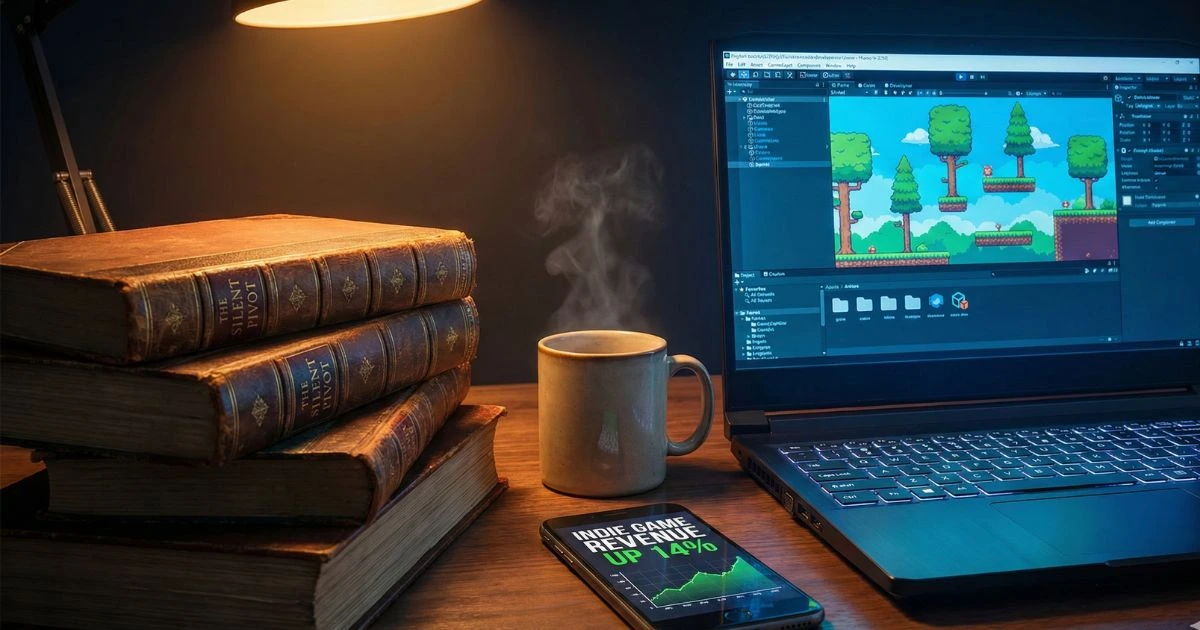
The rise of “Agentic Commerce” and more sophisticated licensing tools has made managing these partnerships easier. Authors are using CRMs to track their outreach to studios, treating their IP like a business portfolio. It is a shift from being a “writer” to being a “rights holder.” I’ve watched authors reject traditional publishing contracts because the “All Media” clause was too broad. They know that by holding onto those interactive rights, they are keeping the most valuable piece of the pie for themselves. They are looking at the 14% CAGR of the indie game market and realizing that their prose is the raw material for a five-billion-dollar industry.
This isn’t about chasing a trend. It’s about the fact that in 2026, the barrier between “reader” and “player” has almost entirely dissolved. People want to participate in the stories they love. For the author, this means the work is never truly finished. It evolves. It gets a soundtrack. It gets a UI. It becomes a living, breathing entity that generates revenue while they sleep. The risk, of course, is picking the wrong partner. A buggy release can tarnish a brand, but that is where the “imperfect authority” of the indie world comes in. It’s about finding the right fit, the small team that shares the vision, and building something that feels like an extension of the soul rather than a corporate product.
As I left that convention, I saw the novelist and the lead developer shaking hands. There was no agent in sight, just two creators discussing revenue splits and character arcs. It felt like a glimpse into a much more decentralized, much more profitable future for anyone who owns a story worth telling. The question is no longer whether a book should be a game, but which part of the world the author is willing to let the players change.
The market is moving away from the “one-and-done” sale of rights toward a more nuanced, long-term ownership model. It requires a bit of courage to step away from the safety of the traditional path, but for those who understand the value of their own invention, the rewards are starting to look very significant. We are moving into an era where the most successful writers might not be the ones with the most books on a shelf, but the ones with the most diverse digital footprints. It is a quiet revolution, happening one licensing deal at a time, and it is fundamentally changing what it means to be a professional storyteller in the modern age.
