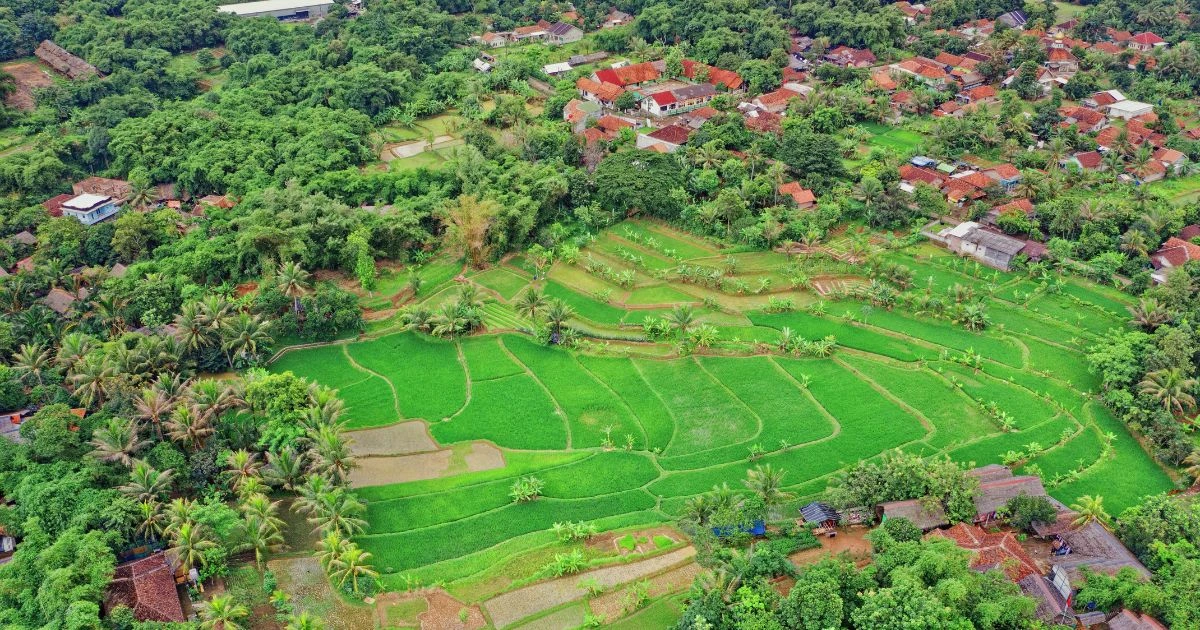
Standing on a dusty perimeter road in Iowa, watching the combines kick up a haze of gold against a bruising autumn sky, you don’t think much about blockchain. You think about the smell of dry earth and the terrifyingly consistent way that people need to eat, regardless of what the Federal Reserve decides to do with interest rates in a mahogany room miles away. There is a weight to land that you just cannot find in a brokerage account. For years, this was the playground of the ultra-wealthy or the generational lucky, those who inherited three hundred acres of prime silt loam and held onto it like a holy relic. The rest of us were left watching from the fence, clutching our eroding dollars while the real value stayed buried in the dirt.
But the world shifted while we were distracted by flashier things. We are entering a phase where the digital and the physical are finally shaking hands in a way that actually makes sense for someone trying to survive the economic turbulence of the mid-2020s. This isn’t about speculative vaporware or digital monkeys. It is about the quiet, relentless utility of the ground beneath our feet.
The quiet shift toward real-world assets in a volatile era
It feels like every decade has its own flavor of anxiety. Right now, that flavor is the creeping realization that paper wealth is getting thinner by the day. We have spent years inflating bubbles, and as we look at the horizon of 2026, the traditional safety nets look a bit frayed at the edges. This is why the conversation has pivoted so sharply toward real-world assets. People are tired of owning things they can’t touch, things that vanish when the power goes out or a CEO sends a late-night tweet. There is a primal comfort in knowing that your portfolio includes a piece of a peach orchard or a sustainable corn operation.
Real-world assets provide a tether to reality. When you move away from pure abstraction, you start to see why the massive institutional funds have been quietly buying up acreage across the Midwest and the Delta for decades. They weren’t looking for a quick flip. They were looking for a hedge against the inevitable moments when the currency loses its bite. The brilliance of the current moment is that the technology has finally caught up to the asset class. You no longer need five million dollars and a connection at a local land bank to get exposure to high-quality soil. You just need a sense of where the tide is going.
Investing in things that grow, breathe, and yield a physical product feels like a return to sanity. It’s a rejection of the high-frequency trading madness that treats companies like betting slips. When you look at a farm, you see a cycle that spans seasons, not milliseconds. That change in tempo is exactly what a modern portfolio needs to offset the frantic nature of the current market.
Why tokenized farmland is the most grounded inflation hedge 2026 demands
If you’ve been paying attention to the grocery bills or the cost of a new tractor, you know that the cost of living isn’t just a headline; it’s a tax on existence. As we look toward the specific challenges of an inflation hedge 2026 strategy, we have to find things that have intrinsic, caloric value. You can’t eat a tech stock, and you certainly can’t build a house out of a government bond. Farmland, however, has this stubborn habit of increasing in value exactly when the dollar is struggling. As the price of food rises, the value of the land that produces that food rises in tandem. It’s a beautifully simple feedback loop.
The emergence of tokenized farmland is the bridge that finally allows the average person to cross into this territory. By breaking down a massive, illiquid asset into digital shares, we’ve solved the biggest problem with land: you can’t exactly sell off the back forty when you need some quick liquidity for a medical bill or a new roof. Or, rather, you couldn’t. Now, the fractionalization of these parcels means that the barrier to entry has crumbled. You can own a sliver of a vineyard in California or a soybean farm in Nebraska with the same ease that you’d buy a share of a big-box retailer.
There is something almost poetic about using cutting-edge ledger technology to track the ownership of the most ancient asset class in human history. It feels like a reconciliation. We are using the future to protect ourselves from the failures of the present. The transparency is the part that gets me. In the old days, if you invested in a land fund, you were buried in paperwork and hidden fees, never quite sure if the manager was actually doing right by the soil. With tokenization, the data is right there. You can see the yields, the water usage, and the health of the asset without needing a private investigator.
I spent some time in a small town outside of Des Moines last summer, talking to a farmer who was exploring these new funding models. He wasn’t a tech guy. He was a third-generation grower who was tired of the predatory lending cycles of the traditional banks. For him, this wasn’t about “crypto.” It was about democratizing the capital he needed to keep his family’s legacy alive while giving outsiders a chance to share in the harvest. It’s a win that feels rare in the modern financial landscape.
We are seeing a move away from the “get rich quick” mentality of the early digital asset craze and toward a “stay wealthy forever” mentality. That shift is crucial. Farmland doesn’t go to zero. It doesn’t declare bankruptcy because of a bad marketing campaign. It just sits there, absorbing sunlight and rain, producing the fundamental building blocks of civilization. In an era where everything feels like it’s made of glass, owning a piece of the dirt feels like holding a stone.
There’s a specific kind of peace that comes with that. You stop checking the charts every fifteen minutes. You start thinking in terms of harvest cycles and soil health. You realize that while the 2026 inflation numbers might be scary, they are also a signal to move into assets that don’t care about the CPI. The world is getting noisier, more complicated, and more expensive. Finding a way to anchor your wealth in something as fundamental as food production isn’t just a smart financial move; it’s a way to sleep better at night.
As the tech matures, the liquidity will only increase. We are at the very beginning of this curve, the quiet period before the mass adoption that inevitably follows when people realize there’s a better way to do things. The traditional gatekeepers are still trying to figure out how to respond, but the gate is already open. You can feel the change in the air, much like the way a farmer can smell a storm coming before the first clouds appear on the horizon.
Whether this becomes the dominant way we manage property in the next decade or remains a potent niche for the savvy few is still an open question. The legal frameworks are still catching up, and the interfaces are still being polished. But the underlying logic is inescapable. We have a growing global population and a finite amount of arable land. You don’t need a degree in economics to see where those two lines intersect.
The future of investing might not look like a sterile office building or a glowing terminal. It might look a lot more like a field of wheat swaying in the wind, broken down into tiny, accessible pieces that anyone can hold. It’s an interesting thought to sit with as the sun goes down and the shadows stretch across the furrows. We’ve spent so long trying to escape the physical world through our screens, but in the end, the screens might be the very thing that lead us back to the land.
It is the process of converting the ownership rights of a physical farm into digital tokens on a blockchain, allowing for fractional ownership.
Farmers get access to capital without the restrictive terms of traditional banks, allowing them to expand or improve their operations.
Yes, you generally need a secure digital wallet to hold and manage your tokens, though many platforms offer integrated solutions.
Market cycles and current debt levels suggest that inflationary pressures may peak or become more volatile around that timeframe.
Risks include environmental factors (drought, pests), changes in global commodity prices, and the evolving regulatory landscape for digital assets.
Some self-directed IRAs allow for investments in alternative assets like tokenized real estate and farmland.
Digital oversight often leads to better data collection on soil health and water usage, making the farm more efficient and valuable.
Many tokenization platforms prioritize sustainable or regenerative farming practices, but it varies by specific project.
The underlying land ownership is usually held in a legal entity like an LLC, which should protect the investors’ claim to the asset regardless of the platform’s status.
It is based on the appraised value of the underlying land and the revenue generated from its agricultural production.
It is a tangible, physical commodity that exists in the real world and has utility beyond its status as a financial instrument.
The entity managing the farm typically handles taxes and maintenance, with those costs reflected in the net returns to token holders.
Farmland is generally viewed as a long-term investment, often spanning five to ten years or more.
While more liquid than owning a whole farm, the secondary market for these tokens is still developing and may not be as fast as selling a stock.
Yes, but it must be done through platforms that comply with SEC regulations regarding securities and digital assets.
Farmland is a hard asset with intrinsic value; as food prices rise with inflation, the value of the land and its yield typically increases.
One of the main benefits is a low barrier to entry, often allowing people to start with as little as a few hundred dollars.
Distributions are usually handled automatically through the platform, often in the form of stablecoins or direct deposits from the lease or crop sales.
Investors typically share in both the risks and rewards; however, many professional farm managers use crop insurance to mitigate these losses.
While similar in concept, tokenized farmland often offers more direct ownership, lower fees, and more transparency regarding specific parcels of land.
Most platforms provide the specific location and details of the property, though physical access depends on the specific legal agreement with the farm operator.