
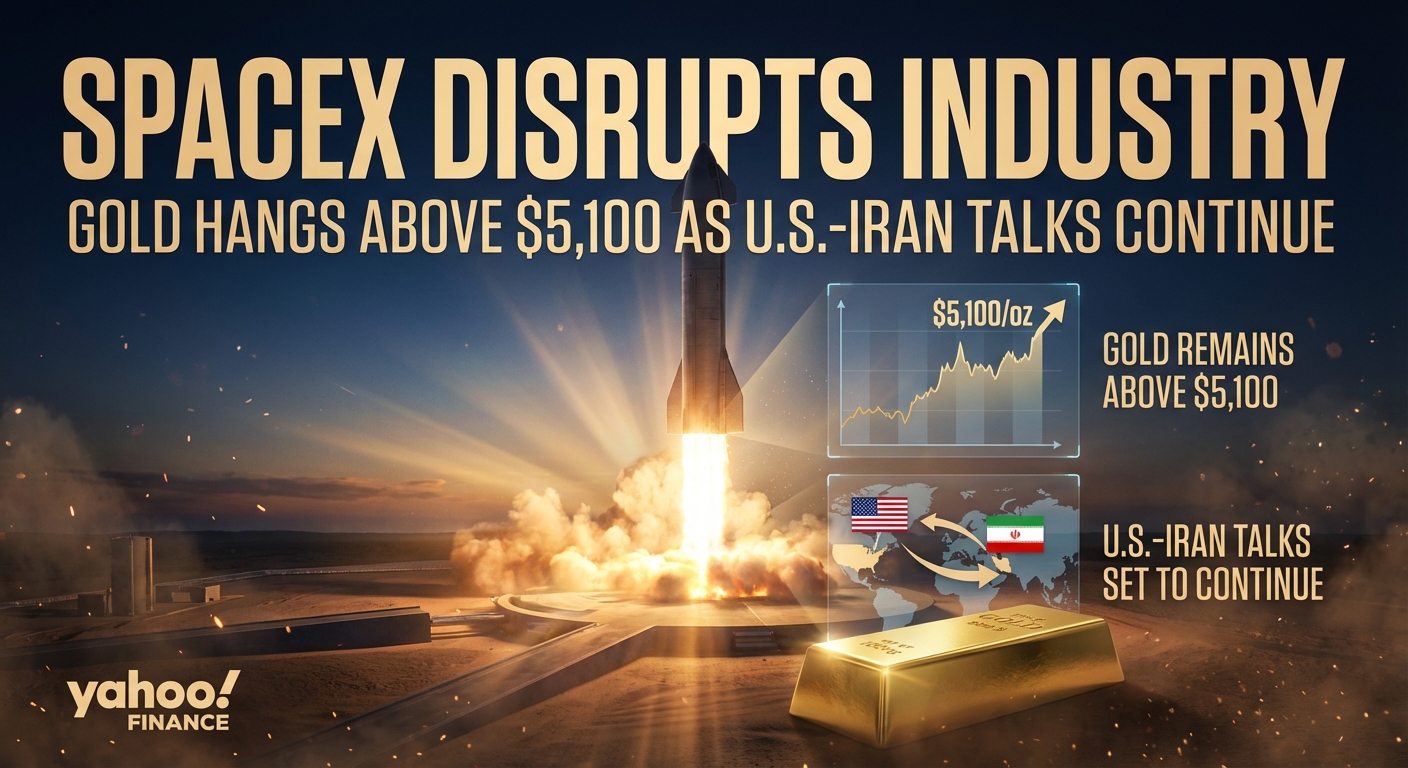
The delicate dance between global superpowers is heating up again, and as always, the canary in the geopolitical coal mine—gold—is screaming. Amid rising tensions between the United States and Iran, the price of the venerable safe-haven asset has decisively breached the psychologically significant $5,100 per ounce mark, holding firm above that level as of \*\*Friday, February 27\*\*. This isn’t just minor market noise; it’s a clear signal that investors are prioritizing capital preservation over growth in volatile waters. The persistent strength of \*\*gold futures\*\* trading confirms that fear is now a primary market driver, overshadowing typical growth narratives.
Specifically, the April gold futures contract opened trading on Friday slightly higher, ticking up 0.1% from Thursday’s close of $5,194.20\. This sustained rally, keeping the metal above $5,100 since Monday, February 23rd, is directly correlated with the precarious state of diplomatic efforts concerning Iran’s uranium enrichment program. While Omani mediators suggest incremental progress in the latest round of talks, the underlying threat remains palpable. President Trump’s decision to reposition military assets in the Middle East hangs heavy in the air, creating a situation where even continued negotiations only serve to temporarily compress volatility, not eliminate the underlying risk premium being priced into the metal.
The Imminent Risk Premium: Why Geopolitics Translates to Gold
The mechanism driving gold higher in this scenario is elegantly simple yet profoundly impactful: the escalation risk. Should diplomatic efforts collapse prematurely, the potential for a targeted U.S. military action against Iran exists. History teaches us that localized strikes in the Persian Gulf region rarely remain localized. Such an incident would almost certainly trigger a wider regional conflict, instantly disrupting vital global energy supply chains and introducing massive systemic uncertainty into the financial ecosystem. Gold, having no counterparty risk and serving as the ultimate store of value for millennia, becomes the immediate destination for panicked capital seeking refuge from the coming storm.
This demand surge is not just theoretical; it’s visible in the futures market activity. When geopolitical temperature rises, large institutional players and hedge funds rotate out of riskier equity exposure and into physical or derivative contracts tracking gold. The fact that settlements have remained above $5,100 for nearly a week demonstrates conviction among buyers who are betting that the risk of crisis outweighs the potential for immediate peace. This $5,100 level is transitioning from a resistance point to a solidified support floor, indicating a recalibration of the baseline value of gold in this uncertain early-year environment.
Furthermore, unlike inflation hedges which rely purely on monetary expansion, gold thrives on uncertainty regardless of central bank activity. If U.S.-Iran tensions escalate, the resulting supply shock in oil markets would feed inflation, providing a double tailwind for gold. If, however, deterrence works and tensions de-escalate suddenly, gold would likely correct sharply, meaning traders are currently placing bets on the downside risk scenario rather than the optimistic diplomatic outcome.
Historical Echoes: Comparing Today’s Price Action to Past Crises
To truly grasp the significance of sustained strength above $5,100, we must look back at prior moments of acute geopolitical stress. Consider the lead-up to the 2003 Iraq War. While the price points were significantly lower then, the \*behavior\* of gold was identical: a slow, grinding accumulation fueled by rising international friction, exploding into a sharp rally once hostilities commenced. Investors learned the hard way that waiting for the first missile launch guarantees the worst possible entry price. The current environment signals that market participants are attempting to front-run a potential military action, buying preemptively based on the known instability of the region.
Recall the period following the September 11th attacks. While the immediate reaction was complex, gold quickly stabilized and began a multi-year upward trend as concerns over global security and the subsequent long wars dominated the narrative. The market’s memory includes knowing that geopolitical flare-ups—especially involving major global powers and vital choke points like the Strait of Hormuz—rarely resolve quickly. This market is pricing in not just \*a\* conflict, but a \*prolonged period\* of elevated insecurity.
We can also draw parallels to earlier confrontations involving sanctions or naval standoffs in the Middle East. During those smaller escalations, gold would see rapid 3% to 5% spikes followed by slow retracements. What we are seeing now is a \*sustained floor build\* at a much higher altitude, suggesting that the perceived long-term risk premium embedded in the asset is higher than in previous, less severe confrontations. This stability above $5,100 suggests institutions are comfortable holding positions through the near-term negotiation cycle, indicating a lack of faith in a swift and peaceful resolution by \*\*March 2\*\*.
The Expert Divide: Allocation Strategies Amidst Uncertainty
If the news cycle is pushing gold higher, how should the average portfolio manager or retail investor react? The consensus on \*how much\* gold to hold is anything but unanimous, highlighting the philosophical split between treating gold as a portfolio stabilizer versus a potential growth asset. Analyzing the recommendations from financial experts reveals a crucial spectrum of belief regarding gold’s role in a modern, diversified portfolio.
On one end, you have the staunch non-believers, like Professor Robert R. Johnson, who actively advise against gold for long-term investors, especially younger demographics. His argument centers on opportunity cost; capital allocated to non-yielding gold could otherwise be compounding significant growth in equities over decades. For those with a 30-year time horizon, a negligible dampening of short-term volatility might not justify sacrificing long-term potential returns. This perspective treats gold purely as a defensive measure, perhaps necessary only during acute, but temporary, market dislocations.
Conversely, Vince Stanzione advocates for a highly aggressive 20% allocation, specifically citing wealth protection in an era of global currency devaluation. His stance shifts the focus from portfolio volatility to the intrinsic value of fiat money itself. If one believes that aggressive quantitative easing and ballooning national debts will ultimately erode the purchasing power of the dollar, then physical gold or gold ETFs become mandatory insurance against systemic monetary failure. This view sees geopolitical risk as merely the accelerant on an already burning foundation of monetary debasement.
Mid-range advisors, like Blake McLaughlin and Thomas Winmill, settle into the 5% to 15% allocation band. This middle ground acknowledges gold’s historical resilience during geopolitical turmoil and economic uncertainty, offering diversification benefits without excessively dragging down overall portfolio returns during bull markets. The key variable they emphasize is the investor’s existing asset mix. An investor heavily weighted towards high-growth, high-volatility tech stocks might safely target the higher end of this range, while someone whose wealth is primarily tied up in paid-off real estate might require less exposure to hard assets.
Technical Structure and Market Psychology Driving the Price Floor
Technically, the firmness near $5,100 suggests that the supply of sellers has been exhausted relative to the current level of geopolitical fear. When buyers step in aggressively at a specific price point, it implies several things about market psychology. First, there is a deep structural need for insurance. Second, technical analysts are likely employing moving averages or Fibonacci retracements that converge around this area, creating programmed buy orders that reinforce the support level.
The trading dynamic is currently characterized by risk aversion overriding yield-seeking behavior. In a normal environment, the lack of yield from gold makes it unattractive compared to bonds or dividend stocks. However, when the premium for avoiding loss exceeds the desire for gain, price floor support solidifies. We are observing risk-off sentiment being actively expressed through the commodity market, a classic indicator that financial professionals are hedging macro exposure rather than trading on company fundamentals.
The continuation of U.S.-Iran talks, even if they are frustratingly slow, introduces a nuance. If the talks break down entirely without any military impetus, the support at $5,100 might still hold because the underlying Iranian issue—its nuclear program and regional influence—is a persistent global pressure point, not a momentary crisis. Therefore, the price is arguably building a new, higher base incorporating long-term strategic conflict rather than just short-term tactical escalation.
Scenario Planning: Where Gold Headed Next
Looking ahead, three primary paths emerge for the gold market, each dictated by the outcome of the diplomatic tightrope walk and associated geopolitical fallout.
The first scenario involves a \*\*Controlled De-escalation\*\*. Should the negotiators secure a temporary agreement or clarity that significantly pulls back the threat of immediate military conflict, gold would likely see a swift technical correction. We could see a drop back toward the $5,050 or even $5,000 level as the immediate risk premium is withdrawn. However, given the foundational disagreement on uranium enrichment, this relief would likely be short-lived, perhaps lasting only weeks before the market resumes pricing in the long-term friction.
The second, and most feared, scenario is \*\*Hard Escalation\*\*. If talks definitively collapse and military assets are deployed as a show of force or a genuine strike occurs, the demand for gold would become parabolic. In this environment, breaking $5,300 becomes highly probable within days, with price discovery entering uncharted territory as global supply chains face their first major test of this decade. This outcome would vindicate the aggressive 20% allocation advocates and cause sharp pain for those underweight the metal.
The third path is the \*\*Protracted Stalemate\*\*. This scenario aligns most closely with current market behavior. Negotiations continue intermittently, providing just enough hope to prevent a full panic sell-off, but too little progress to justify a major rally based on peace. In this protracted, grinding stalemate, gold would remain range-bound, perhaps between $5,100 and $5,250, acting as a persistent, highly visible barometer of baseline global instability, rewarding patient holders who understand that geopolitical uncertainty is the new normal.
The underlying economic reality remains that paper assets are abundant, while tangible, conflict-neutral assets like gold are finite. Whether driven by the fear of missiles or the fear of monetary instability, the sustained price point above $5,100 confirms that investors are paying a significant premium for physical security in their portfolios, a trend unlikely to reverse soon.
FAQ
What specific geopolitical event is currently driving the price of gold above $5,100?
The primary driver is the rising, precarious tension between the United States and Iran, particularly concerning Iran’s uranium enrichment program. This situation is causing investors to prioritize capital preservation over growth narratives.
What is the significance of gold futures trading remaining above $5,100 since Monday, February 23rd?
This sustained level indicates strong conviction among institutional buyers and hedge funds who are actively rotating into gold as a hedge against escalating risk. It suggests that fear is currently a more dominant market driver than traditional growth expectations.
How does a potential conflict in the Persian Gulf specifically translate into increased demand for gold?
A conflict risks disrupting vital global energy supply chains, introducing systemic uncertainty across the financial ecosystem. Gold, lacking counterparty risk, becomes the immediate destination for panicked capital seeking refuge from this anticipated supply shock.
What does the $5,100 price level represent now, following this sustained rally?
The $5,100 level has transitioned from being a historical resistance point to a solidified support floor for the metal. This indicates a recalibration in the baseline value investors assign to gold amidst current geopolitical instability.
How does gold’s reaction to geopolitical uncertainty differ from its role as an inflation hedge?
Unlike inflation hedges that depend on central bank monetary expansion, gold thrives purely on uncertainty, regardless of central bank policy. Geopolitical crises can act as a double tailwind if oil supply shocks ultimately feed into inflation.
What historical precedent suggests investors are attempting to ‘front-run’ potential military action?
Investors are drawing parallels to the lead-up to the 2003 Iraq War, where gold saw a grinding accumulation fueled by friction before hostilities commenced. Markets are attempting to preemptively buy before an entry price dictated by an actual military strike.
What does the stability of gold prices above $5,100 suggest about institutional expectations for a swift resolution?
The stability suggests that institutions lack faith in a swift and peaceful resolution to the Mideast tensions, possibly holding positions through the near-term negotiation cycle expected by March 2nd. They are pricing in a prolonged period of elevated insecurity.
According to Professor Robert R. Johnson, why should younger investors with long time horizons avoid allocating heavily to gold?
Johnson argues that the opportunity cost for long-term investors is too high, as capital allocated to non-yielding gold sacrifices decades of potential compounding growth in equities. He views gold purely as a tactical defense against temporary dislocation.
What is Vince Stanzione’s argument for an aggressive 20% gold allocation?
Stanzione bases his recommendation on protecting wealth against systemic monetary failure due to aggressive quantitative easing and ballooning national debts. For him, geopolitical risk is simply an accelerant on the foundation of fiat currency debasement.
What range do mid-range advisors, like McLaughlin and Winmill, typically recommend for gold allocation?
These advisors generally settle into the 5% to 15% allocation band, balancing gold’s diversification benefits against the drag it can impose during equity bull markets. The appropriate allocation depends on the investor’s existing risk exposure, like high-volatility tech stocks.
What psychological shift is indicated when physical security in holdings outweighs yield-seeking behavior in the market?
This signifies a strong ‘risk-off’ sentiment where the premium for avoiding loss supersedes the desire for gain, causing risk aversion to dominate yield-seeking behavior. This solidifies the technical support floor seen near the $5,100 mark.
What technical factors likely reinforce the $5,100 price support besides market psychology?
Technical analysts are likely employing indicators such as converging moving averages or Fibonacci retracements around this price point. These alignments create programmed buy orders that mechanically reinforce the established support level.
In the scenario of a Controlled De-escalation, what price reaction should investors anticipate for gold?
A swift technical correction is likely as the immediate risk premium is withdrawn from the market. Investors could see gold drop back toward the $5,050 or even the $5,000 level in the short term.
What would trigger the ‘Hard Escalation’ scenario, and what is the immediate expected price movement for gold?
Hard Escalation occurs if talks definitively collapse and military assets are deployed, leading to sharp regional conflict. In this event, breaking $5,300 becomes highly probable within days, with price discovery entering uncharted territory.
What defines the ‘Protracted Stalemate’ scenario for the gold market, and what is the expected price range?
This scenario involves ongoing, intermittent negotiations that prevent panic selling but offer no real peace, keeping gold range-bound between $5,100 and $5,250. This reflects the market pricing in persistent, long-term strategic friction.
What happened to the April gold futures contract on Friday, February 27th, specifically referencing the previous day’s close?
The April contract opened trading slightly higher on Friday, ticking up 0.1% from Thursday’s closing price of $5,194.20. This continued the sustained rally keeping the metal firmly above the significant $5,100 psychological threshold.
Why does the market perceive gold as having a higher long-term risk premium now compared to smaller Middle East escalations?
During smaller standoffs, gold would see rapid 3% to 5% spikes followed by slow retracements, but the current action involves a sustained floor build at a much higher altitude. This suggests the perceived long-term risk embedded in the asset is fundamentally greater.
If the U.S.-Iran talks break down without immediate military action, will the $5,100 support likely hold?
Yes, the support is likely to hold because the underlying dispute over Iran’s enduring nuclear program and regional influence is a persistent global pressure point. The price is building a new base incorporating long-term strategic conflict rather than only tactical risk.
What is the core reason why gold is described as the ‘canary in the geopolitical coal mine’?
Gold serves as the quickest indicator of rising global superpower tension because it is the ultimate safe-haven asset that investors flee to when diplomatic efforts falter. Its pronounced price reaction signals palpable underlying fear.
What risk does the potential US military repositioning in the Middle East pose to market volatility?
The redeployment hangs heavy, ensuring that even continued negotiations only serve to temporarily compress volatility, but they do not eliminate the underlying risk premium that the market is currently baking into gold prices.
If the $5,100 level holds in a protracted stalemate, what does this imply about the future view of paper assets?
It implies that investors are placing a significant, sustained premium on tangible, conflict-neutral assets because they believe paper assets remain abundant and are potentially subject to further devaluation. This confirms a long-term trend of demanding physical security in portfolios.
