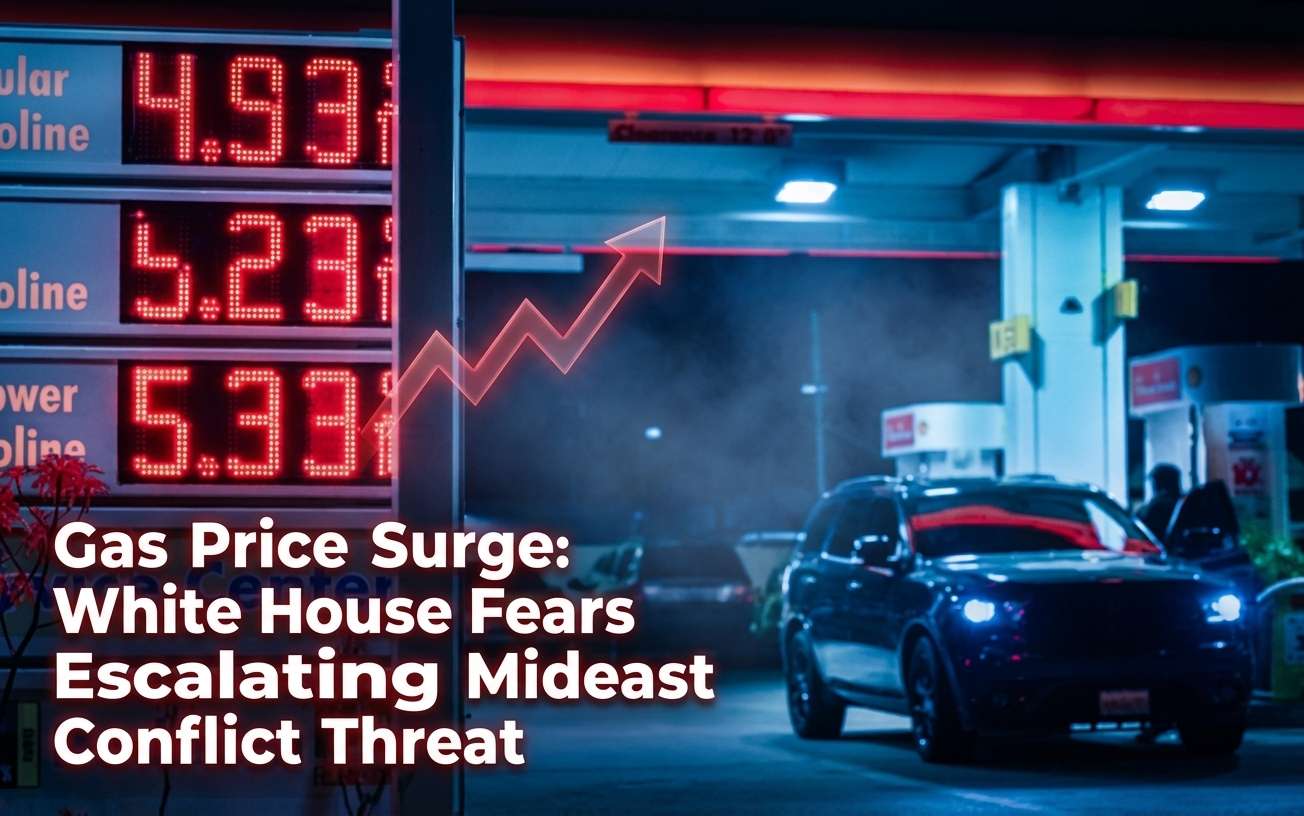
The American driver is feeling the squeeze again, and this time the pressure isn’t just coming from quarterly earnings reports; it’s originating from geopolitical fault lines deep in the Middle East. Across the nation, the average cost of a gallon of regular unleaded gasoline has spiked nearly 27 cents in just seven days, landing uncomfortably at $3.25\. This sharp increase is signaling a very clear market anxiety: the escalating conflict between the US and Israel against Iran is now tangibly threatening the arteries of global oil supply routes, and Washington is reportedly panicking.
This isn’t just pocket change lost at the pump; this is a psychological bellwether for inflation and consumer confidence. The immediate impact is visceral. For many American households operating on tight budgets, this jump represents an immediate budget cut—less spending on discretionary goods, more sleepless nights calculating commutes, and a direct headwind for any potential economic recovery narrative heading into the latter half of the year. The fact that the White House, now reportedly driven by aides like Donald Trump’s chief of staff Susie Wiles, is urgently searching for remedies illustrates the political toxicity of high energy prices, especially when they are directly linked to unresolved international conflict.
The anxiety level within the corridors of power suggests they are keenly aware that while the US energy landscape has fundamentally changed, it has not become entirely immune to global shocks. The worry isn’t merely about the current $3.25 average; it’s about the trajectory set by the Strait of Hormuz closure. When Iran effectively choked off traffic through that vital chokepoint—a waterway responsible for moving approximately 20% of the world’s energy supplies—the die was cast for higher prices globally, irrespective of how much oil America pumps domestically.
The Fading Shield: How US Fracking Resilience is Being Tested
For years, the booming shale revolution offered a comforting narrative: the United States, self-sufficient in crude production, was largely shielded from the volatility that plagued markets when Middle Eastern tensions flared. We became the world’s largest crude oil producer, outpacing rivals like Saudi Arabia. Predictions suggest the US could pump a near-record 13.6 million barrels of crude per day by 2026, according to EIA projections. This sheer volume was supposed to act as a shock absorber, ensuring that American consumers were insulated from the geopolitical theater playing out overseas.
However, oil remains a globally priced commodity. When Brent crude, the international benchmark, surges past $90 a barrel following aggressive rhetoric concerning Iran’s unconditional surrender, that price is immediately priced into every barrel traded internationally, including those feeding American refineries. The temporary calm seen when the US pledged naval escorts for tankers through the Strait of Hormuz proved fragile. Prices climbed again when the geopolitical temperature rose, demonstrating that while US production capability is massive, the risk premium associated with shipping and global inventory management is embedded in the pump price.
Market analysts like Patrick De Haan of Gas Buddy anticipate that even if current oil prices stabilize, retail gasoline could still climb another 20 to 25 cents, pushing the national average toward $3.40\. This creep is the delayed effect of the futures market reacting to supply chain instability. The cushion is high, certainly, but it is not infinite. The dynamic hinges on whether high prices persist long enough to incentivize sufficient reactivation of drilled but uncompleted wells or the rapid planning of new drilling projects, a process that takes time, regardless of immediate executive branch pressure.
Historical Echoes: Remembering the $5.00 Shock of 2022
To understand the current gravity, we must revisit the trauma of mid-2022\. Following Russia’s invasion of Ukraine, the world saw an energy shock that was arguably more immediate and supply-constrained than the current geopolitical risk premium. During that period, US gasoline prices soared to an average of $5.01 per gallon nationwide. That level of sustained pricing caused consumers to actively change behavior, slashing discretionary spending and acting as an undeniable drag on GDP growth.
The comparison to 2022 is crucial because it provides a scale for potential pain. Joseph Brusuelas, Chief Economist for RSM, offers a crucial metric: the US economy, a gargantuan $30 trillion entity, can absorb significant shocks, but it has finite limits. Brusuelas estimates that sustained oil prices hitting $125 per barrel, translating to gasoline near $4.25 a gallon, would inflict measurable damage—potentially dropping GDP by 0.8% and pushing core inflation up toward 4%.
Every $10 increase in the barrel price correlates to an estimated 0.1% loss in growth and a 0.2% rise in price levels. This relationship shows clearly why the White House is so nervous, even if the current average is only $3.25\. The market is pricing the \*risk\* of hitting those damaging thresholds, which explains the rapid 27-cent jump recently. The relative resilience of the economy post-2022 is often cited, but history shows that when pain hits the wallet at this level, consumer sentiment evaporates quickly, slowing down economic momentum far faster than economists might predict in controlled models.
The Shale Producer Dilemma: Waiting for the Long Signal
The core question facing Washington and the markets is whether current high prices will trigger the necessary production response from the American shale patch. In previous energy scares, oil producers rapidly ramped output once sustained higher prices signaled profitability. However, the calculus has changed for these companies post-pandemic. Capital discipline, demanded by cautious investors, now reigns supreme over the ‘drill at all costs’ mentality that characterized the last decade.
Rob Thummel, Senior Portfolio Manager at Tortoise Capital, provides the critical insight here: producers need a sustained period above a certain threshold, likely $70 per barrel, before they commit significant capital to increase output meaningfully. They are not going to rush back into high-volume production based on a week of geopolitical jitters. They need assurances that the high price environment will last long enough to justify the expense of reactivating rigs and bringing drilled wells online.
While the US is forecast to nearly set a production record in 2026, that production timeline is still too slow to counteract an immediate, severe disruption in the Strait of Hormuz. If that route remains choked, global oil—even if US domestic production rises marginally—will trade at a significant scarcity premium. A modest increase of half a million barrels a day might be the initial response from shale, but that is a drop in the bucket compared to the multi-million barrel flow through the chokepoint currently at risk around \*\*March 9\*\*.
Forecasting the Next Quarter: Three Paths Diverge
The path forward for gasoline prices is entirely contingent upon the diplomacy and military maneuverings occurring in the Gulf. We are approaching several critical decision points that will determine whether consumers see further hikes or a slight reprieve. There are three distinct scenarios that traders and policy advisors are currently modeling.
Scenario One: Diplomatic De-escalation and Stabilization. If a sustainable ceasefire or significant reduction in hostilities occurs, and the Strait of Hormuz reopens to normal traffic in the coming weeks, the immediate risk premium on oil prices would collapse rapidly. We would likely see Brent crude fall back towards the $80 range, and gas prices could stabilize or even retreat slightly from the $3.25 mark. This scenario relies on external parties successfully mediating a quick end to the high-tension environment, allowing the global supply cushion to effectively reset.
Scenario Two: Sustained Tension with Limited Blockade. This is a higher-risk path where conflict remains geographically constrained but the threat to shipping remains high, forcing insurers and tanker companies to demand excessively high security premiums. In this case, oil prices might hover stubbornly between $90 and $100 for several months. This sustained pricing—combined with the US not yet fully pushing shale output past expectations—would likely see the national average gasoline price creep toward $3.50, putting undeniable pressure on consumer spending by \*\*March 9\*\* and beyond.
Scenario Three: Full Supply Disruption. This is the catastrophic scenario where the Strait of Hormuz closes entirely for an extended period, forcing oil to be rerouted or creating an immediate scarcity shock that supersedes US domestic production benefits. If this occurs, the $125 barrel price tag becomes a realistic target. The resulting economic fallout, as predicted by RSM economists, would be significant, potentially triggering mandatory strategic reserve releases and forcing emergency policy action from the Federal Reserve, shifting focus entirely from inflation management to growth preservation.
The reality facing both Wall Street and Main Street is that the luxury of energy independence during a major geopolitical crisis has proven illusory. While American producers have built incredible capacity, the mechanics of the global energy trade mean that risk priced in the Middle East ultimately transfers its cost directly to the American consumer at the service station.
FAQ
What is the current national average price for regular unleaded gasoline mentioned in the article?
The national average cost of a gallon of regular unleaded gasoline has spiked to $3.25. This reflects a sharp increase of nearly 27 cents over the preceding seven days, signaling heightened market anxiety.
What geopolitical conflict is primarily driving the current surge in US gas prices?
The surge is being driven by escalating conflict between the US and Israel against Iran. This tension is critically threatening the arteries of global oil supply routes, particularly the Strait of Hormuz.
Why is the price increase significant beyond the immediate cost at the pump?
It serves as a psychological bellwether for broader inflation and negatively impacts consumer confidence. For many households, it necessitates immediate budget cuts to discretionary spending.
Which vital waterway contributes 20% of the world’s energy supplies that is currently threatened?
The Strait of Hormuz is identified as the vital chokepoint being threatened by Iran. Its closure or significant disruption dictates a trajectory for higher global oil prices.
How has the US shale revolution historically shielded Americans from Middle Eastern conflicts?
The booming shale revolution made the US the world’s largest crude oil producer, which was intended to act as a supply shock absorber against external volatility. This massive domestic output was supposed to insulate daily pump prices from external geopolitical theater.
How does the Brent crude price impact American gasoline prices despite high US production?
Oil remains a globally priced commodity, meaning that when international benchmarks like Brent crude surge (e.g., past $90), that higher price is immediately applied to all oil traded internationally, including that used by US refineries.
What is the anticipated near-term gasoline price target predicted by analysts like Patrick De Haan?
Analysts anticipate that retail gasoline could climb another 20 to 25 cents even if current crude prices stabilize. This scenario suggests the national average could creep toward $3.40 due to delayed effects from futures market reactions.
What critical metric must shale producers wait for before meaningfully increasing output?
Producers are now prioritizing capital discipline and require a sustained period above a certain price threshold, likely $70 per barrel, before committing funds to ramp up production.
What were the peak US gasoline prices Americans experienced during the 2022 energy shock?
Following Russia’s invasion of Ukraine, US gasoline prices reached an average high of $5.01 per gallon nationwide. That historical trauma serves as a scale benchmark for potential future pain.
According to RSM Chief Economist Joseph Brusuelas, what oil price level would cause measurable damage to the US economy?
Sustained oil prices hitting $125 per barrel, translating to gasoline near $4.25 a gallon, is estimated to inflict measurable damage. This level could potentially drop US GDP by 0.8%.
How much does the correlation between oil price hikes and economic performance suggest the White House is nervous?
Every $10 increase in the oil barrel price equates to an estimated 0.1% loss in US growth and a 0.2% rise in price levels. This clear metric explains the administration’s unease even at current lower averages.
What is the expected US crude production forecast by 2026 according to EIA projections?
The US is predicted to pump a near-record 13.6 million barrels of crude per day by 2026. However, this projected increase is still too slow to counteract an immediate supply shock.
Why is the ‘drill at all costs’ mentality no longer characterizing shale producers?
Post-pandemic, shale producers face intense pressure from cautious investors demanding capital discipline over volume expansion. They are hesitant to commit large capital expenditures based only on temporary geopolitical jitters.
What is the primary factor determining which of the three economic scenarios for gas prices unfolds?
The path forward is entirely contingent upon the diplomacy and military maneuverings occurring in the Middle East. The speed and success of de-escalation efforts in and around the Gulf will be decisive.
What defines Scenario One: Diplomatic De-escalation?
This scenario requires a sustainable ceasefire and the swift reopening of the Strait of Hormuz to normal traffic within weeks. If achieved, Brent crude could fall toward $80, and gas prices might retreat from $3.25.
What is the outcome projected in Scenario Two: Sustained Tension with Limited Blockade?
Conflict remains geographically constrained, but high security premiums keep oil prices hovering stubbornly between $90 and $100 per barrel for months. This could push the national gasoline average toward $3.50.
What is the catastrophic outcome described in Scenario Three: Full Supply Disruption?
This involves the Strait of Hormuz closing entirely for an extended period, immediately creating a scarcity shock where $125 per barrel becomes a realistic target. This would likely trigger strategic reserve releases.
What is the approximate volume of oil flow through risk areas like the Strait of Hormuz that domestic US production cannot immediately replace?
The waterway is responsible for moving approximately 20% of the world’s energy supplies. A potential loss of multi-million barrels a day throughput far exceeds the immediate production response shale can offer.
What key figure is reported to be urgently searching for remedies within the White House regarding high energy prices?
The article reports that aides, specifically naming Donald Trump’s chief of staff, Susie Wiles, are driving the urgent search for remedies.
What is the timeframe mentioned where sustained tension could push gas prices toward $3.50?
Scenario Two suggests that sustained pricing pressures could see the national average creep toward $3.50 by March 9 and beyond. This date marks a critical near-term forecast checkpoint.
Why is the current US energy resilience considered ‘illusory’ during this crisis?
The luxury of energy independence is deemed illusory because the mechanics of global trade ensure that risk priced in the Middle East—specifically shipping and insurance costs—is immediately transferred to the American consumer’s pump price.