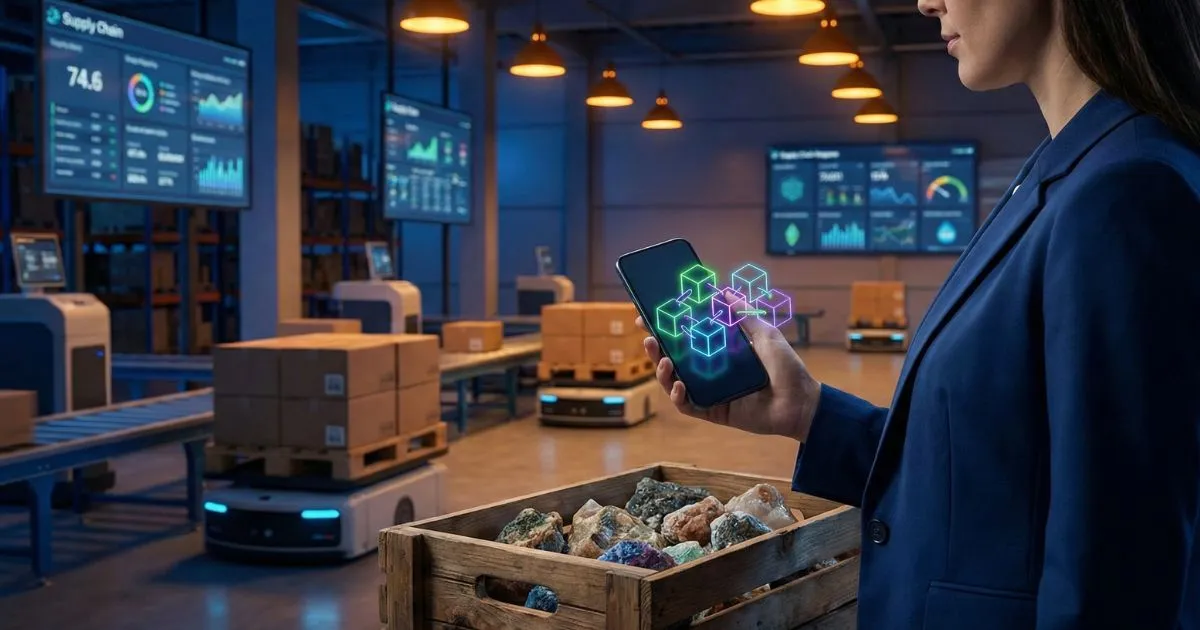
I spent a morning last week in a warehouse that smelled faintly of ozone and old cardboard, watching a technician scan a crate of raw cobalt destined for a battery plant. Ten years ago, that crate would have been accompanied by a stack of paper invoices, a few dubious stamps of approval, and a lot of hope. Today, that technician’s handheld device didn’t just log a arrival, it pinged a decentralized network that verified the mineral’s journey from a specific, audited artisanal mine thousands of miles away. It felt clinical, almost mundane, but beneath the surface of that digital handshake lies the most significant shift in corporate accountability we have seen in a generation. We have moved past the era of the pinky-promise and into the era of the cryptographic receipt. Blockchain Sourcing has become the silent arbiter of truth in a world that is increasingly weary of greenwashed marketing and vague corporate social responsibility reports.
The shift didn’t happen because CEOs suddenly grew a collective conscience. It happened because the math became unarguable. When a ledger is distributed across a thousand nodes, the cost of lying becomes higher than the cost of simply doing the right thing. I remember talking to a procurement officer for a major electronics brand who admitted that, in the early 2020s, their supply chain was essentially a black box. They knew their tier-one suppliers, but the tier-threes and tier-fours were ghosts in the machine. Now, in 2026, those ghosts have digital identities. Every movement, every hand-off, and every ethical certification is hashed into a block that cannot be rewritten by a clever accountant or a corrupt local official. It is a strange kind of comfort, knowing that the purity of a product is no longer a matter of opinion but a matter of computation.
Navigating the New Architecture of Ethical Business
Building an Ethical business in this climate requires more than just a mission statement, it requires a technical infrastructure that can withstand a forensic audit at any moment. I have watched several firms struggle with this transition, often because they treat blockchain like a shiny new software update rather than a fundamental rewiring of how they interact with the world. The reality of 2026 is that transparency is a liability if you have something to hide, but it is the ultimate competitive advantage if you don’t. We are seeing a divergence in the market. On one side, companies are embracing these transparent rails to prove their ESG metrics in real-time. On the other, those who cling to the old, opaque ways of doing business are finding themselves increasingly uninsurable and uninvestable.
There is a particular kind of friction that occurs when a traditional business model meets a transparent ledger. It forces a level of honesty that can be uncomfortable. For instance, if a smart contract is programmed to only release payment when a specific labor certification is uploaded from a third-party auditor, there is no room for a mid-level manager to look the other way for the sake of meeting a quarterly deadline. The code is indifferent to your production targets. This cold, hard logic is exactly what is driving the surge in consumer trust. People are tired of hearing that a brand is sustainable, they want to see the hash. They want to know that the cotton in their shirt didn’t just come from a farm, but from a farm that hasn’t been flagged for soil depletion or labor violations on the public record.
The Evolution of the Supply Chain Audit
The traditional Supply chain audit used to be a snapshot in time, a clipboard-wielding consultant visiting a factory for four hours once a year. It was a performance, often carefully choreographed to hide the very things it was meant to find. By 2026, the audit has become a continuous, living stream of data. Sensors in shipping containers, satellite imagery of mining sites, and biometric check-ins for workers are all being fed directly into the chain. This isn’t just about catching the bad actors, it is about rewarding the good ones. Small-scale farmers in Southeast Asia or miners in the DRC who can prove their compliance are finally getting direct access to global markets without having to pay a middleman to vouch for them. The technology is effectively democratizing trust.
I find myself thinking about the “digital twins” of physical goods quite often. Every pound of coffee or ounce of gold now exists twice: once in the physical world and once as a token on a ledger. If the two don’t match, the system screams. This level of granular detail has turned the life of a compliance officer from a game of detective work into one of data management. It is less about finding the needle in the haystack and more about ensuring the haystack was built correctly in the first place. The implications for the finance niche are massive. Risk is no longer a guess. When a company can prove the purity of its supply chain through an immutable record, its cost of capital drops. Lenders in 2026 are looking at blockchain data as much as they are looking at balance sheets, because a clean supply chain is the best hedge against the massive regulatory fines that are now the norm for environmental or human rights violations.
The beauty of this system, if beauty is the right word for a series of cryptographic proofs, is its persistence. A brand cannot “delete” a bad year. The blocks remain, a permanent record of where things went wrong and how they were fixed. This creates a long-term incentive for ethical behavior that quarterly profit incentives never could. We are moving toward a state where the market itself polices behavior through radical visibility. It is a world where the most valuable asset a company owns isn’t its intellectual property or its real estate, but its history of verified actions.
As I left that warehouse last week, I realized that we are still in the early days of this transformation. We are still learning how to handle the sheer volume of truth that these systems produce. But the direction is clear. The era of the “untraceable” ingredient is ending. Whether you are a consumer looking for a guilt-free purchase or an investor looking for a resilient asset, the ledger is becoming the primary source of reality. It is a bit colder than a human promise, perhaps, but it is infinitely more reliable. In a world of deepfakes and doctored reports, there is something profoundly grounding about a piece of data that simply cannot be changed.