
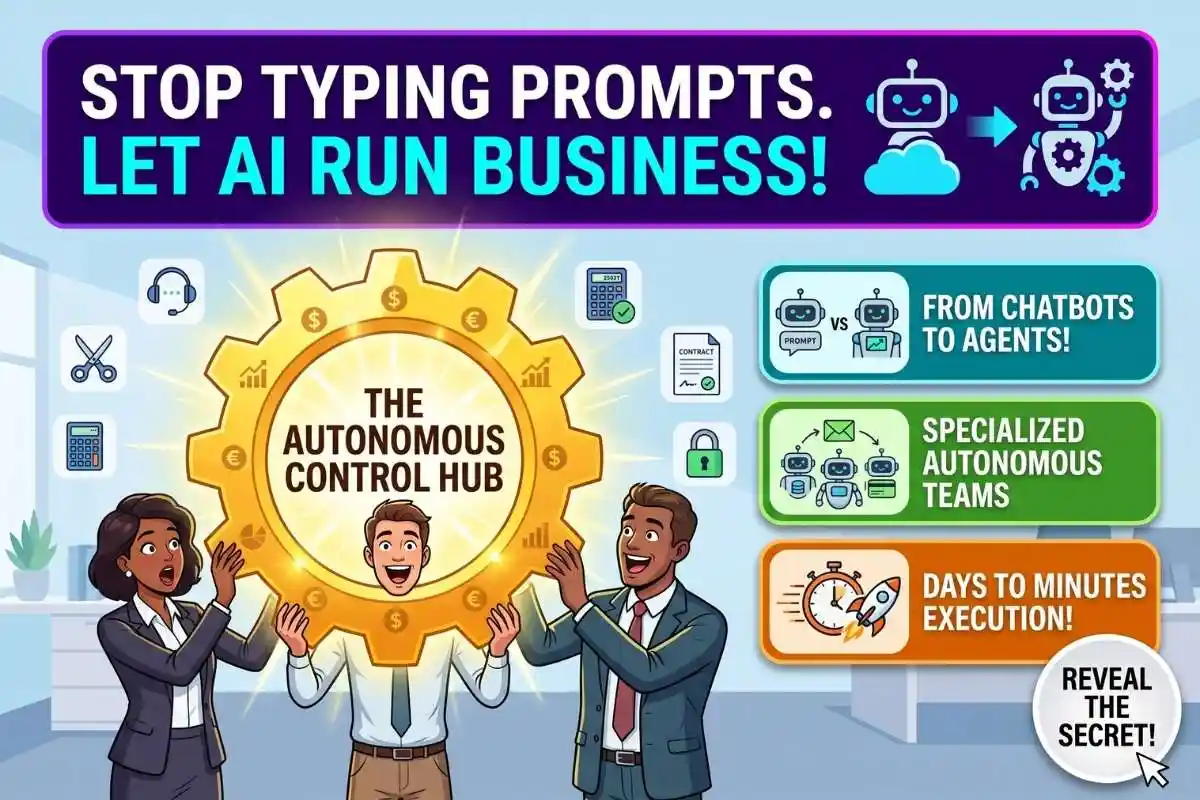
Remember when using artificial intelligence meant carefully typing out a request into a chatbox, hoping the machine understood your intent, and then manually copying its output into an email or spreadsheet? That era of conversational ping-pong is rapidly coming to a close. Today, modern businesses are entering a dynamic new operational frontier where software no longer waits passively for human instructions. Instead, intelligent systems actively plan, collaborate, and execute entire end-to-end business processes on their own. Welcome to the era of enterprise agentic workflows, a transformative workplace evolution designed to liberate human workers from repetitive digital chores. Rather than managing software tools step-by-step, business leaders simply assign an overarching corporate objective, sit back, and allow autonomous digital coworkers to orchestrate the heavy lifting across corporate networks.
The Shift From Reactive Chatbots to Proactive Digital Coworkers
To understand how we arrived at this pivotal technological milestone, we must examine the inherent limitations of traditional generative artificial intelligence. Standard chatbots are remarkable text generators, but they remain fundamentally reactive; they sit completely dormant until a human user feeds them a specific prompt. Once they output a singular response, their operational utility ceases, leaving the human worker to verify factual accuracy, switch software applications, and carry out the physical execution of the task. Enterprise agentic workflows completely invert this traditional dynamic. Built upon the foundational computer science principles of intelligent agents, these advanced digital systems possess independent reasoning capabilities, contextual working memory, and secure API connections to enterprise databases. When assigned a multifaceted goal—such as resolving a delayed logistics shipment or reconciling a complex quarterly expense audit—an agentic workflow autonomously decomposes the massive objective into sequential sub-tasks. It queries internal databases, drafts personalized vendor communications, and routes explicit approval requests directly to relevant managers, transforming artificial intelligence from a passive drafting tool into an active coworker.
Behind the Curtain: How Multi-Agent Teams Collaborate
What makes enterprise agentic workflows truly extraordinary is that they rarely rely on a single software program attempting to manage every complex corporate operation simultaneously. Instead, modern enterprise architectures deploy specialized teams of autonomous agents that communicate and collaborate, mirroring the structured division of labor found in human departments. In a standard enterprise orchestration framework, an executive “conductor” agent receives the primary strategic directive from leadership. This conductor evaluates the broader operational requirements and delegates distinct sub-routines to specialized worker agents. For example, within a global supply chain network, one agent might monitor real-time shipping port congestion, while a second agent inspects regional warehouse inventory levels. Concurrently, a third agent negotiates replacement material pricing via automated email exchanges with verified suppliers. As these independent agents operate, they continuously share intermediate findings through shared memory ledgers, cross-referencing data and challenging each other’s logical assumptions to eliminate hallucinations before executing finalized corporate actions across live production environments.
| Operational Dimension | Traditional Generative AI | Enterprise Agentic Workflows |
| Execution Style | Reactive (waits for human prompts) | Proactive (pursues overarching corporate goals) |
| System Integration | Isolated browser or chat window | Deep API access across enterprise software |
| Task Complexity | Single-turn responses and text drafting | Multi-step planning, execution, and self-correction |
| Human Involvement | Constant manual prompt input and review | Strategic goal-setting and exception handling |
| Business Impact | Minor individual task acceleration | End-to-end departmental process automation |
Real-World Impact Across Core Corporate Industries
The tangible benefits of autonomous workflows are already materializing across major global industries, demonstrating that this technological shift extends far beyond theoretical laboratory hype. In customer support divisions, agentic systems no longer simply provide generic troubleshooting hyperlinks; they investigate root causes by analyzing historical billing records, diagnosing technical faults, and issuing customized service refunds instantaneously. Within the financial sector, autonomous compliance agents inspect thousands of daily ledger transactions, identifying subtle fraudulent patterns and generating comprehensive regulatory audit documentation without suffering from human cognitive fatigue. Furthermore, corporate software development has experienced a truly radical shift. Rather than relying entirely on human engineers for routine maintenance, agentic workflows autonomously diagnose syntax bugs, write functional code patches, run testing suites inside virtual sandbox environments, and deploy validated software updates directly to live production servers. By integrating sophisticated artificial intelligence into their core operational infrastructure, organizations are shrinking complex execution timelines from several days to mere minutes.
Safeguarding the Enterprise: Governance and Human Oversight
Granting autonomous software direct control over critical corporate operations naturally introduces significant challenges surrounding enterprise governance, cybersecurity, and regulatory accountability. An unchecked software agent capable of reading confidential customer databases, initiating wire transfers, or transmitting binding legal agreements presents an unacceptable business risk. To neutralize these operational vulnerabilities, enterprise agentic workflows incorporate strict human-in-the-loop verification mechanisms and deterministic security guardrails. Enterprise orchestration platforms empower IT leaders to establish immutable operational boundaries for digital workers. During routine, low-stakes activities—such as categorizing inbound sales inquiries or updating customer contact profiles—agents operate with unrestricted autonomy. However, whenever a workflow encounters an exceptional scenario, such as approving an unverified vendor payment exceeding a specific monetary threshold, the autonomous sequence pauses immediately. The system generates an explanatory summary of its intended action and alerts a designated executive for explicit cryptographic approval before execution, ensuring organizations maintain absolute authority over sensitive corporate decisions.
The Curiosity Horizon: What Happens When AI Hires AI?
As we stand on the frontier of this autonomous business transformation, an intriguing and profound curiosity emerges: what happens when digital agents become capable of hiring other digital agents? Consider a dynamic scenario where an enterprise marketing agent detects a sudden viral surge in consumer demand for a specialized product line. Instead of awaiting human administrative intervention, the primary agent autonomously commissions three temporary sub-agents: one to generate targeted regional advertisements, one to optimize search engine visibility, and a third to coordinate localized warehouse fulfillment. Once the consumer demand spike normalizes, the primary agent quietly decommissions its digital hirelings, optimizing computational overhead instantly. We are entering an economic era where competitive superiority will no longer belong to corporations with the largest human workforces, but rather to those operating the most agile, self-organizing digital ecosystems. Ultimately, long-term enterprise success no longer depends on mastering the manual art of prompt engineering; it requires the visionary courage to design an autonomous digital workforce.
Frequently Asked Questions
What is the difference between traditional robotic process automation and agentic AI?
While traditional robotic process automation excels at automating high-volume, repetitive digital tasks, it operates strictly on rigid, pre-programmed scripts. If an unexpected user interface pop-up appears or data formatting deviates even slightly from the static script, a standard automation bot fails immediately and requires manual developer debugging. Enterprise agentic workflows, conversely, leverage underlying cognitive language models to interpret broader context and dynamically adapt to unexpected obstacles. When an intelligent agent encounters an unfamiliar software layout or missing database field, it autonomously reasons through the problem, queries alternative corporate repositories, and dynamically adjusts its execution path without requiring human coding intervention or workflow interruption.
How do organizations ensure data privacy when deploying autonomous agents across enterprise systems?
Protecting corporate privacy within autonomous workflows requires implementing strict zero-trust data architectures and granular role-based access controls. Modern agentic orchestration platforms ensure that digital workers inherit the exact same security permissions and authorization boundaries as the human employees who supervise them. Furthermore, sensitive customer personally identifiable information and proprietary corporate trade secrets are systematically masked or encrypted before being processed by underlying language reasoning models. Organizations also deploy specialized automated guardrails that continuously monitor agent behavior in real time, immediately terminating any autonomous sequence that attempts to exfiltrate restricted records or communicate with unauthorized external network endpoints.
