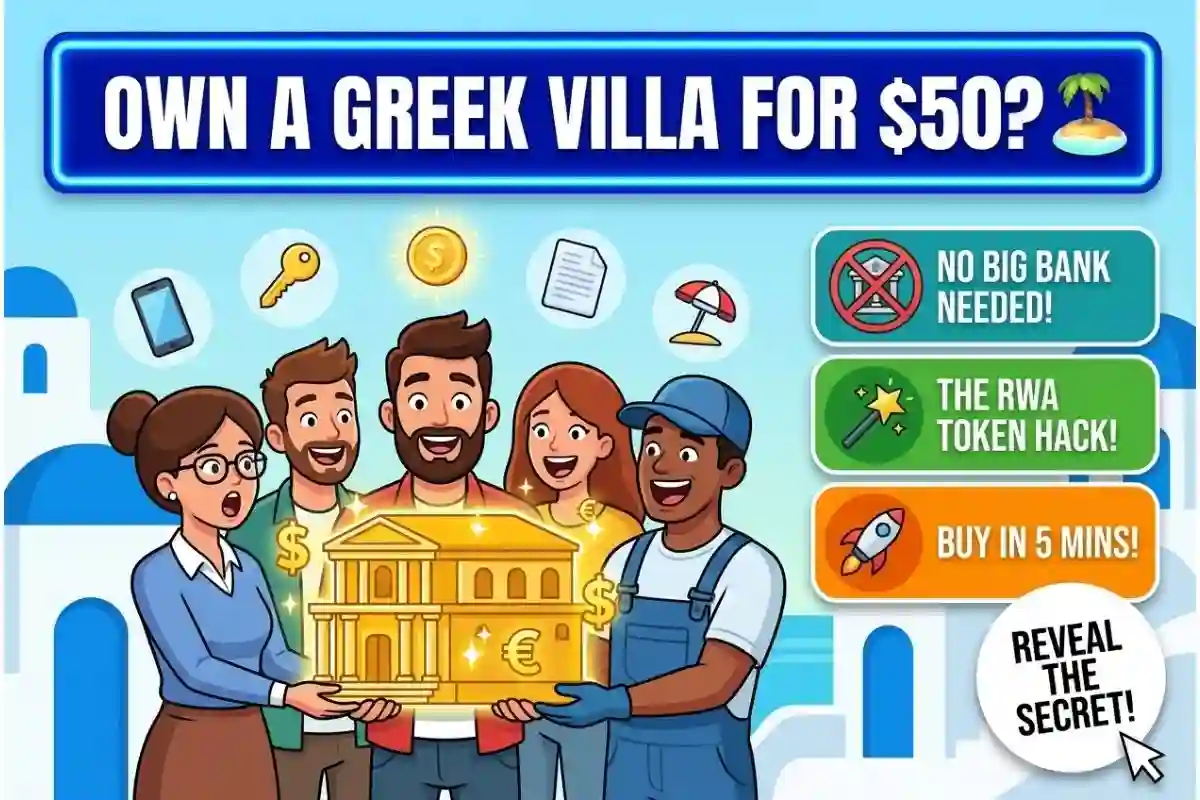
Imagine the cerulean waters of the Aegean Sea, the iconic whitewashed walls of Santorini, and the warm Mediterranean breeze sweeping across a private, sun-drenched terrace. For decades, owning a slice of this paradise was a privilege strictly reserved for the ultra-wealthy, remaining nothing more than a beautiful pipe dream for the average vacationer. But as we navigate through the vibrant and evolving economic landscape of 2026, a groundbreaking financial shift is making the impossible entirely accessible to the public. You no longer need millions of dollars in the bank to claim a stake in a luxurious European getaway. Thanks to rapidly advancing financial technologies, the doors to international property ownership have swung wide open for everyday investors. For as little as $50, you can now purchase a legally binding, fractional share of a high-end Greek villa just in time to capitalize on the bustling summer tourist season. This isn’t a restrictive timeshare gimmick from the 1990s; it is a sophisticated, digitally backed method of wealth-building that is rapidly transforming how we think about global property markets, passive income, and personal investment portfolios.
The Democratization of International Real Estate
The traditional path to buying an overseas vacation home has always been fraught with almost insurmountable hurdles for the average working person. Historically, purchasing a property in a highly desirable location like the Greek islands meant dealing with astronomical down payments, navigating complex and foreign international property laws, enduring mountains of obscure legal paperwork, and committing to exorbitant ongoing maintenance fees. Picture yourself trying to buy a beautiful cliffside villa in Mykonos through the old system; you would inevitably need to hire a local lawyer, secure a hefty cross-border mortgage with terrible interest rates, and employ a full-time property management team just to keep the lights on and the pool clean while you are back home. This outdated, friction-heavy model effectively locked out millions of eager investors who desperately wanted exposure to the lucrative European tourism market but simply lacked the immense upfront capital required to get their foot in the door. However, the narrative has fundamentally changed in recent years. We are currently witnessing a massive democratization of wealth where the towering barriers to entry have been dismantled piece by piece. Instead of forcing individuals to buy the entire financial pie, modern platforms allow investors to pool their resources together to buy precisely measured slices. This paradigm shift means that a school teacher in Ohio or a graphic designer in Tokyo can instantly own a tangible piece of the Mediterranean dream, sharing in both the rental yields and the potential appreciation of the property without ever having to worry about a leaky roof.
The Power of Tokenized Real Estate
At the very heart of this incredible market transformation is a technological innovation known as tokenized real estate. But what exactly does this specific term mean for the everyday buyer looking to invest their $50? In simple, practical terms, tokenization is the rigorous legal and digital process of converting the ownership rights of a physical, real-world asset into digital tokens on a highly secure network. Imagine taking a spectacular $5 million Greek villa and legally dividing its deed into 100,000 equal digital shares, each priced at exactly $50. These digital tokens act as legally binding certificates of ownership, recorded permanently and transparently on a digital ledger that cannot be altered or forged. This revolutionary process completely removes the need for slow, expensive middlemen like traditional brokers, title agencies, or escrow officers, allowing international transactions to happen almost instantly and with significantly reduced fees. If you want to dive deeper into the underlying ledger technology that securely powers these modern transactions, you can explore the comprehensive overview of Blockchain provided by Wikipedia. By utilizing this incredibly secure digital framework, tokenized real estate ensures that every single $50 investment is backed by real, physical bricks and mortar in the real world. It is a brilliant fusion of cutting-edge financial technology and one of the world’s oldest and most historically stable asset classes, offering unparalleled flexibility. Unlike a traditional physical property that can take many months or even years to sell, these digital tokens can often be traded on regulated platforms in a matter of seconds, giving modern investors unprecedented control over their capital.
Redefining Fractional Vacation Homes
When you participate in this modern financial ecosystem, you are essentially investing in fractional vacation homes, a concept that completely redefines the boundaries of both the hospitality and real estate sectors. Let’s break down exactly how this plays out in the real world for an investor aiming to capitalize on the massive 2026 summer tourist rush in Greece. A specialized, heavily vetted property management company officially acquires the luxury villa, seamlessly handles all the complex legal tokenization, and maintains the physical property to a five-star standard year-round. As a verified token holder, you are legally entitled to a proportional share of the net rental income generated whenever global tourists book the villa for their summer holidays. Because Greece consistently ranks as one of the world’s absolute top tourist destinations—drawing millions of visitors to its islands every single summer—a well-managed luxury property can generate highly substantial seasonal revenue. Furthermore, if the underlying physical property value increases over time—perhaps due to a booming global travel sector, inflation, or local infrastructure upgrades in Greece—the open-market value of your digital tokens will theoretically rise in tandem. Some innovative platforms even offer exciting utility perks alongside the standard financial returns, allowing investors who hold a certain number of digital tokens to book heavily discounted stays at the very property they co-own. This means you are not just making a sterile financial calculation; you are buying into a vibrant lifestyle ecosystem, securing the passive income of a landlord while enjoying the ultimate flexibility of a digital investor.
The Rise of RWA Investing 2026
This fascinating trend of buying $50 shares in Mediterranean luxury properties is not an isolated, fleeting phenomenon; rather, it is a vital and rapidly growing component of the broader movement known globally as RWA investing 2026. RWA stands for “Real World Assets,” and the systematic process of bringing these tangible assets onto highly efficient digital ledgers is currently one of the most significant trends in global finance. For many years, digital investments were largely confined to highly volatile cryptocurrencies that were completely untethered from any physical reality or intrinsic value. Today, the global financial focus has shifted dramatically toward digitizing tangible, cash-flowing assets like commercial real estate, fine art, precious metals, and even agricultural land. The United States government, alongside various international regulatory bodies, has actively begun closely monitoring, guiding, and shaping the strict policies around these digital assets to ensure consumer protection and market stability, as detailed in educational resources provided by the U.S. Securities and Exchange Commission (SEC). By successfully tokenizing Real World Assets, the financial industry is finally bridging the long-standing gap between traditional Wall Street stability and modern Web3 efficiency. For the smart investor looking at the economic landscape of 2026, RWA investing offers a highly unique and secure harbor. It provides an excellent, historically proven hedge against inflation—since premium real estate historically retains and grows its value—while simultaneously offering the frictionless modern conveniences of digital trading apps. As we move deeper into this decade, the tokenization of physical properties is rapidly transitioning from a niche technological experiment into a mainstream, essential financial strategy.
Comparing the Old Way vs. The New Way
To truly understand the massive leap forward this technology represents for the average person, it helps to see the stark differences laid out side-by-side. Here is a quick breakdown of how traditional property buying compares to the modern tokenized approach:
| Feature | Traditional Real Estate | Tokenized Real Estate |
| Minimum Investment | $100,000+ (Down payments) | As low as $50 |
| Time to Purchase | 30 to 90 days | Under 5 minutes |
| Liquidity (Selling) | Low (Months or years to sell) | High (Instant peer-to-peer trading) |
| Maintenance Burden | High (Owner manages repairs) | None (Handled by platform) |
| Geographic Barriers | High (Complex foreign laws) | None (Accessible globally via app) |
Frequently Asked Questions (FAQ)
What exactly happens to my investment if the Greek villa is damaged by a storm or natural disaster? Every properly tokenized physical property is required to carry comprehensive, premium commercial property insurance. In the rare event of severe damage from a storm, fire, or other disaster, the insurance policy covers the full cost of the physical repairs. During the rebuilding phase, rental income may temporarily pause, but the underlying value of your digital token remains legally protected by the insurance payout and the land value.
How do I actually sell my $50 tokenized share if I need my money back quickly? Unlike traditional real estate, where you must hire a real estate agent and wait months for a qualified buyer, tokenized shares can typically be sold on secondary digital marketplaces provided by the issuing platform. You simply list your digital tokens at the current market price, and other investors on the platform can purchase them from you almost instantly, providing unprecedented liquidity for property investors.
Are there hidden ongoing fees that will slowly eat into my $50 investment? Transparency is a core feature of the tokenization model. While there are absolutely costs associated with maintaining a luxury property—such as cleaning, property taxes, and management fees—these specific expenses are automatically deducted from the gross rental income before the final profits are distributed to the token holders. You will never be asked to write a surprise check to fix a broken water heater; your returns are simply the net profit.
A Final Curiosity: The Golden Era of Digital Ownership
Did you know that Greece welcomed over 32 million tourists in a single recent year, vastly outnumbering its own actual population of roughly 10 million citizens? This incredible, unyielding demand for high-quality short-term accommodations is exactly what makes the Greek short-term rental market such a highly coveted target for institutional global investors. By leveraging the power of tokenized real estate, the everyday person is finally invited to sit at the table and take a bite of this incredibly lucrative pie. The summer rush of 2026 is rapidly approaching, bringing with it sun-seeking tourists from every corner of the globe. With just a smartphone and a $50 bill, you now have the unprecedented power to transform yourself from a casual, dreaming tourist into a fractional international landlord. The future of global property ownership is already here, and it fits neatly right inside your pocket.