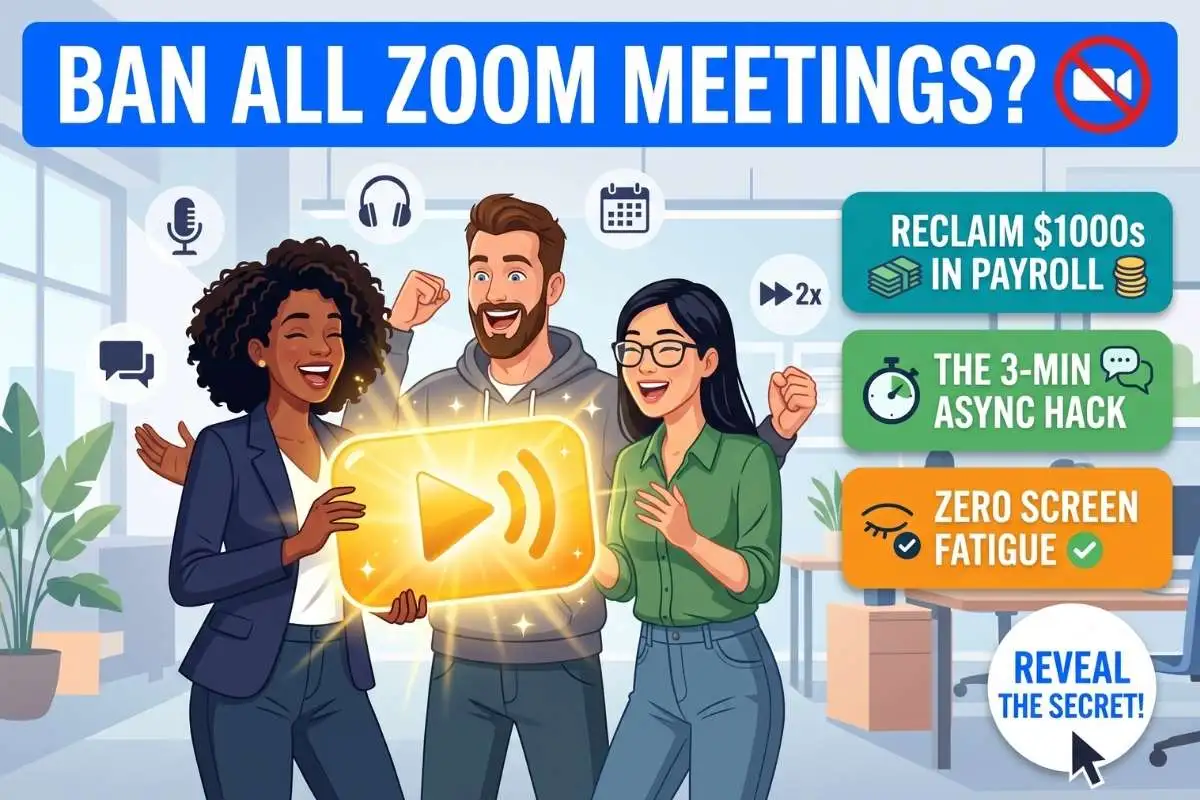
Imagine sitting in a bright apartment in Berlin or a quiet home office in Toronto, sipping your morning coffee while preparing for a productive workday. Now, imagine watching four hours of that day instantly evaporate as you jump from one rigid calendar invitation to the next, staring at a rigid grid of digital faces. For years, remote teams accepted this exhausting ritual as the unavoidable cost of working outside a traditional corporate office. However, a cultural shift has swept through the tech ecosystem. By 2026, progressive founders are officially treating mandatory real-time video calls like legacy fax machines. Instead of forcing distributed teams to synchronize their clocks across multiple continents, modern companies are aggressively adopting asynchronous video workflows.
The Breaking Point of Synchronous Culture
To understand why startup leaders are issuing blanket bans on default live meetings, we must examine the profound psychological toll of synchronous work culture. When global lockdowns initially normalized remote operations, organizations simply translated traditional office habits into digital spaces. If a manager wanted a quick project update, they booked a thirty-minute live call. Yet, cognitive scientists quickly discovered that this constant real-time performance creates severe mental strain. Research published through the National Center for Biotechnology Information highlights how prolonged exposure to on-screen stimuli, intense unnatural eye contact, and continuous self-view monitoring triggers emotional exhaustion. Founders eventually recognized that forcing software engineers, writers, and designers to break their creative flow every two hours for routine status checks actively destroys daily productivity.
How Asynchronous Video Workflows Actually Function
Replacing live meetings does not mean eliminating human face-to-face connection; rather, it means decoupling communication from rigid schedules. In a modern 2026 startup, daily stand-up updates look fundamentally different. Instead of coordinating calendars across London, New York, and Tokyo, a product manager records a crisp three-minute screen walkthrough using dedicated video tools. They visually highlight interface bottlenecks, speak naturally into their microphone, and share the recording link in a team channel. Colleagues watch the update at accelerated playback speeds whenever their personal workflow naturally allows for a break. Furthermore, team members leave threaded text replies or drop quick thirty-second video responses tied to exact timestamps. By applying Wikipedia’s overview of asynchronous communication principles, companies allow information to flow without interrupting focus.
When startup leaders evaluate internal operations, the contrast between legacy live calls and asynchronous messaging becomes starkly apparent across several core metrics.
| Feature | Synchronous Live Calls | Asynchronous Video Workflows |
| Schedule Requirement | Everyone must align calendars simultaneously | Participants consume content on their own schedule |
| Cognitive Impact | High disruption and severe screen fatigue | Preserves deep-work focus and mental energy |
| Global Reach | Punishes employees in distant time zones | Fully equitable for distributed global teams |
| Information Retention | Unrecorded details are forgotten instantly | Creates a permanent, searchable video library |
To see how these operational differences impact your bottom line, use the interactive calculator below to estimate the weekly hours and payroll funds your team could reclaim.
The Economic Reality of Hidden Payroll Burn
Beyond protecting mental well-being, the primary catalyst driving founders to ban real-time meetings in 2026 is simple financial math. During the early days of remote work, leaders viewed calendar invitations as free digital commodities. Today, seasoned executives calculate the literal dollar cost of internal gatherings. When ten senior professionals sit on a sixty-minute live call to review a slide deck that could have been read independently, the organization burns ten hours of expensive payroll on passive listening. In an economic landscape where capital efficiency dictates survival, wasting thousands of dollars a week on status meetings is considered organizational malpractice. Asynchronous video eliminates this financial drain by forcing senders to organize their thoughts beforehand, producing concise updates that dramatically accelerate execution cycles.
Building the 2026 Asynchronous Playbook
Implementing an effective real-time meeting ban requires founders to establish clear operational boundaries and robust digital infrastructure. Companies cannot simply cancel all meetings without providing structured alternative pathways for collaboration. Successful 2026 startups enforce a strict communication hierarchy that dictates exactly how different types of information must be shared. Live synchronous video is strictly reserved for complex sensitive situations, such as initial employee onboarding, emergency server outages, or delicate interpersonal conflict resolution. Everything else—design critiques, code reviews, quarterly financial summaries, and marketing brainstorming—must default to recorded video messages. To support this architecture, organizations leverage intelligent platforms that automatically transcribe videos, extract bulleted action items, and translate spoken audio into native languages, ensuring corporate knowledge is permanently archived.
Frequently Asked Questions About Async Video Workflows
How do teams handle urgent emergencies if real-time meetings are officially banned?
Banning default live meetings does not mean an organization forfeits the ability to handle genuine crises. In the 2026 operating playbook, companies establish explicit protocols distinguishing between routine operational chatter and true emergencies. If a critical database crashes or a major security vulnerability appears, teams bypass asynchronous channels and initiate instant live war rooms or direct voice calls. However, founders strictly enforce the definition of an emergency. A delayed marketing graphic or a minor bug fix never qualifies for an instant live interruption. By fiercely protecting team members from routine interruptions, employees remain calm and highly responsive when a rare emergency demands immediate real-time action.
Doesn’t relying exclusively on recorded video make employees feel isolated and disconnected?
Counterintuitively, teams using asynchronous video frequently report stronger feelings of personal connection than those trapped in endless live meetings. When employees are forced to sit through hours of mandatory video calls, they often turn their cameras off and disengage to protect their mental bandwidth. In contrast, watching a short, expressive recorded message from a colleague allows personality to shine through without the exhausting pressure of performing live. Furthermore, because asynchronous workflows reclaim several hours of focused working time each day, progressive companies encourage employees to use that surplus energy for genuine social bonding, virtual coffee chats, and localized in-person gatherings.
What tools are required to successfully transition a team to an asynchronous model?
Transitioning away from synchronous culture requires a curated technology stack designed specifically for asynchronous media creation and consumption. At the foundation, organizations invest in dedicated asynchronous video software that allows one-click screen recording, webcam capture, and instant link sharing. Alongside video capture tools, teams utilize centralized workplace messaging platforms where recordings can be categorized into specific project channels. Finally, modern workflows rely heavily on artificial intelligence assistants integrated directly into the communication ecosystem. These intelligent systems automatically generate accurate searchable transcripts, summarize key takeaways, and translate video messages across multiple languages to bridge communication gaps across distributed global workforces.
The Curiosity: What Happens When the Noise Stops?
When founders eliminate the relentless ping of meeting notifications and banish the exhausting grid of real-time video calls, something remarkable happens within the organization. The frantic, reactive corporate energy that defined early remote operations gives way to profound calm and deep focus. Software developers write cleaner code, marketers craft more compelling narratives, and strategic leaders make better long-term decisions because they finally have the uninterrupted mental space to think. By abandoning synchronous meetings in favor of asynchronous video workflows, 2026 founders are not just optimizing software tools; they are fundamentally redesigning the human work experience. They are proving that when you stop forcing people to talk about work in real time, they finally get the time to actually do it.