
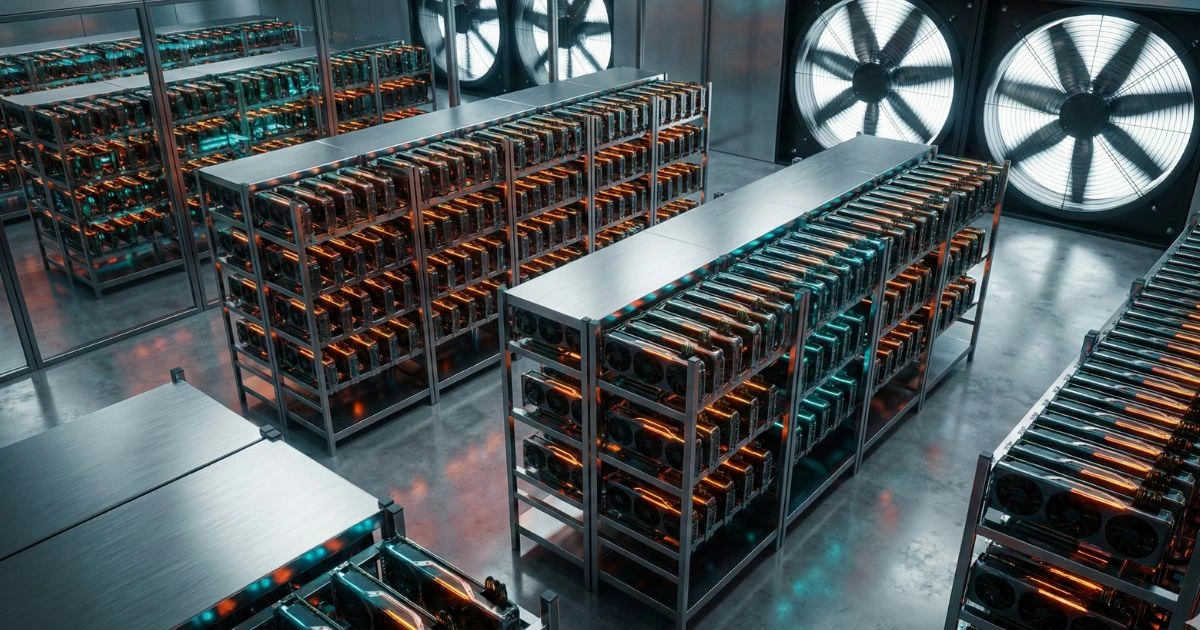
The air in the server room has a specific, metallic scent that never quite leaves your clothes. It is the smell of heat, electricity, and the quiet humming of a thousand digital dreams being processed in real-time. A few years ago, this room might have been dedicated to chasing the next block on a proof-of-work chain, a frantic race against global hashrates that often felt like running up a down escalator. But the landscape has shifted. We have entered a period where the raw materials of the digital age are no longer just speculative coins, but the very compute power that keeps the world’s intelligence functioning. This is the era of Decentralized Physical Infrastructure Networks, or DePIN, and it feels remarkably like the early days of a gold rush, only the shovels are GPUs and the gold is the fluid, shimmering potential of artificial intelligence.
I remember sitting in a dimly lit office in early 2024, watching a screen filled with red and green candles, wondering if the infrastructure play was just another buzzword designed to separate venture capitalists from their liquid assets. It wasn’t. By the time we reached the mid-point of 2026, the narrative had solidified into something far more tangible. The world has a bottomless hunger for intelligence, and that intelligence requires a physical home. Centralized data centers are bursting at the seams, their cooling bills reaching the stratosphere, and their waitlists for high-end silicon stretching into years. This bottleneck created a vacuum, and as any student of history knows, nature—and the market—abhors a vacuum.
The Architecture of AI Compute Tokens and the New Hardware Standard
Walking through a modern facility today, you don’t just see racks of equipment. You see nodes in a global, living brain. The transition from traditional mining to providing resources for decentralized networks has been messy, imperfect, and incredibly lucrative for those who stopped thinking like hobbyists and started thinking like infrastructure providers. We are no longer just guessing at hashes. We are rendering the frames of the next blockbuster film, training large language models that will run the customer service departments of the Fortune 500, and providing the latency-free environment required for autonomous agents to negotiate with one another.
The tokens we earn for this work, often referred to as AI compute tokens, are effectively the lifeblood of this new economy. They represent a claim on a slice of the global processing power. When a developer in Berlin needs to run a simulation but doesn’t want to wait for a legacy cloud provider to approve their credit line, they tap into the network. They pay in tokens, and the individual providers—people with high-performance setups—receive that value directly. It is a peer-to-peer exchange of utility that makes the old ways of doing business look remarkably slow and bureaucratic.
The shift hasn’t been without its casualties, of course. I’ve seen many who held onto their old rigs for too long, hoping for a resurgence of a specific algorithm that never came. The hardware requirements for DePIN 2026 are unforgiving. You need the memory bandwidth, the VRAM, and the interconnect speeds that allow disparate units to function as a cohesive whole. It is no longer enough to just have a GPU; you need to be part of an ecosystem that understands how to route tasks to the most efficient node. This is where the real profit lies, in the orchestration of these resources, moving beyond the “set it and forget it” mentality of the past decade.
Navigating the Reality of GPU Crypto Mining in a Post-Scarcity World
There is a certain irony in talking about GPU crypto mining today. In many ways, the term itself is a relic of a previous era. We are still using the same silicon, sure, but the “mining” part has evolved into something closer to digital tenant management. You aren’t digging for a hidden treasure anymore; you are renting out a high-tech apartment to a very demanding, very fast-moving tenant. The returns are no longer tied purely to the whims of a volatile market, but to the actual, measurable demand for compute.
I often find myself explaining to skeptical colleagues that the volatility hasn’t disappeared, it has just changed its shape. The profitability of a node now depends on its uptime, its geographic location relative to the user, and its ability to handle specific types of workloads. It’s a more professional game. You have to watch your electricity costs with a hawk’s eye, and you have to be ready to pivot when a new protocol offers better incentives for a different type of processing. It’s exhausting, but for those of us who have lived through the lean years, it’s also exhilarating.
The beauty of the 2026 landscape is that the barriers to entry have changed. It isn’t just about who has the most money to buy the latest ASICs anymore. It’s about who can manage their resources most effectively. We see small-scale operations that are incredibly profitable because they’ve found a niche in the market—perhaps providing specialized rendering for boutique architectural firms or supporting localized AI agents in emerging markets. These aren’t the faceless industrial farms of the past; they are agile, smart, and deeply integrated into the communities they serve.
As I look out over the blinking lights of a small cluster we recently helped a client stabilize, I can’t help but wonder where the ceiling is. Every time we think we’ve reached a point of saturation in the demand for AI, a new application emerges that requires even more power. It’s a cycle of growth that seems destined to continue for the foreseeable future. The gold is there, scattered across the digital landscape in the form of idle cycles and untapped potential. All that’s left is to build the pipes that allow it to flow.
The conversation around these assets is shifting from “what is this?” to “how do I scale this?” and that is a very healthy place for any market to be. We are seeing a maturation of the space that feels permanent. The speculators have mostly moved on to the next shiny object, leaving the builders to do what they do best. There is a quiet confidence in the air, the kind that comes from knowing you are providing something the world actually needs. It’s not just about the money, though the money is certainly a welcome side effect. It’s about being a part of the foundational layer of the future.
In the end, the success of DePIN and the rise of compute tokens isn’t just a financial story. It’s a story about the democratization of power. It’s about taking the keys to the most important technology of our generation out of the hands of a few gatekeepers and giving them back to the people who actually build the infrastructure. It’s a messy, complicated, and sometimes frustrating process, but I wouldn’t trade it for anything. The hum of the servers continues, a steady pulse that suggests, despite all the noise and the chaos, we are exactly where we are supposed to be.
