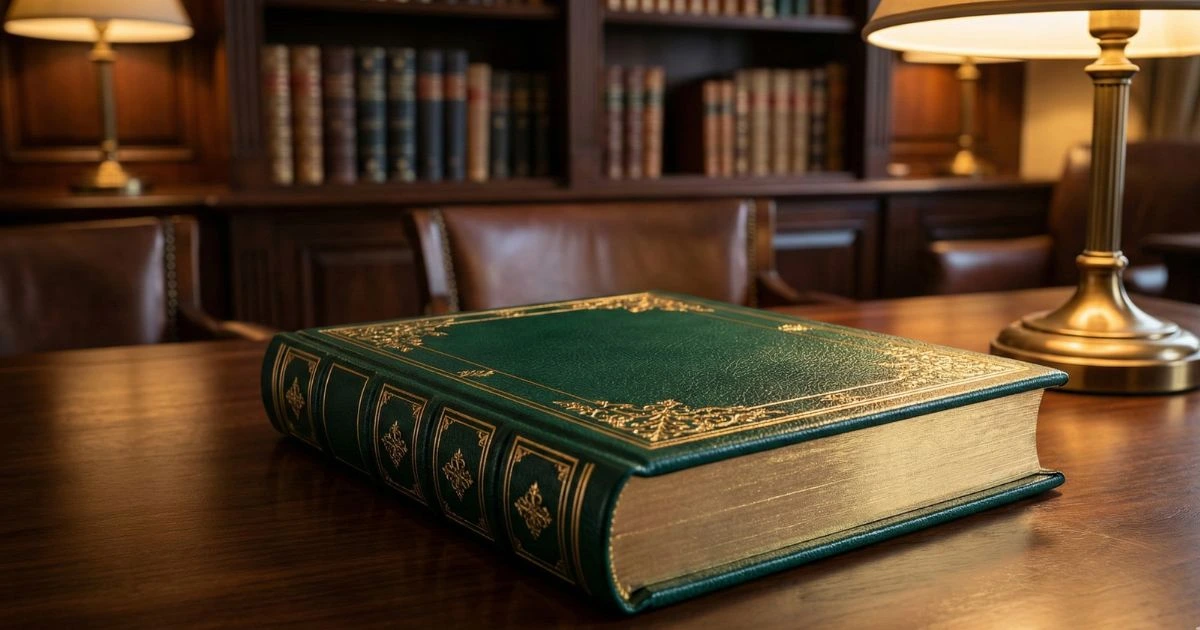
There is a specific, muffled thud that a heavy book makes when it settles onto a mahogany desk, a sound that digital pixels simply cannot replicate. In an era where our financial lives are increasingly tethered to the ephemeral glow of a smartphone screen, a strange thing is happening in the quiet corners of high-end studies and private libraries. People are rediscovering the physical. Specifically, the Luxury Hardcover is experiencing a renaissance that feels less like a nostalgic trip and more like a tactical pivot toward permanence.
I remember standing in a small, independent bindery in London a few months ago, watching a craftsman apply gold leaf to the spine of a first-edition economic treatise. There was no rush. There was no “refresh” button. The air smelled of animal glue and old paper, a scent that somehow feels more “real” than the sterile environment of a modern trading floor. It struck me then that we are witnessing a fundamental shift in how we define value. When everything is available instantly and infinitely, the things that are limited, tactile, and difficult to produce become the ultimate status symbols.
For the modern investor or the seasoned bibliophile, a book is no longer just a vessel for information. Information is cheap; you can find the entire history of the Federal Reserve on a Wikipedia page in seconds. But owning a Luxury Hardcover of a foundational text, designed with the precision of a Swiss timepiece, is an act of curation. It is a statement that says some ideas are too important to be left to the mercy of a cloud server that might be deprecated in a decade.
The Architecture of Premium Publishing and the Tangible Portfolio
Design is the silent language of authority. When we talk about Premium Publishing in 2026, we aren’t just talking about a sturdier cardboard sleeve. We are talking about the architecture of an object. I have seen collectors pass over rare manuscripts because the binding lacked soul, yet they will fight tooth and nail at auction for a contemporary “Collectors Edition” that understands the weight of its own presence.
The trend for this year is moving away from the loud, over-branded aesthetics of the early 2020s. We are seeing a return to what some call “quiet luxury” in the library. Think of deep jewel tones, forest greens so dark they look like midnight, and navy blues that feel like the deep Atlantic. These aren’t just colors, they are moods. They provide a backdrop for the real stars of the show: the textures.
A book that feels like linen under the fingertips, or perhaps a soft-touch vegan leather that mimics the patina of a century-old tome, creates a sensory bridge between the reader and the thought. Designers are now utilizing debossing techniques that create physical valleys in the cover, inviting you to trace the title with your thumb while you contemplate a complex market move. This is where the physical meets the psychological. In a world of high-frequency trading and digital volatility, there is a profound comfort in the unmoving, unchangeable nature of a well-bound book.
I often find that the most successful people I know have libraries that look nothing like a corporate lobby. They are messy, idiosyncratic, and filled with books that have “heirloom” written into their DNA. They understand that a library is a physical manifestation of one’s intellectual capital. It is a portfolio you can touch.
Future-Proofing the Shelf with Modern Book Design Trends
If you look closely at the Book Design Trends emerging this year, you’ll notice a fascinating tension between old-world craftsmanship and futuristic geometry. We are seeing a lot of “dual-scale” design. A book has to look striking as a tiny thumbnail on a digital marketplace, yet it must reveal hidden layers of detail when held six inches from the face. It is a difficult balance to strike.
One of the more interesting developments is the rise of the “narrative edge.” No longer are the edges of pages left plain and white. We are seeing sprayed edges with intricate stenciled patterns that complete an image when the book is closed. Some publishers are even experimenting with metallic foils that catch the light differently depending on the time of day. It makes the book feel alive, a shifting object that interacts with the environment of your room.
There is also a move toward what I call “typography as structure.” Instead of a small title centered on the cover, we are seeing massive, bold letterforms that are woven into the very fabric of the artwork. The words aren’t just sitting on top of the image, they are the image. This creates a sense of monumentalism. It suggests that the contents of the book are heavy, significant, and unshakeable.
I recently spoke with a designer who spent three weeks just picking the right shade of cream for the internal paper stock of a limited run. To the uninitiated, that sounds like madness. To those of us who appreciate the finer points of the craft, it is the difference between a product and an artifact. You want paper that has a certain opacity, a certain “tooth” that grips the ink, and a weight that feels substantial as you turn the page. It’s about the “crackle” of the paper, the way it sounds in a quiet room.
We are also seeing a shift in how these editions are released. The mass-market model is showing its age. Instead, we are seeing smaller, more intentional print runs. Exclusivity is the new currency. When only 500 copies of a particular design exist, the relationship between the owner and the object changes. It becomes a shared secret between the publisher and the collector.
As we look toward the end of the decade, the library is becoming the new sanctuary. It is the one place where the “always-on” culture of the 21st century is forced to slow down. You cannot “skim” a three-pound hardcover while checking your emails. It demands your full attention, your seat in a comfortable chair, and perhaps a glass of something aged.
The resurgence of the luxury book isn’t a rejection of technology, it is a refinement of it. We use digital tools to design more perfect physical objects. We use global marketplaces to find the one artisan who still knows how to hand-stitch a spine. It is a beautiful irony that the more digital our world becomes, the more we crave the things that have a physical shadow.
So, the next time you see a beautifully bound edition, don’t just look at it as a purchase. Look at it as a stake in the ground. It is a piece of the world that won’t change when the next software update rolls out. It is a legacy in ink and cloth, waiting to be passed down to someone who will appreciate the muffled thud of a heavy book on a mahogany desk just as much as you do.