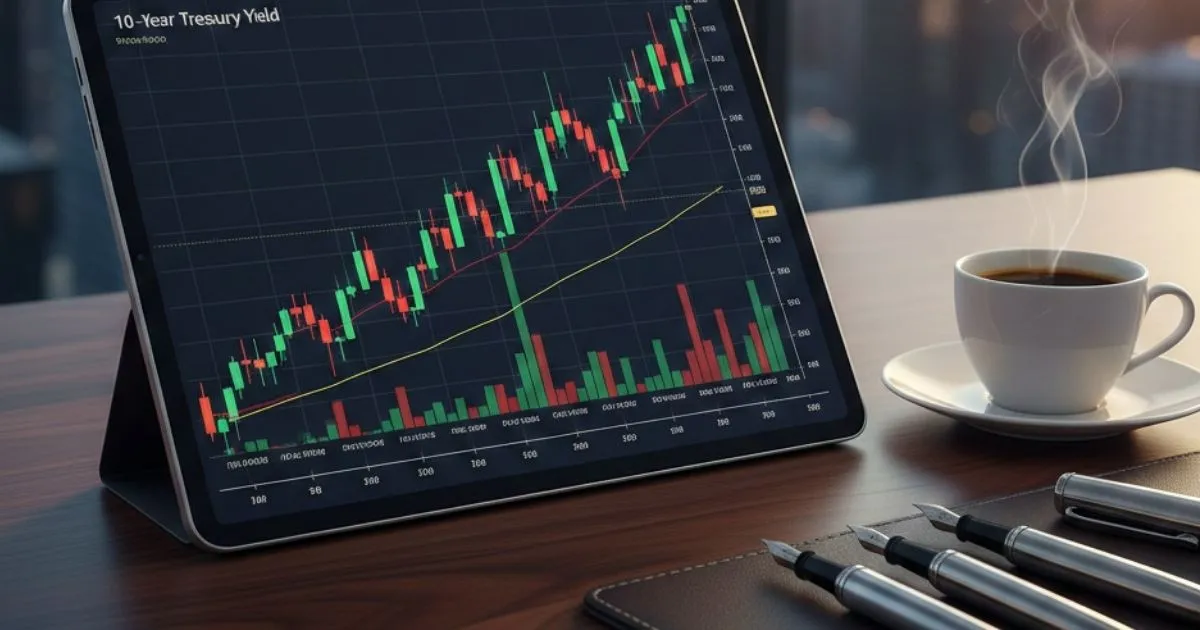
The fluorescent hum of the trading floor has a specific frequency when the air is thick with indecision, a sound that feels more like a vibration in your teeth than a noise in your ears. Standing here in early 2026, looking at the terminal screens, there is a collective holding of breath. We have spent the last few years obsessed with the peak, constantly asking when the Federal Reserve would finally stop its relentless march and when the gravity of interest rates would finally pull the economy back down to earth. Now, the 10-year Treasury yield is hovering around 4.24 percent, a number that feels like a sturdy ledge on a crumbling cliffside.
There is a strange comfort in these numbers. We are no longer in the frantic, panicky ascent of 2023, nor are we in the basement-level yields of the pandemic era. We are in a window of clarity. For the seasoned investor, this isn’t just a data point on a chart, it is a signal. Bond Yields 2026 are telling a story of a resilient economy that refuses to break, yet one where the easy money has already left the room. If you listen closely to the market whispers, the message is clear: the peak is not a single point, but a plateau, and plateaus are where the most significant moves are made.
I remember a conversation with an old colleague who used to say that the best time to plant a tree was twenty years ago, but the second best time is when the sun is still out. In the world of fixed income, the sun is currently at high noon. We are seeing a unique alignment where inflation is cooling just enough to keep the central bank from further tightening, yet fiscal deficits and a “Sell-America” sentiment from some foreign holders are keeping yields from sliding back into the abyss. It is a sweet spot for those looking to lock in a future that doesn’t depend on the volatility of the tech sector or the whims of a meme-stock rally.
Securing Passive Income Through the 2026 Yield Curve
Locking in a steady stream of revenue in this environment requires a bit of a departure from the “set it and forget it” mentality of the past decade. The yield curve has begun to steepen, finally rewarding those who are willing to look a bit further out into the horizon. While the 2-year note has dipped toward 3.60 percent, the longer-dated 30-year bonds are still offering a healthy 4.82 percent. This gap is where the magic happens for anyone looking to build a sustainable base of passive income.
When you look at a portfolio today, you have to ask yourself what you are actually buying. Are you buying a gamble on capital appreciation, or are you buying time? The beauty of the current bond market is that it allows you to buy time with a guaranteed coupon. By utilizing a laddering strategy, where you purchase bonds that mature at different intervals, you create a self-sustaining engine. As the shorter-term notes mature, you roll that capital into the belly of the curve, capture the yields that remain elevated due to persistent fiscal pressures, and ignore the noise of the daily news cycle.
It is about building a moat. In a world where high-quality corporate credit spreads are historically tight, the safety of government-backed paper looks increasingly like the smartest play for the foundational layer of a wealth strategy. You aren’t just chasing a percentage; you are anchoring your lifestyle. I have seen too many people try to time the absolute bottom of the market, only to watch the opportunity evaporate as the Fed makes its move. The reality of 2026 is that the window is open, but the breeze is starting to change direction. Waiting for a perfect 5 percent yield on the 10-year might mean missing the 4.25 percent that is sitting right in front of you today.
Navigating Fixed Income Opportunities in a Shifting Economy
There is a certain irony in the fact that the more stable the economy feels, the more dangerous the market becomes for the unprepared. We are currently seeing a “rangebound” environment where the 10-year Treasury is likely to oscillate between 3.75 percent and 4.25 percent for the foreseeable future. This lack of a clear trend is exactly why fixed income has become the sophisticated investor’s playground again. When the market isn’t moving in a straight line, the reliability of the coupon becomes the hero of the story.
We are also seeing a resurgence in the importance of credit quality. The era of “junk” providing enough of a premium to justify the risk is largely over for this cycle. Today, the smart money is moving toward investment-grade corporate bonds and municipal offerings. For those in higher tax brackets, the tax-equivalent yield of a municipal bond in 2026 is often the silent winner of the portfolio. It is the kind of boring, reliable growth that doesn’t make for great headlines but makes for very great retirements.
There is also the matter of the “why” behind these yields. We are dealing with a government that continues to run significant deficits, which means the supply of bonds isn’t going away. This constant supply acts as a ceiling on how low yields can go, providing a safety net for those who fear a sudden return to zero-interest-rate policy. It is a structural shift in how the American economy functions. We are moving away from a world driven by central bank intervention and toward one driven by fiscal reality. This shift favors the creditor, the person who owns the debt, the person who is disciplined enough to take the yield while it is being offered on a silver platter.
I often think about the difference between wealth and riches. Riches are what you have today, but wealth is what you have when the music stops. The 2026 market is offering a chance to convert the riches of the last bull market into the wealth of the next decade. It doesn’t require a crystal ball or a high-frequency trading algorithm. It requires the patience to look at a 4.5 percent yield and realize that, in the context of history and the future of inflation, that is a very handsome gift.
As we move deeper into the year, the conversations will inevitably shift. People will start worrying about the next election, the next geopolitical flare-up, or the next technological disruption. But for those who have already locked in their path, those headlines will just be background noise. There is a profound sense of peace that comes from knowing exactly what your capital will return to you on the first of the month, regardless of what the talking heads on the news are shouting about.
The plateau won’t last forever. Eventually, the cycle will turn, the economy will cool further, and the Fed will be forced to act more aggressively. When that happens, the yields we see today will look like a historical anomaly, a missed connection that people will talk about with regret. The question isn’t whether bond yields are peaking; the question is what you did while they were there.