
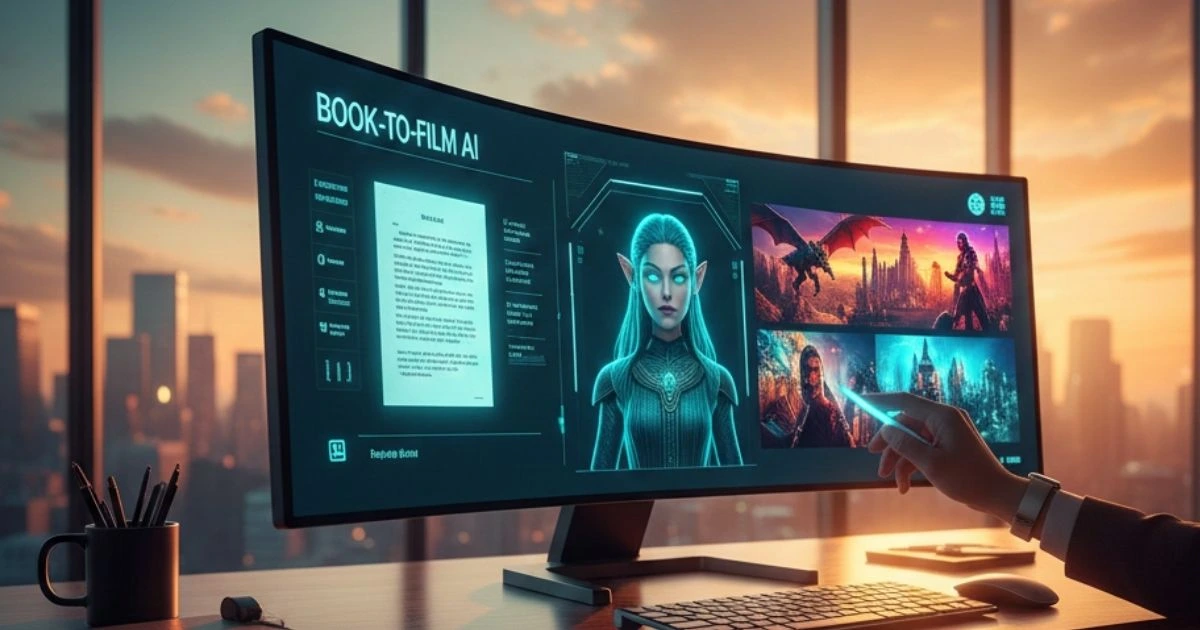
The air in the room at the latest media rights summit was thick with the scent of overpriced espresso and a palpable, low-grade anxiety. I watched a veteran literary agent lean over to a young producer, his voice dropping an octave as he whispered about a new software suite that had just “greenlit” a psychological thriller manuscript before a human had even finished the first chapter. It was a moment that felt like a shift in the tectonic plates of the industry. We are no longer living in a world where a book travels to the screen solely on the back of a lucky break or a storied connection. The reality of 2026 is that the gatekeepers have changed, and they speak in algorithms. The emergence of Book-to-Film AI is not just another tech trend, it is a complete restructuring of how intellectual property is valued, packaged, and sold in a landscape that demands immediate visual proof of concept.
For years, the process was agonizingly slow. An author would spend years writing, then months finding an agent, then years hoping for a scout to pick up the scent. Now, the wall between a block of text and a cinematic vision has become porous. I have seen creators use these tools to bridge the gap between a 400-page novel and a high-fidelity teaser trailer in a weekend. It is disorienting, frankly. There is a certain loss of the “magic” when a machine can analyze the emotional beats of a character arc and suggest the perfect lighting for a scene that hasn’t been shot yet. But if you are holding a piece of intellectual property that you believe in, the sentimentality of the old ways is a luxury you probably cannot afford. The market is moving, and it is moving toward those who can present their stories as ready-made visual ecosystems.
The New Dynamics of Author IP Licensing and the Synthetic Pitch
There was a time, not too long ago, when a pitch deck for a book was just a series of static slides with some “mood” photography pulled from Pinterest. Those days are dead. Today, Author IP licensing is driven by the ability to show, not just tell, what a franchise looks like. Producers are increasingly risk-averse, looking for “biographical anchors” and data-driven proof that a story will resonate with a global audience. When I look at how modern pitch kits are being assembled, I see a fascinating blend of human narrative and synthetic visualization. Authors are now acting as their own miniature studios, using AI to generate character consistency sheets and location concept art that looks indistinguishable from high-budget pre-production.
It is a strange irony that in our quest for authenticity, we are using the most artificial tools imaginable to prove our stories have heart. I recently spoke with a writer who had been stuck in “development hell” for three years. She took her manuscript, ran it through a series of analysis tools to identify the strongest commercial hooks, and generated a sixty-second “vibe reel” using a text-to-video engine. She had a deal on the table within a month. The tool didn’t write the story for her, but it translated her prose into the only language the current film market truly understands: the visual. This shift in film rights 2026 trends suggests that the “book” is no longer the final product, it is the data source for a much larger, multi-platform machine.
The leverage has shifted. If you can provide a studio with a comprehensive visual map of your world, you are no longer just a writer, you are a partner in the production process. This is where the finance side of the industry gets interested. When the cost of failure is so high, any tool that reduces uncertainty becomes a primary asset. We are seeing a massive influx of capital into platforms that help bridge this specific gap. The value of a literary property is now tied directly to its “translatability.” Can the AI find the three-act structure in your experimental memoir? Can it identify the market segments that will respond to your protagonist’s specific brand of cynicism? If the answer is yes, your IP just doubled in value.
Navigating the Shifting Landscape of Film Rights 2026
I find myself wondering if we are losing the soul of the story in this rush toward efficiency. There is a danger, of course, that the algorithms will begin to favor certain types of narratives—those that are easy to visualize or those that fit the existing data patterns of previous hits. But then I see a truly weird, avant-garde piece of fiction get picked up because an AI tool recognized a unique emotional resonance that a tired human reader might have missed at 4:00 PM on a Friday. It is a double-edged sword, like most things worth talking about. The gatekeepers used to be a small circle of people in Los Angeles and New York. Now, the gatekeeper is a distributed network of tools that anyone with a laptop can access.
The practical reality of pitching in this environment requires a certain level of technical literacy that most authors never signed up for. You have to understand how to prompt for consistency, how to curate the output of these machines so they don’t look like generic “AI art,” and how to protect your copyright in a legal landscape that is still trying to catch up. The 10th Circuit rulings on “biographical anchors” and the ongoing debates over data scraping are the background noise to every deal memo being signed right now. It is a messy, vibrant, and slightly terrifying time to be a creator.
But if you look at the numbers, the opportunity is staggering. The demand for content has never been higher, and the platforms are desperate for stories that come with a pre-vetted audience and a clear visual identity. If you are sitting on a library of work, or if you are building a boutique agency that represents these kinds of assets, the goal is no longer just to sell a book. The goal is to sell a “universe.” The book is the anchor, but the AI-generated trailers, the character bibles, and the market analysis reports are the sails that actually move the ship.
I think back to that agent at the summit. He wasn’t really worried about the technology replacing him. He was worried about the people who knew how to use it replacing the people who didn’t. He was right to be. The future of story-driven investment isn’t about choosing between the human and the machine, it is about finding the point where they intersect to create something that a studio cannot ignore. It is about taking that raw, messy, beautiful human IP and refining it through the lens of modern tech until it shines with a clarity that demands a green light.
So, where does that leave the solitary writer or the small-scale investor? It leaves them in a position of unprecedented power, provided they are willing to get their hands dirty with the tools of the trade. The barrier to entry has never been lower, yet the standard for a “professional” pitch has never been higher. It is a paradox that defines our current era. We are all filmmakers now, whether we want to be or not. The only question left is whether you have the vision to guide the tools, or if you will let the tools dictate the vision.
The conversation is far from over. As we move deeper into 2026, the distinction between “digital” and “traditional” rights will likely vanish entirely. Every contract will be a multi-modal agreement, and every pitch will be a multimedia event. It is a heavy lift, but for those who can navigate this terrain, the rewards are not just financial—they are the chance to see their worlds come to life in ways that were once reserved for the elite few. The machine is ready. The question is, are you ready to pitch?
