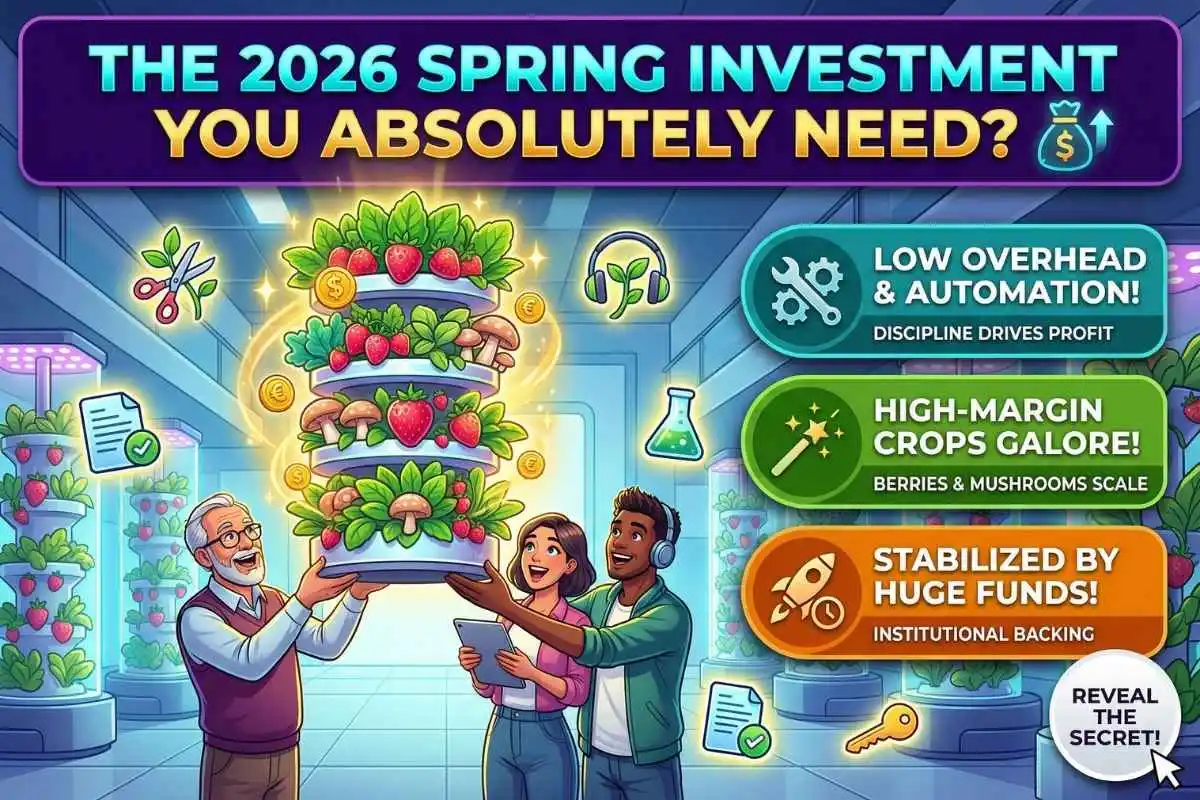
As the frost melts and we welcome the spring of 2026, the financial world is buzzing with a renewed, grounded enthusiasm for an agricultural sector that has completely redefined itself. For years, the concept of growing food indoors in massive, glowing towers felt like a science fiction movie brought to life—a flashy idea that captured headlines but often struggled to deliver consistent financial returns. However, the narrative has shifted dramatically. The agricultural technology landscape has matured, shaking off the speculative frenzy of its early days. Today, indoor agriculture represents one of the most compelling intersections of sustainability, artificial intelligence, and food security. If you are looking to revitalize your portfolio this season, understanding the profound evolution of this industry is no longer optional. This is the moment when the pioneers of indoor agriculture transition from cash-burning startups into profitable, operationally sound enterprises, making these forward-looking stocks the quintessential spring investment for savvy individuals.
The Great Industry Correction and Rebirth
To truly appreciate the opportunity that stands before us in 2026, we must first acknowledge the rocky road of the recent past. Between 2023 and 2024, the vertical farming industry experienced a harsh but entirely necessary market correction. Many early startups failed spectacularly because they relied on a seemingly endless supply of cheap venture capital rather than establishing solid, sustainable business models. They built massive facilities without figuring out how to manage exorbitant energy costs or streamline expensive labor. However, as we step into this spring season, the industry has emerged stronger, leaner, and fundamentally transformed. Today’s successful companies are no longer simply burning cash to construct inefficient indoor farms; instead, they are laser-focused on operational discipline, localized energy optimization, and securing long-term buyer agreements. By integrating cutting-edge artificial intelligence to monitor plant health and utilizing advanced robotics to automate the harvesting process, the surviving entities have drastically lowered their overhead costs. This vital evolution from a speculative dream to a disciplined, profit-generating machine makes the current market incredibly attractive for investors who recognize that the initial growing pains have finally yielded a mature industry.
The Climate and Supply Chain Imperative
Why is vertical farming suddenly such a hot and resilient commodity again? The answers lie in a perfect storm of compounding global challenges and simultaneous technological breakthroughs. Climate change continues to relentlessly disrupt traditional, soil-based agriculture with unpredictable weather patterns, severe droughts, and rapidly degrading soil quality across major farming belts. Concurrently, massive global urbanization means that more people live in densely populated cities than ever before, creating a logistical nightmare and heavy carbon footprint for fresh food transportation. Vertical farming brilliantly solves these pressing issues by cultivating crops in stacked layers within highly controlled environments right in the heart of urban centers. This revolutionary method uses up to 95 percent less water than conventional outdoor farming and completely eliminates the need for harmful chemical pesticides. Add in the recent flood of capital aimed at securing national food sovereignty, and it is easy to see why this sector is projected to surge well past the eleven billion dollar mark this year alone.
Shifting Focus: From Simple Greens to Premium Produce
For a remarkably long time, the only things you would find growing on the shelves of an indoor farm were basic lettuces, simple herbs, and microgreens. While these leafy greens still represent a significant and reliable chunk of the market’s revenue, the real excitement and profit potential in 2026 stems from the rapid diversification into high-margin, complex crop varieties. Groundbreaking technological advancements in specific LED lighting spectrums and highly calibrated aeroponic nutrient delivery systems have finally allowed commercial growers to successfully cultivate delicate berries, exotic mushrooms, and even high-value ornamental flowers at scale. Strawberries, for instance, are currently the fastest-growing crop segment within the entire indoor farming space, offering companies a significantly higher return on investment compared to standard salad blends. This aggressive shift toward premium produce not only dramatically boosts the bottom line for these agricultural technology companies but also provides everyday consumers with perfect, pesticide-free fruits year-round, completely detached from the limitations of outdoor seasons. For more on the basics of these controlled setups, you can explore the USDA’s guide on indoor growing.
The Rise of Sovereign Wealth and Institutional Backing
Another massive catalyst propelling vertical farming into the mainstream financial spotlight this spring is the unprecedented influx of institutional and sovereign capital. In previous years, retail investors and venture capitalists primarily funded these ambitious projects. Today, the landscape is heavily influenced by massive national funds from regions like the Middle East and Asia. Countries with limited arable land and harsh climates recognize that they can no longer rely entirely on complex, fragile global supply chains to feed their populations. By investing billions of dollars into advanced indoor agriculture, these nations are actively purchasing food security and technological independence. This top-down institutional backing provides vertical farming companies with the stable, long-term runway they need to perfect their technology and scale their operations without the constant panic of quarterly earnings misses. This profound shift in the investor base dramatically reduces the overall volatility of the sector, giving everyday investors a much safer entry point. You can read more about the history and mechanics of these massive investment vehicles on Wikipedia’s Sovereign Wealth Fund page.
How to Strategically Invest in the Ecosystem
So, how exactly should an everyday investor approach this blooming sector without repeating the painful mistakes of the past? Rather than placing risky bets on unproven, newly launched farm operators, modern financial strategists are looking at the foundational companies that power the entire ecosystem. This means looking closely at publicly traded entities that manufacture the essential “picks and shovels” of the industry—think advanced LED lighting manufacturers, precision climate control hardware developers, and the agricultural technology software firms that manage complex day-to-day operations using artificial intelligence. Additionally, major legacy agricultural and chemical companies are steadily acquiring smaller vertical farming tech firms, making them safer, highly diversified plays for conservative portfolios. By targeting the infrastructure and technology providers rather than just the crop growers, investors can directly participate in the industry’s phenomenal, compounding growth while successfully insulating themselves from the localized operational risks of individual farm operators. It is a calculated, strategic way to harvest the gains of the agricultural revolution.
The Industry Shift at a Glance
To visualize just how far this industry has come in a few short years, review the comparative data below. The transition from a growth-at-all-costs mindset to a disciplined, high-margin business model is the primary reason these stocks are turning heads this spring.
| Industry Metric | The 2022 Hype Phase | The 2026 Mature Phase |
| Primary Investors | Venture Capitalists & Speculators | Sovereign Wealth Funds & Institutions |
| Core Crop Focus | Basic Lettuces & Microgreens | High-Margin Berries, Herbs & Ornamentals |
| Growth Strategy | Rapid Geographic Expansion | Operational Efficiency & Profitability |
| Labor Dynamics | Highly Manual & Expensive | Heavily Automated via AI & Robotics |
| Market Resilience | Highly Volatile | Stabilized by Long-Term Buyer Contracts |
Frequently Asked Questions
What exactly is a “vertical farming” stock? A vertical farming stock represents a publicly traded company involved in the indoor agriculture industry. This can include direct farm operators who grow and sell the produce, as well as the essential technology providers who manufacture the LED lighting, hydroponic hardware, and climate-control software required to run these highly advanced facilities.
Why did so many vertical farms fail prior to 2026? Many early companies failed because they prioritized rapid expansion over actual profitability. They relied heavily on venture capital to sustain operations while facing massive energy bills and high labor costs. Today’s successful companies have solved these issues through disciplined scaling, automation, and shifting toward higher-margin crops that justify the indoor growing costs.
Is indoor farming genuinely better for the environment? Yes, in several critical ways. Vertical farms use up to 95% less water than traditional soil farming because water is constantly recycled through closed-loop systems. They also eliminate agricultural runoff and the need for toxic chemical pesticides. Furthermore, by locating farms inside cities, the carbon emissions associated with transporting food over thousands of miles are drastically reduced.
Can I invest safely without betting on a single farm? Absolutely. The most strategic way to invest in this sector without taking on the risk of a single farm failing is to invest in the broader supply chain. Look for established companies that provide the specialized lights, seeds, automation robotics, and software systems that all vertical farms must purchase in order to operate.
The Final Harvest: A Fascinating Look Forward
As you consider adjusting your portfolio this spring, it is worth pausing to marvel at just how futuristic this industry has become. Did you know that in 2026, some of the most advanced vertical farms have completely eliminated the need for human observation to determine when a crop is thirsty? They achieve this by using microscopic acoustic sensors that literally “listen” to the plants. When roots dry out, the plant stems emit tiny, high-frequency popping sounds that are entirely inaudible to the human ear. The farm’s artificial intelligence picks up these microscopic acoustic distress signals and instantly deploys the exact micro-dose of water and nutrients required to keep the plant in a state of perfect growth. We are no longer just farming; we are engineering nature to perfection. Investing in this space today means buying a stake in a future where human ingenuity ensures there is always fresh food on the table, no matter what happens to the world outside.