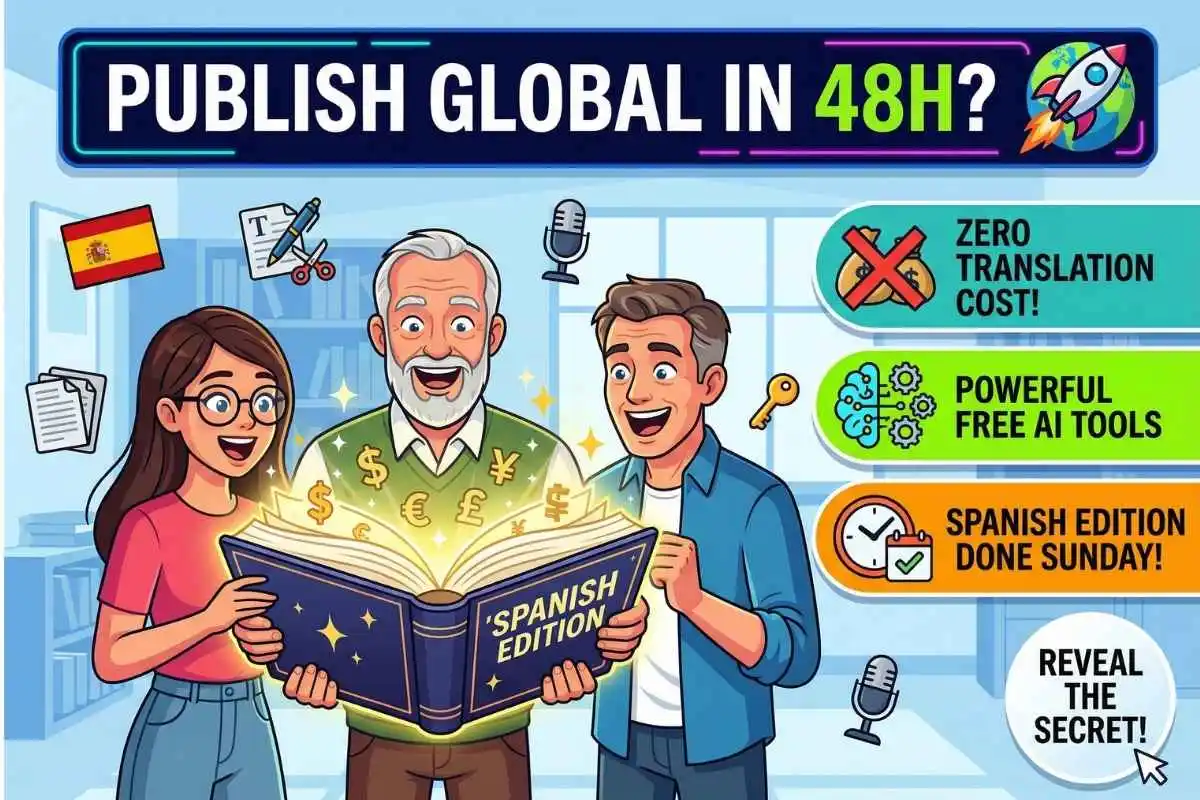
Imagine waking up on a Monday morning, logging into your author dashboard, and seeing a sudden, unexpected spike in book sales. But these sales are not coming from your home country; they are pouring in from Spain, Mexico, and Argentina. For decades, the traditional publishing route demanded thousands of dollars and months of agonizing waiting to get a single manuscript translated. It was a high-end luxury reserved exclusively for blockbuster authors with massive publishing houses backing them. But today, the technological landscape has completely shifted beneath our feet. We have entered the era of the “1-Click Polyglot,” a time where powerful software is available to anyone with a Wi-Fi connection and a dream. If you have a finished manuscript sitting on your hard drive, you can quite literally translate your entire book into Spanish for free this very weekend. Let’s explore exactly how you can tap into this modern miracle and share your stories with a massive new global audience.
The Magic of Modern Neural Networks
To truly understand how we got to this incredible point in time, we have to look back at the dark ages of digital translation. Just a decade ago, feeding a carefully crafted novel into a computer would result in a robotic, confusing, and often hilarious mess of literal translations. If a character were to “kick the bucket,” the early internet translators would assume they were physically striking a pail. However, the technology has undergone a revolutionary transformation thanks to the advent of sophisticated artificial intelligence. Today’s translation engines do not just blindly swap words out one by one; they read whole sentences and paragraphs simultaneously to understand the deep, underlying context. This advanced process, known formally as Neural Machine Translation, uses deep learning algorithms to mimic the human brain’s complex neural pathways. These systems are trained on billions of bilingual texts, allowing them to grasp idioms, emotional tones, and complex narrative structures. As a result, the initial draft spit out by modern free tools is astonishingly coherent. While it is not utterly flawless right out of the gate, it provides a profoundly solid foundation that takes the heavy lifting out of the equation, transforming a year-long project into a simple weekend hobby.
Setting Up Your Weekend Translation Retreat
So, how exactly do you pull off this publishing magic trick in just forty-eight hours? The strategy requires nothing more than a quiet room, a strong cup of coffee, and your completed manuscript document. Your primary engine for this project will be top-tier, freely available translation software. While many people default to standard browser translators, authors often find the best results using a combination of powerful desktop applications and cloud-based systems. First, you will want to break your book down into manageable chapters to prevent overwhelming the software and to ensure you can easily track your progress. Tools like Google Docs have built-in translation features that can instantly duplicate your document into Spanish with surprisingly good formatting retention. Alternatively, you can copy and paste your text chapter by chapter into platforms like DeepL, which is widely celebrated in the indie author community for its nuanced, highly natural-sounding phrasing. By dedicating your Saturday morning to feeding your text through these powerful engines, you will have a complete Spanish manuscript sitting on your desktop by lunchtime. The speed of this process is truly breathtaking, allowing you to bypass the traditional gatekeepers and take complete creative control over your international publishing journey without spending a single dime upfront.
Comparing Your Translation Toolkit
As you prepare to embark on your weekend translation journey, choosing the right software is a critical first step. There is no single “correct” way to do this, but understanding your options will save you a massive amount of time. Here is a quick breakdown of the most popular free or freemium tools available for authors right now to get the job done efficiently.
| Translation Tool | Cost Structure | Speed | Best Feature for Authors |
| Google Docs | 100% Free | Instant | Retains all original document formatting and headings. |
| DeepL | Free tier available | Fast | Highly nuanced phrasing; captures emotional tone beautifully. |
| ChatGPT (Free) | Free tier available | Moderate | Can be prompted to translate in a specific genre or authorial tone. |
| Calibre Plugins | 100% Free | Moderate | Translates directly from an EPUB ebook file to a Spanish EPUB. |
Author Tip: Many successful indie writers use a hybrid approach. They use Google Docs for the initial, rapid translation to keep their formatting intact, and then run complex dialogue scenes through DeepL to ensure the conversational flow sounds natural to native speakers.
The Essential “Clean-Up” Phase
Of course, hitting a translation button is only the first major step of your weekend journey. Once the algorithms have done the heavy lifting, you must switch gears and put on your editor’s hat. Even the most advanced computer systems occasionally stumble over cultural colloquialisms, specific regional dialects, or highly complex fictional world-building terms. A fantasy novel overflowing with made-up magical vocabulary, for instance, might confuse the software into producing some very strange Spanish equivalents. This is exactly why your Sunday should be entirely devoted to the “clean-up” phase. If you have a basic understanding of Spanish, you can read through the text side-by-side with your English original to catch obvious errors, awkward phrasing, or weird formatting glitches. If you do not speak a single word of the language, this is the perfect opportunity to utilize free online grammar checkers tailored specifically for Spanish, or to swap favors with a bilingual friend. You might offer to format their next book or review their English manuscript in exchange for them doing a quick beta-read of your newly translated Spanish novel. This crucial human touch ensures that your book doesn’t just read like a cold machine output, but actually carries the soul and voice of your original story.
Why Spanish? The Massive Market Opportunity
You might be wondering, out of all the incredible languages spoken around the world, why should you specifically dedicate your weekend to translating your book into Spanish? The answer lies in the sheer scale, passion, and accessibility of the market. Spanish is an absolute global powerhouse, serving as the official language of twenty countries and boasting a massive, voracious reading population. By translating your book, you are instantly unlocking doors to readers in Spain, across Latin America, and within the rapidly growing Hispanic demographic in the United States. According to comprehensive demographic data available on the Spanish language Wikipedia page, there are nearly 500 million native speakers globally, making it the second most spoken native language on the planet, just behind Mandarin Chinese. These readers are incredibly active on digital reading platforms, often hungry for new indie voices in genres like romance, science fiction, and thrillers. Independent authors who have taken the leap and published Spanish editions frequently report that their international royalties eventually match or even exceed their domestic earnings. It is a massive, often untapped goldmine of opportunity, and thanks to modern technology, the barrier to entry has been completely obliterated.
Publishing and Launching Your New Edition
After your weekend of translating and refining, you are finally ready for the most exciting phase of the entire process: bringing your brand new Spanish book to the world. Publishing a translated work follows the exact same process as publishing your original English manuscript, but it requires a slightly different marketing mindset to succeed. You will need a new book cover that features the translated title, which you can easily generate using free design software or by simply tweaking your existing cover file. Next, you must navigate to your chosen publishing platform—whether that is Amazon Kindle Direct Publishing, Apple Books, or Draft2Digital—and upload your freshly minted Spanish manuscript as a completely new, standalone project. When setting up your book’s metadata, it is crucial to research Spanish keywords and categories to ensure your book appears in the right foreign-language searches. A direct translation of an English keyword might not be what a reader in Mexico actually types into the search bar when looking for a good book. Taking the time on Sunday evening to optimize your metadata, write a compelling Spanish blurb, and finally hit the publish button will cement your status as an international author, all before you even start the new work week.
Frequently Asked Questions
Is it actually legal to translate my own book using AI software? Yes. Because you own the absolute copyright to your original English manuscript, you legally possess all rights to create derivative works from it. This includes translating it into any language you choose. You hold the rights to the story, regardless of the language it is printed in.
Do major book retailers penalize authors for using AI translation tools? Currently, major retailers readily accept AI-translated books, allowing you to publish them freely. However, platforms like Amazon do require you to honestly disclose the use of artificial intelligence during the uploading setup process. Always make sure to review the latest terms of service for your specific publishing platform to stay compliant.
What happens if my book relies heavily on local slang, jokes, or puns? This is where machine translation traditionally struggles the most. Puns and culturally specific jokes rarely translate directly across borders. If your book is a comedy highly reliant on clever wordplay, you will definitely need a native speaker to adapt and localize the jokes, rather than just translating them directly through a machine.
The Curiosity Corner: A Final Thought
Did you know the bold dream of machine translation actually dates all the way back to the early days of the Cold War? In 1954, the famous Georgetown-IBM experiment successfully translated more than sixty Russian sentences into English using an early, room-sized computer. The scientists involved confidently predicted that within three to five years, the entire complex problem of human language translation would be permanently solved. It ended up taking over six decades of painstaking computer science to finally perfect! Today, as you sit down this weekend to effortlessly translate your novel, you hold the breathtaking realization of that incredible 1950s sci-fi dream right at your fingertips. Happy publishing!