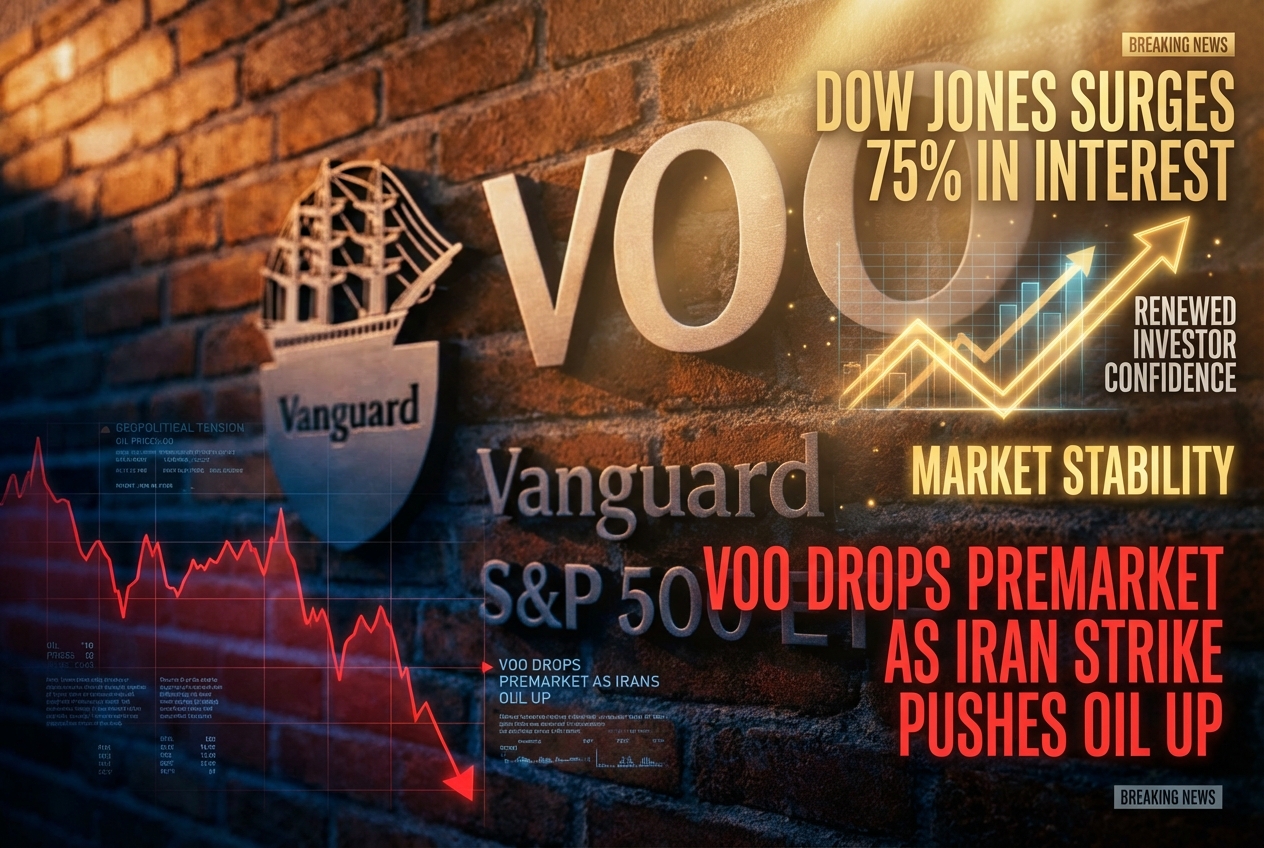
The market whispers turned into a distinct shudder this Monday morning as institutional money signaled deep discomfort with escalating geopolitical tensions. While many eyes are fixed on headline indices, the real temperature check for American corporate health is often found in the massive flows of passive investment vehicles. Specifically, the Vanguard S&P 500 ETF, known intimately by its ticker \*\*VOO\*\*, took a significant hit premarket, dropping nearly 1% as oil prices spiked near 8% following aggressive military actions involving the United States, Israel, and Iran. This isn’t just about one ETF; it’s a crucial bellwether indicating that investor complacency regarding Mideast stability has evaporated, potentially rewriting the playbook for the immediate future of US equities.
The Immediate Shockwave: Safe Havens Over S&P Exposure
The reaction seen in \*\*VOO\*\* premarket trading serves as a near-perfect manifestation of classic risk-off sentiment in real time. When major economies engage in strikes impacting key global chokepoints, the immediate pivot is away from broad exposure to the US economy—which is what \*\*VOO\*\* represents—and towards tangible safety. Gold futures simultaneously ripped higher, surging 3.4% as investors sought bullion over paper assets. This simultaneous action—a primary index tracker falling while precious metals spike—is the textbook signal that capital is prioritizing preservation over growth. The fact that the Strait of Hormuz, a vital artery for global oil transit, is reportedly facing effective closure adds a layer of acute anxiety that transcends quarterly earnings reports.
Analysts observing the initial market dip noted that the response was, by some metrics, relatively moderate considering the gravity of the Strait’s status. However, this moderation is predicated on the assumption that this conflict remains geographically contained. Market psychology operates on probabilities, and right now, the probability of sustained energy disruption has dramatically increased. If energy prices remain elevated, or if supply chains face protracted delays, that initial 1% dip in the S&P 500 tracking ETF could quickly morph into something far more severe. The $2.68 billion in net inflows VOO saw in the preceding five sessions, suggesting strong bullish momentum built up over March, is now being tested severely by exogenous shocks.
This movement wasn’t solely a reaction to the recent military maneuvers, however. Geopolitics acted as the accelerant on existing anxieties concerning US trade policy. Investors were already navigating potential headwinds from proposed tariffs, including figures aimed at potentially reaching 15% under Section 122 of the Trade Act of 1974\. When systemic geopolitical risk collides with ongoing trade friction, the combined drag on large-cap multinationals held within the S&P 500 becomes amplified, creating a perfect storm for pre-market sell-offs in vehicles like \*\*VOO\*\*.
Echoes of History: Comparing Crises and Current Resilience
To understand the potential scale of this Monday morning event, we must look back at periods where oil price shock coincided abruptly with equity market performance. The 1973 Oil Crisis and the 1990 Gulf War stand as monumental examples where energy cost shocks fundamentally rewired inflation expectations and consumer spending power, leading to prolonged bear markets. In those eras, the immediate market drop upon realizing the extent of the disruption was often deeper and more sustained than what we are seeing today, largely because the market infrastructure was less interconnected and hedge awareness was lower.
However, the current situation possesses unique variables. Unlike past conflicts where the disruption primarily affected supply volume, today’s fragility stems from transit routes and the embedded inflationary expectations already present in the post-pandemic economy. Furthermore, unlike the sharp, immediate reactions witnessed during the dot-com bubble bursts, the equity market this time has displayed a degree of relative fortitude, partly due to massive inflows into passive funds like Vanguard’s offerings throughout the prior month. Analysts at Commerzbank are suggesting caution, but also pointing out the systemic resilience demonstrated so far, contrasting sharply with past knee-jerk reactions when the Strait of Hormuz was threatened historically.
We must also factor in the role of technology stocks, which heavily influence the S&P 500\. While the broader index tracker sold off, specific stock analysis last month showed that volatility in tech—exemplified by Nvidia’s post-earnings movements—was already causing localized wobbles in \*\*VOO\*\*. The market had already absorbed significant volatility from earnings and inflation data leading into this geopolitical flare-up. Therefore, while this current drop is significant, it is layered on top of pre-existing technical vulnerability rather than striking a completely complacent market at an all-time high oblivious to internal pressures.
The Mechanics of the Sell-Off: Crude, Contracts, and Counterparts
The mechanism driving the initial decline centers almost entirely on inflation expectations stemming from energy costs. If crude oil sustains a price level above $100 a barrel—a threshold Wells Fargo flagged as potentially triggering an S&P 500 drop toward 6,000—the Federal Reserve’s calculus on interest rates becomes immensely complicated. Higher input costs reduce corporate profit margins, while simultaneously, higher energy prices act as a tax on consumers, dampening aggregate demand. This stagflationary threat is the core fear underlying the premarket liquidation in S&P 500 trackers.
The technical signal itself is critical: \*\*VOO\*\* dropping alongside E-mini futures for the Dow, S&P 500, and Nasdaq 100 shows a wholesale abandonment of near-term bullish positioning. Large institutional traders using derivatives often hedge their exposures by shorting index futures ahead of known risk events. The pre-market move suggests these hedges were either initiated aggressively or that stop-loss orders tied to geopolitical headlines were triggered, exacerbating the downward velocity before the official NYSE opening bell.
Furthermore, analysts at Barclays have issued a pointed warning that the market may be suffering from optimism bias regarding the conflict’s containment. Should diplomatic efforts fail to de-escalate the situation quickly, the market’s current muted reaction—viewed optimistically by some—will swiftly be re-evaluated. This re-evaluation would likely involve rapid de-risking, potentially sending money not just to gold, but into short-term US Treasury bills, favoring deep liquidity over market equity exposure entirely.
The interesting counterpoint to this widespread de-risking is that some capital is reportedly moving offshore. Reports highlighted the \*\*Vanguard FTSE Developed Markets ETF (VEA)\*\* as an early beneficiary of money potentially exiting the US. This “Sell-America” sentiment, driven by both trade policy anxiety and geopolitical concerns concentrated in the US, suggests a rotation that isn’t just safety-seeking, but geography-shifting, viewing developed international markets as comparatively insulated from the immediate conflict risks.
The role of the Strait of Hormuz cannot be understated in this equation. Its effective closure is not just a threat to future supply; it creates immediate logistical friction and forces shippers to take longer, more expensive routes. This friction translates directly into higher operating costs for multinational corporations tracked by the S&P 500, making their future earnings estimates look less secure, thus justifying the selling pressure seen in \*\*VOO\*\* even before the New York Stock Exchange floor opens for action.
Scenario Mapping: Three Paths for S&P 500 Recovery or Retreat
Looking ahead, the market trajectory hinges on two primary variables: the duration of energy disruption and the efficacy of diplomatic intervention. We can map out three distinct paths for the S&P 500, and by extension, for the performance of major instruments like \*\*VOO\*\*.
The first scenario is the “Soft Landing Path.” In this sequence, diplomatic channels swiftly reopen the Strait within 48 to 72 hours, and oil prices retreat back toward their pre-event trending levels. In this case, the premarket sell-off in \*\*VOO\*\* would be classified as an aggressive, but temporary, geopolitical risk premium being stripped out. Equities would likely stage a strong intraday recovery, potentially erasing Monday’s losses by Tuesday, as investors realize the underlying economic fundamentals were not fundamentally broken, merely interrupted by brief fear.
The second scenario is the “Protracted Stress Path.” Here, the Strait closure lingers for several weeks, or the conflict expands regionally without directly hitting major production sites. Oil remains stubbornly above $95 per barrel. This environment forces the market to price in sustained inflationary pressure and slower GDP growth. In this path, the initial dip in \*\*VOO\*\* finds new lows throughout the week. The S&P 500 would experience a grinding correction, settling closer to the $4,800-$4,900 territory until clarity on inflation or energy dominance returns. Investors would prioritize defensive sectors and actual safe havens over generalized market exposure.
The third, and most severe, scenario is the “Escalation Path.” If this geopolitical event broadens its scope, leading to confirmed significant damage or sustained shutdown of major oil production facilities, the market reaction modeled by analysts like Ohsung Kwon at Wells Fargo becomes the baseline. Crude topping $100 for an extended period validates maximum stagflationary fears. In this path, the premarket weakness becomes the first leg of a severe bear market, driven by mandatory central bank intervention fears clashing directly with sharply contracting corporate investment. The $631 six-month high for \*\*VOO\*\* would become a distant memory as capital seeks deep liquidity and cash equivalents.
The reality remains that while the structural confidence in US markets is profound, this incident exposes the extreme leverage that Middle Eastern energy politics still holds over global financial health. The trading floors are now holding their breath, watching news wires and energy tickers with far more intensity than they are watching earnings transcripts, as the immediate price action in instruments tracking the major US averages clearly dictates.
FAQ
What specific financial instrument served as the primary bellwether for institutional discomfort regarding geopolitical tensions?
The Vanguard S&P 500 ETF, known by its ticker VOO, took a significant premarket hit. This movement indicated investor anxiety about escalating Mideast stability and its consequences for U.S. equities.
What immediate asset class spiked simultaneous to VOO falling, signaling a classic risk-off sentiment?
Gold futures surged by 3.4% concurrently as broad exposure to the U.S. economy (represented by VOO) was abandoned. This simultaneous movement is the textbook signal that capital is prioritizing preservation over growth.
Why is the effective closure of the Strait of Hormuz a critical factor driving anxieties in the VOO decline?
The Strait of Hormuz is a vital artery for global oil transit, and its closure creates acute anxiety regarding sustained energy supply disruption. This friction translates directly into higher operating costs for S&P 500 multinationals, justifying selling pressure.
What pre-existing economic headwinds were already concerning investors before the geopolitical shockwave hit?
Investors were already navigating potential headwinds from proposed US trade policies, including figures aimed at potentially reaching 15% tariffs under Section 122 of the Trade Act of 1974. The geopolitical event amplified this existing trade friction.
How does the current situation differ fundamentally from the 1973 Oil Crisis regarding market reaction?
Unlike the 1973 crisis, where the primary concern was supply volume disruption, today’s fragility stems heavily from transit route instability and embedded inflationary expectations. However, historical precedents show energy shocks can lead to prolonged bear markets.
What technical signal indicated a wholesale abandonment of near-term bullish positioning in the pre-market?
The simultaneous drop in VOO alongside E-mini futures for the Dow, S&P 500, and Nasdaq 100 signaled a sharp de-risking move. This often happens when large institutional traders aggressively initiate hedges or trigger stop-loss orders based on geopolitical headlines.
What price point for crude oil did Wells Fargo flag as potentially triggering a severe S&P 500 downturn towards 6,000?
Wells Fargo flagged crude oil sustaining a price level above $100 a barrel as the threshold that complicates the Federal Reserve’s calculus. This level validates maximum stagflationary fears among analysts.
What is the primary fear underlying the premarket liquidation observed in S&P 500 tracking instruments like VOO?
The core fear is the onset of stagflation, where higher input costs erode corporate profit margins while simultaneously acting as a consumer tax, dampening aggregate demand. This threatens the Fed’s ability to manage rates effectively.
What alternative geographic investment vehicle was noted as an early beneficiary of capital potentially exiting the U.S. market?
Reports highlighted the Vanguard FTSE Developed Markets ETF (VEA) as an early beneficiary of this capital rotation. This suggests a geography-shifting ‘Sell-America’ sentiment driven by concentrated geopolitical and trade policy risks.
How does the current relative resilience of the market compare to previous shock events?
The equity market has shown relative fortitude compared to past knee-jerk reactions, partly due to massive inflows into passive funds like VOO throughout the prior month. This contrasts with historical precedents where market infrastructure was less interconnected.
What is the ‘Soft Landing Path’ scenario for the S&P 500, and what is its timeline?
This scenario requires diplomatic channels to swiftly reopen the Strait of Hormuz within 48 to 72 hours, allowing oil prices to retreat. If materialized, the premarket VOO sell-off would be temporary, and equities would stage a strong intraday recovery.
What defines the ‘Protracted Stress Path’ for VOO performance, and what price level for oil sustains it?
This path involves the Strait closure lingering for several weeks or regional conflict expansion without hitting major production sites. Oil remaining stubbornly above $95 per barrel would force VOO to find new lows throughout the week as inflationary pressure is priced in.
Under the ‘Escalation Path,’ what financial metric is expected to become a distant memory for VOO?
If the conflict triggers significant sustained shutdowns, the market faces a severe bear market driven by stagflationary fears, making the $631 six-month high for VOO distant. Capital would seek deep liquidity and cash equivalents instead.
What role did pre-existing volatility in specific large-cap sectors play in VOO’s current vulnerability?
Volatility in technology stocks, exemplified by Nvidia’s movements, was already causing localized wobbles in VOO prior to the geopolitical event. This means the current drop is layered on top of pre-existing technical vulnerabilities.
What metric concerning VOO suggests that bullish momentum built up over March is currently under severe test?
The article notes that VOO saw $2.68 billion in net inflows in the preceding five sessions leading into Monday’s event. This significant recent bullish accumulation is now being severely tested by exogenous geopolitical shocks.
What specific concern regarding the Federal Reserve’s calculus is tied directly to sustained high crude oil prices?
Sustained high oil prices complicate the Fed’s interest rate policy by simultaneously increasing input costs (hurting margins) and acting as a tax on consumers (dampening demand). This fuels stagflationary fears.
Which asset class moves in opposition to VOO, indicating a shift away from broad corporate exposure during geopolitical uncertainty?
Gold prices move in opposition, surging as investors pivot away from paper assets like broad index trackers. This confirms the classic prioritization of tangible safety.
What warning did Barclays issue regarding market perception of the current conflict containment?
Barclays issued a warning that the market may be suffering from optimism bias regarding the conflict’s containment. Should diplomatic efforts fail quickly, the current muted reaction will likely be re-evaluated swiftly via rapid de-risking.
How does the mechanism of commodity disruption today (transit routes) impact S&P 500 earnings estimates differently than in past conflicts?
Today’s fragility focuses on transit routes rather than just production volume, forcing shippers to take longer, more expensive routes. This friction translates directly into higher operating costs for multinationals, making future earnings estimates less secure.
What specific condition would lead analysts to categorize the drop as the beginning of a severe bear market?
The ‘Escalation Path’ defines this severity, occurring if the geopolitical event broadens and sustains crude topping $100 for an extended period. This validates maximum stagflationary fears clashing with investment contraction.
What type of financial instrument would capital likely favor over equity exposure during a shift toward ‘deep liquidity’?
If the situation deteriorates severely, capital would abandon equity exposure in favor of short-term US Treasury bills. This preference reflects a move toward the deepest possible liquidity and cash equivalents over market risk.