
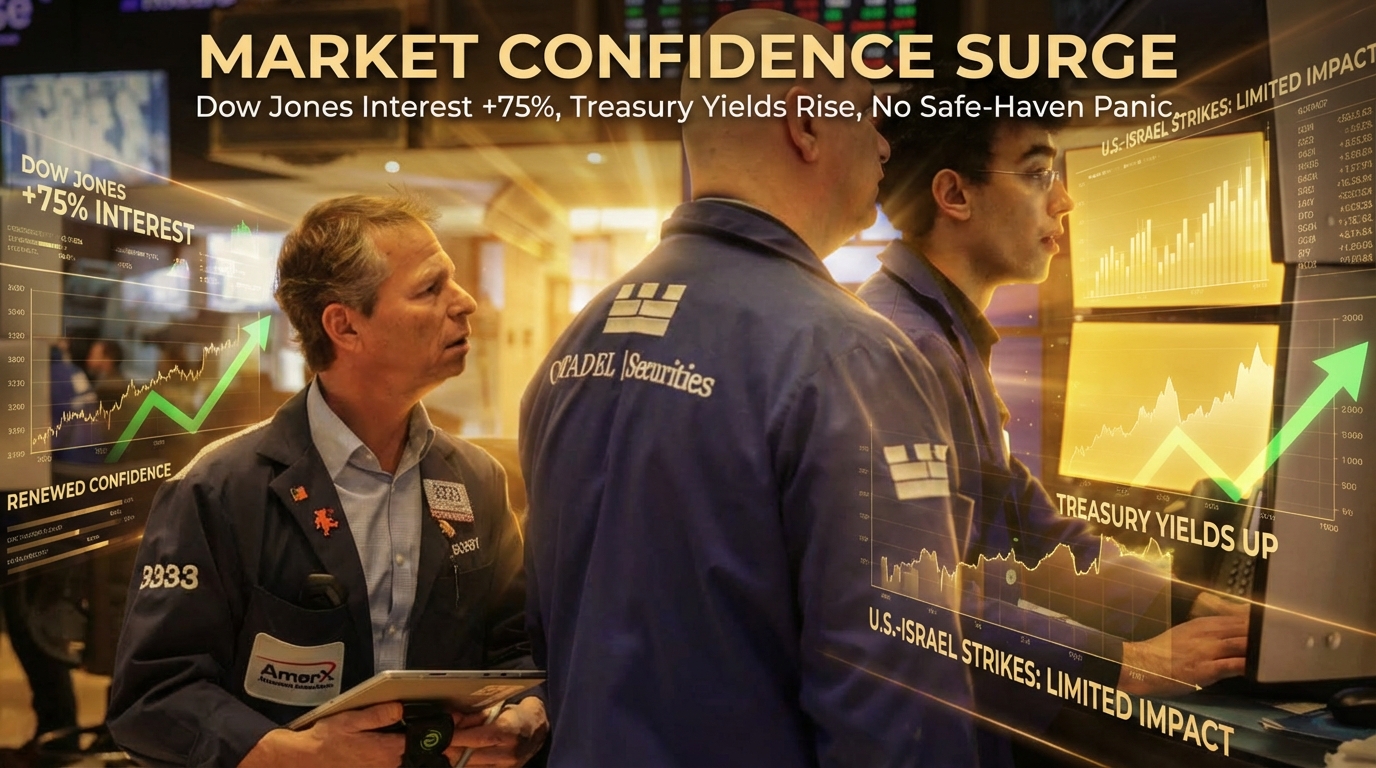
The Unsettling Signal: Yields Rise Amid Mideast Conflict
The financial world held its breath waiting for the traditional safe-haven trade to kick in as tensions flared in the Middle East following coordinated strikes by the U.S. and Israel against Iran. Historically, escalations in this volatile region send investors scrambling toward the perceived safety of U.S. government debt, pushing bond prices up and, crucially, driving Treasury yields down. However, the narrative shattered on Monday. Instead of falling, yields across the curve rose, signaling a profound shift in investor priority. The benchmark 10-year Treasury yield, the heartbeat of global borrowing costs, climbed over 6 basis points to settle at 4.025 percent. This movement is not just a modest blip; it’s a loud declaration that inflation fears and ongoing economic risk are now outweighing classic geopolitical hedging behavior. We are watching a market that is prioritizing its long-term fight against rising costs over immediate, if alarming, international instability.
This defiance was notable across the maturity spectrum. The longer end of the curve showed significant pressure, with the 30-year Treasury bond adding more than 4 basis points to sit near 4.681 percent. Even the shorter-term 2-year note, usually highly sensitive to Federal Reserve policy expectations, tacked on more than 7 basis points, reaching 3.451 percent. The aggregate movement suggests that while the loss of life, including three American service members following retaliatory Iranian strikes, is tragic and serious, the underlying economic calculus for investors remains firmly rooted in domestic monetary concerns. When the 10-year Treasury yield moves aggressively upward despite major headlines, it implies that the market believes the Federal Reserve will either keep rates higher for longer or that future inflation expectations are stubbornly elevated, regardless of temporary geopolitical shocks.
The Dow Jones surge of 75 percent in interest, as reported by some measures, perhaps reflects a broader, perhaps even irrational, exuberance or a reassessment of risk premiums across equities, fueled perhaps by the narrative coming out of Washington suggesting military operations were ahead of schedule. Yet, the divergence between equity performance and bond performance is the real story here. Equities might have rallied on the belief that the conflict, if contained, would not derail the economy, or that the swift initial military action might lead to a fast de-escalation. But bonds tell a different tale of enduring inflationary pressure. When the market ignores the traditional panic button, it means the underlying economic fever—inflation—is the greater long-term threat that demands pricing protection.
Historical Precedent Shattered: The Inflationary Override
To understand the gravity of yields moving higher during a crisis, one must look back. During the peak of the Gulf War in the early 1990s, or even during brief flare-ups between Israel and Lebanon, safe-haven flows into U.S. Treasuries were almost guaranteed. Investors panicked, sold risk assets like stocks, and piled into what was universally considered the world’s safest asset, driving the 10-year yield significantly lower as prices soared. This flight to quality was the bedrock of the duration trade for decades. It operated on the simple assumption that in times of war or uncertainty, capital seeks safety above all else, temporarily suspending normal economic considerations for preservation of principal.
Consider the events surrounding the initial shockwaves of the COVID-19 pandemic in March 2020\. While volatility was extreme, the initial reaction on March 2 and subsequently was a massive bid for liquidity, crushing yields as investors demanded cash equivalents. The current environment breaks this historical pattern dramatically. The fact that geopolitical conflict failed to spark this characteristic safe-haven buying suggests that the market is now conditioned by the post-pandemic inflationary surge. Inflation has become the primary anchor for pricing debt, overriding even immediate threats to global stability, as evidenced by the simultaneous rise in oil prices, which were up about 6 percent to over $71 a barrel for WTI crude.
This market behavior contrasts sharply with previous energy shocks. Typically, when crude oil spikes—as it did following the strikes—bond traders would see this as an immediate inflationary headwind guaranteed to pressure the Fed, yet they would still buy Treasuries as a hedge against immediate supply chain collapse or widespread systemic risk. The failure to do so indicates that the market has internalized the central bank’s rhetoric, perhaps believing that the current inflation rate, driven partly by energy costs, will persist regardless of minor external shocks, necessitating higher nominal returns on bonds to compensate investors.
The situation is reminiscent, though inverted, of moments when optimism overrides fear. For yields to rise during acute risk, the underlying perception must be that the U.S. economy, despite external shocks, can absorb the pressure, and that the cost of money will remain high to subdue domestic demand. This suggests a deep, ingrained skepticism about successful disinflation efforts, creating a permanent upward bias on rates that even mass casualty geopolitical events cannot easily suppress. The memory of high inflation in 2022 and 2023 is clearly influencing current pricing far more than the threat of a regional military confrontation.
The Inflationary Shadow: Why Oil Trumps Geopolitics
The primary mechanism driving yields higher in the face of Middle East conflict appears to be the immediate and tangible impact of energy prices on inflation expectations. Geopolitical tensions directly translated into a 6 percent surge in WTI crude oil prices. For the bond market where duration risk is king, higher oil prices instantly translate into higher forecasts for Consumer Price Index numbers months down the line. Investors selling bonds are essentially demanding a higher premium today—a higher yield—to hold debt whose real return will be eroded by rising energy costs fueling broader inflation.
Furthermore, the character of the conflict itself seems to be pricing in a manageable, albeit dangerous, scenario rather than an immediate, global supply shock. If the market had feared a total shutdown of the Strait of Hormuz or a wider regional war drawing in major powers, the flight to safety would have been overwhelming. Instead, the market perceived the initial military action and subsequent retaliation as being within established, albeit high-risk, parameters. President Trump’s comments noting military operations were ahead of schedule might have subtly reinforced the view that a rapid resolution, or at least a defined, contained conflict, was possible, thus dampening the demand for immediate safe-haven cash equivalents.
This pivot towards inflation focus is directly observable in the economic calendar ahead. Traders are already keenly focusing on forthcoming data points: \*\*March 2\*\* employment figures, retail sales, and the ISM manufacturing report. These data points, released later in the week, will provide the next hard evidence of whether the economy is cooling enough to satisfy the Federal Reserve’s inflation mandate. The bond market appears to be pre-pricing a hotter-than-expected report, particularly the jobs data, which would force the Fed’s hand regarding rate cuts, thereby keeping yields elevated now to compensate for the expected lack of immediate rate relief.
The rising yields are a silent stress test on corporate debt and refinancing. Higher yields on the 10-year Treasury benchmark directly translate into higher borrowing costs for mortgages, corporate bonds, and government debt servicing. This increases the risk of a slowdown in corporate investment and potentially strains highly leveraged companies whose debt is coming due. The market is effectively saying, “We can handle high borrowing costs associated with tighter monetary policy, but we cannot tolerate the erosion of principal value that inflation guarantees.” This is a mature—though hawkish—view of the current economic landscape, one that overrides the traditional fear response.
The Divergence: Equities and Gold Tell Half the Story
While Treasury yields were signaling inflation persistence, other safe havens presented a mixed picture. Gold, the ultimate non-yielding store of value, also moved higher, confirming that a portion of the market was indeed seeking shelter from instability. However, the simultaneous surge in the Dow Jones hinted that risk appetite remained robust, viewing the geopolitical event not as a systemic threat but as a temporary risk premium applied to a strong economy. This is the core tension: risk assets rallying while the safety asset’s key indicator—the 10-year yield—moves against tradition.
The relative strength of the stock market suggests institutional money managers are allocating dollars toward sectors they believe will benefit from sustained high energy costs or those insulated from geopolitical supply shocks. Energy companies, defense contractors, and perhaps even inflation-protected technology firms might be enjoying this inflow. This creates a bifurcated market where the perceived threat to the real economy from high rates is considered secondary to the opportunity presented by commodity price strength or perceived military superiority.
The failure of Treasury prices to rally also reflects dealer positioning and supply dynamics. Treasury yields only fall if demand outstrips planned supply. If major global central banks or sovereign wealth funds are maintaining steady purchase programs, or if domestic monetary policy uncertainty is keeping banks cautious about holding long-duration assets, the upward pressure on yields from selling—even if hesitant—will dominate the traditional safe-haven buying pressure. The market structure itself might be limiting the typical downward yield response.
Three Paths Forward: What Happens Next for Yields
The current environment leaves us with several critical pathways for the bond market, dependent almost entirely on upcoming economic data and geopolitical de-escalation. The first path is the Inflation Entrenchment Scenario. If the February jobs report, expected around \*\*March 2\*\*, comes in hotter than anticipated, reinforcing the notion that underlying economic activity remains too strong for the Fed to ease policy, yields could break significantly higher. The 10-year yield could convincingly re-test the 4.10 percent mark, signaling that the market fully believes the Fed pivot is delayed until late in the year, if at all. This would be bearish for long-duration assets across the board.
The second, less likely but possible, path is the Stabilizing De-escalation Scenario. If diplomatic efforts yield immediate, verifiable results over the next few days—perhaps a mutual agreement to stand down rhetoric or a rapid decline in oil prices below $68 a barrel—the temporary yield pressure might subside. In this case, the safe-haven bid, which was merely suppressed on Monday, could finally manifest. Yields would retreat modestly, perhaps settling back toward the 3.95 percent range as investors price in reduced headline risk and a faster path to rate stability, acknowledging that the geopolitical scare was a one-off event.
The third and most dangerous path is the Wider Conflict Spillover Scenario. Should the conflict metastasize—if a major oil producer outside the immediate zone is hit, or if the conflict extends significantly beyond the initially defined targets causing sustained upward pressure past $80 on oil—the market’s current calculus will break. The immediate economic shock of severe supply disruption would override inflation fears. Capital would flood into Treasuries irrespective of inflation concerns, leading to a sharp, violent drop in yields, potentially testing 3.75 percent or lower, because liquidity and survival become the foremost concerns for all portfolios. For now, the market is betting that this third scenario remains remote.
Investors must recognize that the signals are contradictory: equities are signaling resilience, while bond yields are confirming inflation’s stubbornness. The key takeaway from Monday’s trading session is that the war against inflation remains the dominant narrative shaping the cost of capital, and external geopolitical fireworks are currently serving only as minor distractions to that primary monetary battle. Navigating this requires a disciplined focus on upcoming inflation metrics, as they will ultimately determine whether the 4.025 percent level for the 10-year Treasury note solidifies as the new floor or merely a temporary plateau.
FAQ
Why did U.S. Treasury yields rise instead of fall during the recent Middle East geopolitical escalation?
Traditionally, geopolitical conflict drives investors toward safe-haven U.S. debt, pushing yields down. In this instance, yields rose because inflation fears and concerns over persistent high rates outweighed the immediate need for geopolitical hedging. This signals that inflation is the market’s primary concern.
What was the closing yield for the benchmark 10-year Treasury note reported in the article?
The benchmark 10-year Treasury yield climbed over 6 basis points to settle at 4.025 percent following the geopolitical tensions. This aggressive upward movement is significant because it defies the normal flight-to-quality response to regional instability. It suggests prolonged economic risk is being prioritized over immediate global uncertainty.
What does the rise in Treasury yields imply about the Federal Reserve’s monetary policy expectations?
The rising yields suggest the market strongly believes the Federal Reserve will maintain a ‘higher for longer’ interest rate stance. This indicates skepticism that inflation is sufficiently under control to allow for imminent rate cuts. Investors are pricing in the expectation of tight monetary conditions persisting.
How did the 30-year Treasury bond react to the Middle East tensions, in contrast to its historical safe-haven role?
The 30-year Treasury bond also saw pressure, adding more than 4 basis points to trade near 4.681 percent. This lack of a significant safe-haven bid indicates that long-term inflation expectations are dominating pricing models over short-term systemic risk concerns. The longer end of the curve is resisting the traditional rally.
What historical precedent did the market behavior shatter regarding geopolitical risks and Treasuries?
Historical precedent, seen during crises like the Gulf War, dictated an almost guaranteed surge in Treasury prices and corresponding yield drops during conflict. The current scenario breaks this pattern, showing that market behavior is now conditioned by persistent post-pandemic inflationary pressures. Inflation has overridden the traditional flight to safety.
What role did the immediate spike in WTI crude oil prices play in driving Treasury yields higher?
The 6 percent surge in WTI crude oil translated instantly into higher forecasts for future Consumer Price Index figures. Bond investors, concerned about real returns being eroded by energy-fueled inflation, demanded higher nominal yields to hold the debt. This direct link between oil and inflation expectations is a key driver.
What does the simultaneous rise in both the Dow Jones and Treasury yields signify?
The simultaneous rally in equities (Dow Jones surge) and rising yields presents a divergence, suggesting risk appetite remains robust while inflation fears persist. Equities may be pricing in minimal systemic risk from the conflict, whereas bonds are pricing in sustained cost pressures. This indicates a bifurcated market assessment.
What is the ‘Inflationary Override’ concept described in the article regarding bond pricing?
The Inflationary Override describes the mechanism where persistent inflation risk becomes the primary anchor for pricing debt, superseding immediate, even severe, geopolitical shock alerts. This forces investors to seek higher yields as compensation for anticipated erosion of principal value. This phenomenon governed the bond market’s reaction on Monday.
According to the article, what specific economic data points are traders keenly watching next, expected around March 2?
Traders are focusing intently on forthcoming data points, specifically the March employment figures, retail sales, and the ISM manufacturing report. These reports will offer hard evidence on whether domestic economic activity is cooling sufficiently to satisfy the Fed’s inflation mandate. The bond market is pre-pricing a potentially hotter-than-expected report.
How does the failure of traditional safe-haven buying affect corporate borrowing costs?
Since yields on the 10-year Treasury benchmark did not fall, they translate directly into higher borrowing costs across the financial system. This applies pressure to new corporate bond issuances, mortgages, and government debt servicing refinancing risks. This sustained high-rate environment increases the risk profile for highly leveraged entities.
What factor might have dampened the safe-haven bid, assuming the conflict remains contained?
The market perceived the initial military action and subsequent retaliation as operating within established, albeit heightened, conflict parameters rather than an immediate, uncontainable global supply shock. This perception of a manageable scenario reduces the urgent need for cash equivalents.
How does the behavior of gold compare to Treasury yields in this specific instance?
Gold, the ultimate non-yielding store of value, also moved higher, confirming that a segment of the market sought shelter from instability. However, gold’s directional move is less definitive than the sharp, anti-traditional move in yields, which specifically signaled inflation concern.
What market structure factors, besides investor sentiment, could limit the expected downward pressure on Treasury yields?
Dealer positioning and official supply dynamics can limit the yield drop; if major global central banks or sovereign wealth funds maintain steady purchase programs, this steady demand can offset hesitant safe-haven buying. Uncertainty sometimes causes domestic banks to be cautious about holding long-duration assets, adding structural selling pressure.
What is the ‘Inflation Entrenchment Scenario’ predicted for Treasury yields if upcoming data is hot?
The Inflation Entrenchment Scenario suggests that if the upcoming jobs report is stronger than expected, yields could break significantly higher, pushing the 10-year rate to convincingly re-test 4.10 percent. This outcome would cement the belief that the Fed pivot is considerably delayed, proving bearish for risk assets sensitive to long durations.
Under the ‘Stabilizing De-escalation Scenario,’ where might the 10-year Treasury yield retreat to?
If immediate diplomatic success leads to a verifiable stand-down and oil prices drop significantly (e.g., below $68/bbl), the suppressed safe-haven bid could activate. In this case, yields would likely retreat modestly toward the 3.95 percent range as headline risk subsides swiftly.
What conditions would trigger the ‘Wider Conflict Spillover Scenario’ and what would be the yield reaction?
This dangerous path requires the conflict to metastasize, such as a major, sustained hit to a key oil producer outside the immediate zone. This severe supply disruption would override all inflation concerns, causing a sharp, violent flight toward liquidity, driving yields down, potentially testing 3.75 percent or lower.
Why is the current market prioritizing high nominal returns on bonds over inflation?
Investors are prioritizing protection against the erosion of principal value guaranteed by inflation over short-term safety from geopolitical events. This suggests a deep-seated belief that the fight against inflation requires adherence to tighter monetary policy, regardless of external shocks.
What specific segment of investors might be benefiting from the current environment where high energy costs persist alongside stable rates?
Institutional money is likely flowing into sectors insulated from supply shocks or those that directly benefit from sustained high energy costs. This would include energy companies and defense contractors, positioning capital for inflation resilience rather than expecting immediate rate relief.
How much did the 2-year Treasury note yield increase, and what does its reaction signify?
The 2-year note tacked on more than 7 basis points, showing a sharp increase usually tied to expectations of near-term Federal Reserve policy. Its rise confirms the market’s belief that policy tightening expectations are intensifying, even in the short term.
What risk does the market appear to have disregarded by allowing yields to rise during a military escalation?
The market is implicitly disregarding the immediate risk of a widespread systemic shock that would necessitate emergency liquidity injections and asset preservation above all else. They are betting that the central bank’s focus on domestic inflation remains the overriding factor.
What is the main takeaway for investors navigating these contradictory market signals?
The main takeaway is that the war against inflation remains the dominant narrative dictating the cost of capital, overshadowing external geopolitical noise unless the conflict significantly broadens. Investors must maintain a disciplined focus on forthcoming inflation metrics to gauge the sustainability of the current yield level.
